组成图示
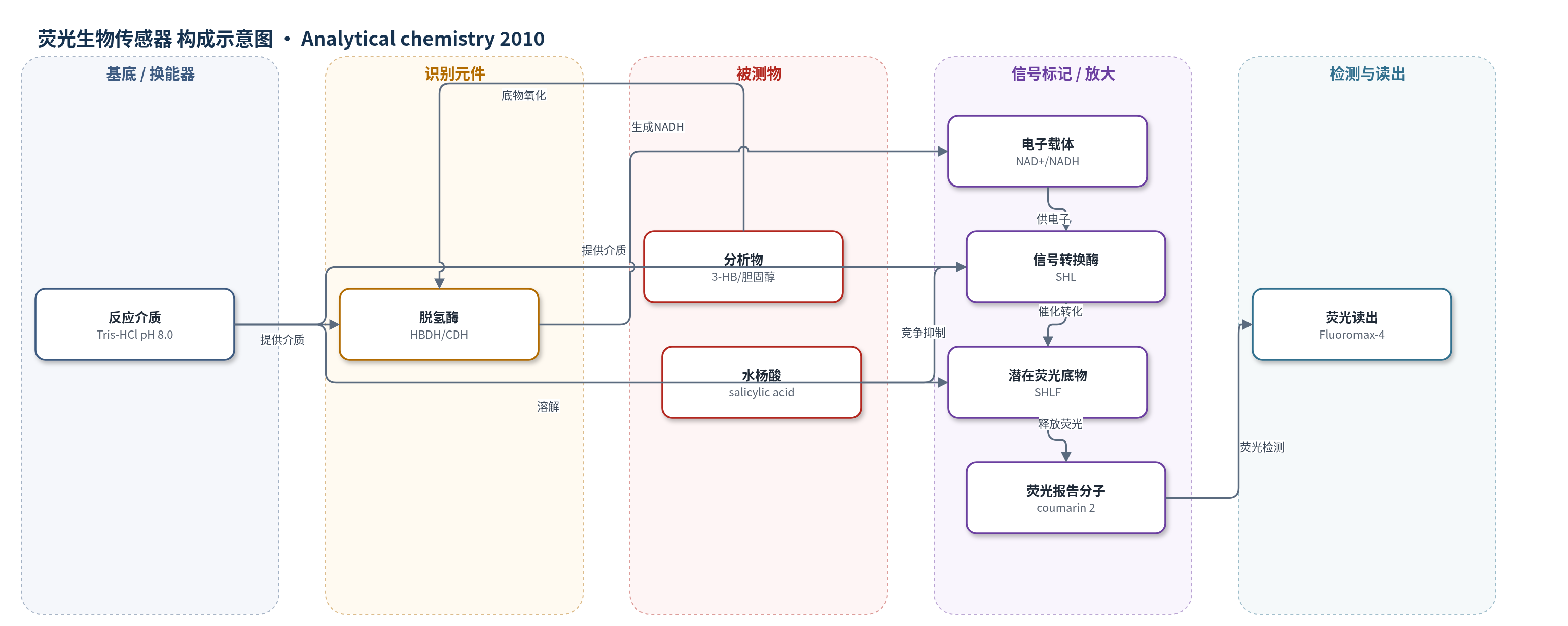
点击图片查看大图 · 依据论文自动绘制
传感器类型
荧光生物传感器
检测对象
3-羟基丁酸(3-hydroxybutyrate)、胆固醇(cholesterol)、水杨酸(salicylic acid/salicylate);样品基质:Tris-HCl 缓冲液(pH 8.0),文中另以 5% 牛血清评估干扰
检测原理
该体系为酶偶联荧光检测:HBDH 或 CDH 特异性氧化 3-羟基丁酸或胆固醇,同时以 NAD+ 为电子受体生成 NADH。生成的 NADH 作为电子供体进入 SHL 反应,SHL 在 O2 存在下催化 SHLF 的水杨酸部分发生脱羧羟基化,形成儿茶酚型中间体;随后发生醌甲烷型重排,自发且不可逆地释放长波长荧光香豆素 2。香豆素 2 在 595 nm 处发射近红荧光,其强度随 NADH 生成量增加而升高,从而与分析物浓度呈正相关。水杨酸可与 SHLF 竞争 SHL 活性位点,使荧光降低。整个信号通过荧光光谱仪在 500 nm 激发、595 nm 发射处读出。
检测灵敏度
线性范围: 3-羟基丁酸 50–280 nM;胆固醇 100–800 nM;水杨酸 200–700 µM
效应效果
SHLF 在仅含 SHL 或 NADH 时荧光保持基线,储存数月仍稳定;对多种生物还原剂和活性氧(ROS)无明显响应,5% 牛血清亦无明显干扰,仅 Fe(ClO4)2 对已释放香豆素 2 产生轻微荧光猝灭。动力学参数为 Km = 4.2 ± 0.4 µM,Vmax = 13 ± 1.2 nM s−1 mg protein−1,kcat = 0.045 min−1,kcat/Km = 0.0087 µM−1 min−1。与 SHL-脱氢酶安培传感器相比,本方法将 3-羟基丁酸检测降至纳摩尔范围,优于微摩尔级安培法;胆固醇检测亦达纳摩尔范围,优于毫摩尔级比色法,作者认为可用于临床诊断光纤荧光生物传感器。
传感器的构成
- 基底/换能器:未报道实体电极或基底;采用溶液相反应体系,以荧光光谱作为换能读出
- 反应介质:50 mM Tris-HCl 缓冲液(pH 8.0),维持酶活与反应条件
- 识别酶层:3-羟基丁酸脱氢酶(HBDH)或胆固醇脱氢酶(CDH),特异性氧化分析物并生成 NADH
- 电子载体层:NAD+ 作为电子载体,被脱氢酶反应还原为 NADH,驱动 SHL 反应
- 信号转换酶层:水杨酸羟化酶(SHL),催化 SHLF 脱羧羟基化并触发荧光释放
- 潜在荧光底物:SHLF(3),作为 SHL 底物,反应后释放长波长荧光香豆素 2
- 信号标记物:荧光香豆素 2(coumarin 2),发射峰 595 nm,作为荧光报告分子
- 读出装置:Horiba Jobin Yvon Fluoromax-4 荧光光谱仪,λex 500 nm/λem 595 nm 检测
中文摘要
水杨酸羟化酶(SHL)在 NADH 和 O2 存在下催化水杨酸生成儿茶酚、CO2 和 H2O。将 SHL 与 NAD(P)+ 依赖性脱氢酶共固定于 Clark 型氧电极前,已被用于开发可检测多种生物分析物的脱氢酶型生物传感器,但目前尚无适用于该体系的荧光探针。本文合成了首个用于 SHL 的长波长潜在荧光底物 SHLF(3)。在 NADH 存在及有氧条件下,SHL 催化 SHLF 发生脱羧羟基化,随后经醌甲烷型重排自发且不可逆地释放荧光香豆素 2,发射峰位于近红区 595 nm。该荧光信号具有特异性,并可被水杨酸抑制;对多种生物活性氧和还原剂不敏感。SHLF 可作为 SHL 偶联脱氢酶检测中的荧光指示剂,在该体系中 NAD+ 被转化为 NADH。该荧光法可在纳摩尔范围检测 3-羟基丁酸和胆固醇,灵敏度高于现有 SHL-脱氢酶安培传感器,可用于构建临床诊断用光纤荧光生物传感器。
英文摘要
Salicylate hydroxylase (SHL) catalyzes the production of catechol (plus CO(2) and H(2)O) from salicylate, NADH, and O(2). Coimmobilization of SHL with a NAD(P)(+)-dependent dehydrogenase in front of a Clark-type oxygen electrode has been investigated in the development of a general type of dehydrogenase-based biosensors that can detect various biological analytes; however, currently, no fluorophores are available for these applications. We synthesized the first new long-wavelength latent fluorogenic substrate SHLF (3) for SHL. In the presence of NADH and under aerobic conditions, SHL catalyzes the decarboxylative hydroxylation of SHLF followed by a quinone-methide-type rearrangement reaction concomitant with the ejection of a fluorescence coumarin 2, which is spontaneous and irreversible at physiological temperatures in aqueous media. The fluorescence signal generated by this process is specific and, in the near red spectral region with an emission maximum at 595 nm, is suppressed by salicylic acid. The fluorescence response of SHLF is insensitive to various biological reactive oxygen species (ROS) and reductants. Furthermore, SHLF is a sensitive fluorimetric indicator for analyte determination in the SHL-coupled dehydrogenase assay in which NAD(+) is converted to NADH. This novel fluorescence assay detected 3-hydroxybutyrate and cholesterol in the nanomolar range and is more sensitive than the current SHL-dehydrogenase amperometric sensors, making it applicable to the construction of a fiber-optic fluorescence biosensor for clinical diagnostic uses.