组成图示
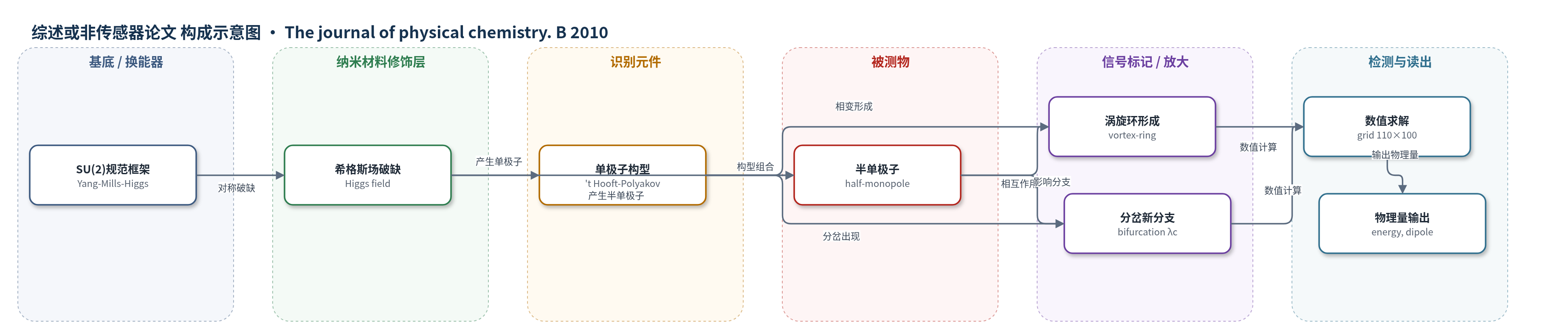
点击图片查看大图 · 依据论文自动绘制
传感器类型
综述或非传感器论文
检测对象
不适用:理论物理研究对象为磁单极子(magnetic monopole)与半单极子(half-monopole),非生物样品基质。
检测原理
本文并非传感检测,而是研究 SU(2) 杨-米尔斯-希格斯理论中“一个单极子加一个半单极子”的拓扑孤子解。希格斯场自发破缺 SU(2) 非阿贝尔对称性后,规范场与希格斯场形成有限能量、无奇点的 't Hooft-Polyakov 单极子;半单极子作为拓扑缺陷引入。数值求解能量泛函或场方程,在给定 φ 绕数 n 和希格斯耦合常数 λ 下获得场构型。随 λ 增大,系统能量、磁偶极矩、极间距等物理量连续变化;在临界值 λt 处发生相变,叠加 n 单极子之间形成涡旋环,而 n 半单极子保持原点不变;在 λc 处出现分岔,产生更高能量新分支。可观测量为数值场量、能量密度与磁荷密度,其变化反映组分间相互作用。
检测灵敏度
未报道
效应效果
论文未涉及选择性、抗干扰、稳定性、重现性或实际样品回收率等传感器指标。其结果体现为数值解规律:n=2 时解在 λ=8.00 后发散;n≥3 时单极子不与半单极子合并成涡旋环,而是在 λt 处由叠加 n 单极子形成涡旋环,n 半单极子保持原点不变。n≥3 出现分岔,在 λc 处产生更高能量新分支,n=4 出现全新分支;n≥2 存在临界下界 λb,λ<λb 无解。作者认为异常与新分支源于半单极子,并推测其主要影响偶数 φ 绕数解,且半单极子较休眠,物理量变化主要由单极子贡献。
传感器的构成
- 基底/换能器:未报道(理论物理论文,无实体传感器)
- 纳米材料修饰层:未报道
- 识别元件:未报道(研究对象为 magnetic monopole / half-monopole)
- 信号标记物:未报道
- 封闭剂/电子供体:未报道
中文摘要
磁单极子与多磁单极子是 SU(2) 非阿贝尔对称性被希格斯场自发破缺后产生的三维拓扑孤子解,对应 SU(2) 杨-米尔斯-希格斯(Georgi-Glashow)模型。近期半单极子解被提出,并报道了半单极子与普通 't Hooft-Polyakov 单极子构成的构型,但二者相互作用研究较少。本文研究“一个单极子加一个半单极子”解,考察 φ 绕数 n=2–4 及希格斯耦合常数 λ=0–40,数值网格为 110×100。结果表明:n≥2 时单极子与半单极子分别变为同位置叠加的 n 单极子和 n 半单极子;n=2 时解在 λ=8.00 后发散;n≥3 时单极子不与半单极子合并成涡旋环,而是在临界相变值 λt 处由叠加 n 单极子形成涡旋环,n 半单极子保持原点不变。n≥3 还出现分岔,在 λc 处产生更高能量新分支,n=4 出现全新分支;n≥2 存在临界下界 λb,λ<λb 无解。作者认为异常与新分支源于半单极子,并推测其主要影响偶数 n 解,且半单极子较休眠,物理量变化主要由单极子贡献。
英文摘要
Chemical control of surface functionality and topography is an essential requirement for many technological purposes. In particular, the covalent attachment of monomeric proteins to surfaces has been the object of intense studies in recent years, for applications as varied as electrochemistry, immuno-sensing, and the production of biocompatible coatings. Little is known, however, about the characteristics and requirements underlying surface attachment of supramolecular protein nanostructures. Amyloid fibrils formed by the self-assembly of peptide and protein molecules represent one important class of such structures. These highly organized beta-sheet-rich assemblies are a hallmark of a range of neurodegenerative disorders, including Alzheimer's disease and type II diabetes, but recent findings suggest that they have much broader significance, potentially representing the global free energy minima of the energy landscapes of proteins and having potential applications in material science. In this paper, we describe strategies for attaching amyloid fibrils formed from different proteins to gold surfaces under different solution conditions. Our methods involve the reaction of sulfur containing small molecules (cystamine and 2-iminothiolane) with the amyloid fibrils, enabling their covalent linkage to gold surfaces. We demonstrate that irreversible attachment using these approaches makes possible quantitative analysis of experiments using biosensor techniques, such as quartz crystal microbalance (QCM) assays that are revolutionizing our understanding of the mechanisms of amyloid growth and the factors that determine its kinetic behavior. Moreover, our results shed light on the nature and relative importance of covalent versus noncovalent forces acting on protein superstructures at metal surfaces.