组成图示
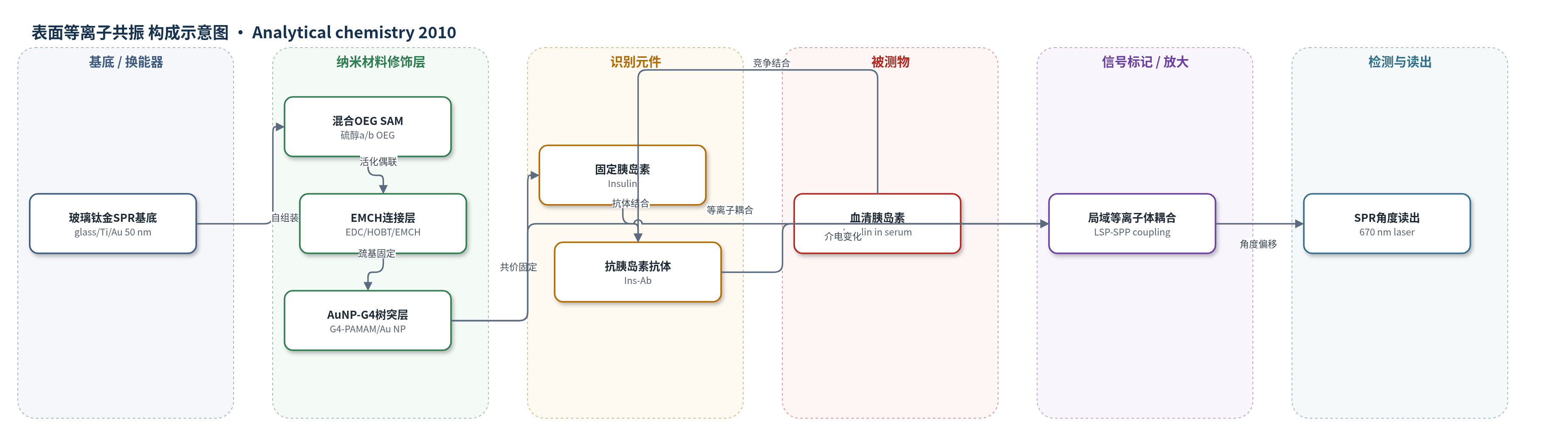
点击图片查看大图 · 依据论文自动绘制
传感器类型
表面等离子共振(SPR)生物传感器
检测对象
胰岛素(Insulin),样品基质:人血清(10倍稀释)、PBS 缓冲液
检测原理
该传感器采用间接竞争免疫分析。人胰岛素经 EDC/NHS 共价固定于 AuNP-G4-OH 树突状聚合物修饰金表面,作为固定抗原。样品中的胰岛素与固定浓度抗胰岛素抗体(Ins-Ab)竞争结合:当样品胰岛素浓度升高时,更多 Ins-Ab 被样品胰岛素占据,结合到固定胰岛素上的抗体减少,传感表面附近介电性质变化减小,SPR 反射角偏移随之降低。Au NP 的局域表面等离子体与金膜表面等离子体波耦合,放大生物识别引起的折射率/介电变化,实现无标记高灵敏检测。
检测灵敏度
胰岛素: LOD: 0.5 pM;线性范围: 2-43 pM;血清中可检测: 0.8 pM。Ins-Ab: LOD: 16 × 10^-3 nM;线性范围: (0.042 ÷ 8.00) × 10^-3 µM;斜率: 115 ± 5 degrees µM^-1;R^2: 0.9906
效应效果
该表面抗非特异吸附能力强,8 种蛋白混合液测试中净 SPR 角移约 0.007°,比氨基树突表面低至少 30 倍。传感芯片可用 10 mM 甘氨酸-HCl(pH 3.0)再生,重复使用 40 次以上且性能损失小于 5%。胰岛素检测 RSD 为 5.6%,批内 CV 2.6–6.1%,批间 CV 3.5–4.9%。9 例健康与糖尿病人血清结果与放射免疫分析(RIA)相关系数 r=0.995。TSH、FSH、LH(各 85 pM)无显著干扰。相比直接免疫法(LOD 8.5 nM)和 G4-OH 表面(0.85 µM),Au NP 树突表面灵敏度显著提高,适用于临床血清和复杂生物基质中胰岛素等生物标志物检测。
传感器的构成
- 基底/换能器:玻璃载片-钛粘附层(1.5 nm)-金膜(50 nm),SPR 换能基底
- 抗非特异 SAM:三乙二醇硫醇 a 与六乙二醇羧酸硫醇 b 混合自组装单分子层,降低蛋白非特异吸附并提供羧基
- 连接活化层:EDC/HOBT 活化羧基后偶联 EMCH,形成马来酰亚胺位点固定树突状聚合物
- 纳米材料修饰层:羟基/巯基 G4-PAMAM 包埋 Au NP(AuNP-G4-OH/SH),提供三维固定位点与局域等离子体放大
- 识别元件:人胰岛素(Insulin)经 EDC/NHS 共价固定于树突状聚合物表面,作为竞争免疫固定抗原
- 竞争识别元件:抗胰岛素单克隆抗体(Ins-Ab,mouse IgG1),与固定胰岛素结合产生 SPR 响应
- 信号放大元件:Au NP 局域表面等离子体(LSP)与金膜表面等离子体波(SPP)耦合,放大介电变化
中文摘要
合成并固定了双功能羟基/巯基官能化第四代聚酰胺胺树突状聚合物(G4-PAMAM)包埋金纳米粒子(Au NP)于混合自组装单分子层(SAM)修饰金表面。该修饰表面对宽分子量与等电点蛋白的非特异性吸附具有抗性。部分树突状聚合物巯基转化为酰肼基团,提供活化表面以进一步固定受体,构建免疫亲和反应传感表面。本文基于竞争免疫分析原理实现胰岛素表面等离子共振(SPR)检测。所得 Au NP 树突状聚合物修饰表面具有较高稳定性、显著增强灵敏度,胰岛素检测限为 0.5 pM。由于生物识别过程引起传感表面附近介质介电性质变化,并通过纳米粒子局域等离子体与表面等离子体波耦合,SPR 信号被放大。所制备传感芯片用于分析健康人和糖尿病患者血清中的胰岛素,结果与参考方法良好相关。该生物传感平台的选择性和提高的灵敏度对复杂生物基质中多种分子和生物标志物检测具有重要意义。
英文摘要
Bifunctional hydroxyl/thiol-functionalized fourth-generation polyamidoamine dendrimer (G4-PAMAM)-encapsulated Au nanoparticle (NP) was synthesized and immobilized on a mixed self-assembled monolayer (SAM)-modified gold surface. This modified surface was resistant to nonspecific adsorption of proteins having a wide range of molecular weight and isoelectric points. Part of the dendrimer thiol groups were converted to hydrazide functionalities providing an activated surface available to subsequently immobilize the receptor for developing a sensor surface to immunoaffinity reaction. Herein, the surface plasmon resonance (SPR) detection of insulin was obtained by means of a competitive immunoassay principle. The resulting Au NP dendrimer-modified surface provided an assay with high stability, significantly enhanced sensitivity, and a detection limit for analyzing insulin of 0.5 pM. The SPR detection of insulin was amplified due to the changes in the dielectric properties of the matrixes, occurring upon the biorecognition processes on the sensor surface, through the coupling of the localized plasmon of the NPs with the surface plasmon wave. The developed sensor chip was used to analyze insulin in human serum samples from healthy and diabetic patients. The results showed good correlation to the reference method. The specificity and the improved sensitivity of this biosensing platform could have significant implications for the detection of a wide range of molecules and biomarkers in complex biological media.