组成图示
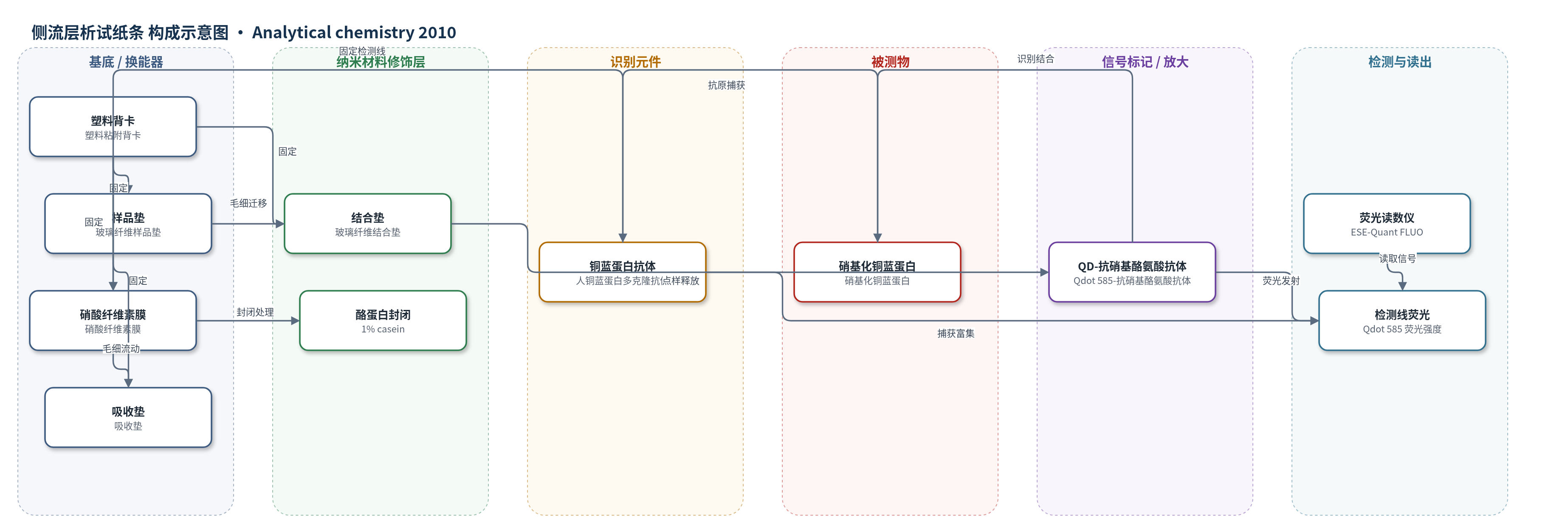
点击图片查看大图 · 依据论文自动绘制
传感器类型
侧流层析试纸条
检测对象
硝基化铜蓝蛋白(nitrated ceruloplasmin);样品基质:PBS/BSA 缓冲液、加标人血浆(20倍稀释)
检测原理
该传感器采用免疫层析与荧光标记相结合的原理。样品加入样品垫后,在毛细作用下经结合垫、硝酸纤维素膜向吸收垫迁移。结合垫上预点样的 Qdot 585-抗硝基酪氨酸抗体偶联物与样品中硝基化铜蓝蛋白上的硝基酪氨酸位点特异性结合,形成荧光标记复合物;复合物继续迁移至检测线,被固定于硝酸纤维素膜上的多克隆人铜蓝蛋白抗体捕获,使 Qdot 585 在检测线富集。未结合的 Qdot 偶联物进入吸收垫。检测线处 Qdot 585 的荧光强度或峰面积随硝基化铜蓝蛋白浓度升高而增大,便携式荧光读数仪据此实现定量。非硝基化铜蓝蛋白不能被抗硝基酪氨酸抗体识别,因此背景低;1% 酪蛋白封闭可进一步降低非特异吸附。该方法无酶促放大,主要依赖量子点高亮度和光稳定性实现灵敏检测。
检测灵敏度
LOD: 0.4 ng/mL (S/N = 3);未稀释血浆等效 LOD: 8 ng/mL (S/N > 3);线性范围: 1 ng/mL–10 µg/mL(峰面积与目标浓度对数线性);最低响应: 1 ng/mL
效应效果
该传感器10 min内完成检测,对非硝基化铜蓝蛋白无明显响应,选择性良好;1%酪蛋白封闭可显著降低非特异结合。试纸条密封4 °C保存至少3个月后仍保持良好性能。不同浓度样品及空白均进行6次重复测量并给出误差棒,原文未报告RSD。加标人血浆(20倍稀释)在1 ng/mL–10 µg/mL范围内获得良好校准曲线,稀释样LOD为0.4 ng/mL,未稀释血浆等效8 ng/mL,与硝基化纤维蛋白原和BSA等检测技术相当。考虑到人血浆铜蓝蛋白约0.5%(2.27 µM),该灵敏度可检测低至0.03%的硝基化水平;血浆中10 ng/mL硝基化铜蓝蛋白荧光带可肉眼观察,相当于未稀释血浆200 ng/mL。作者认为其适用于临床即时检测和现场蛋白标志物分析。
传感器的构成
- 基底/背卡:塑料粘附背卡(plastic adhesive backing card),承载并固定样品垫、结合垫、硝酸纤维素膜和吸收垫。
- 样品垫:玻璃纤维样品垫(glass fiber sample pad),用于加样并引导样品毛细迁移。
- 结合垫:玻璃纤维结合垫(glass fiber conjugation pad),点样并干燥量子点-抗硝基酪氨酸抗体偶联物(Qdot-antinitrotyrosine conjugate)。
- 信号标记/识别元件:Qdot 585 纳米晶偶联山羊抗硝基酪氨酸抗体(Qdot 585-goat anti-nitrotyrosine antibody),识别硝基化酪氨酸并产生荧光。
- 检测膜:硝酸纤维素膜(nitrocellulose membrane),检测线点样多克隆人铜蓝蛋白抗体(polyclonal human ceruloplasmin antibody)以捕获目标蛋白。
- 封闭剂:1% 酪蛋白(1% casein),封闭硝酸纤维素膜以减少非特异结合。
- 吸收垫:吸收垫(absorbent pad),吸收过量样品并维持毛细流动。
- 读出装置:便携式荧光试纸条读数仪(ESE-Quant FLUO strip reader),记录检测线 Qdot 585 荧光强度。
中文摘要
本文报道了一种基于量子点(QD)和侧流层析试纸条(LFTS)的便携式荧光生物传感器,用于蛋白质生物标志物的快速、超灵敏检测。量子点具有信号亮度高、光稳定性好等优点,与侧流层析试纸条一步法、快速、低成本、操作简便等优势相结合,使该传感器在蛋白质检测中兼具高灵敏度、高选择性和快速响应。研究以硝基化铜蓝蛋白(nitrated ceruloplasmin)作为模型蛋白生物标志物,该标志物与心血管疾病、肺癌及吸烟应激反应密切相关。通过记录检测线上捕获的量子点荧光强度,实现对硝基化铜蓝蛋白的定量检测。在优化条件下,该便携式荧光生物传感器可在10 min内对低至1 ng/mL的硝基化铜蓝蛋白产生快速响应。此外,该传感器成功用于加标人血浆样品检测,在较宽动态范围内实现检测,未稀释血浆等效检出限为8 ng/mL(S/N>3)。结果表明,量子点侧流层析试纸条能够实现对硝基化铜蓝蛋白的快速、灵敏、定量检测,并有望用于其他蛋白生物标志物的即时检测与现场分析。
英文摘要
A portable fluorescence biosensor with rapid and ultrasensitive response for protein biomarker has been built up with quantum dots and a lateral flow test strip. The superior signal brightness and high photostability of quantum dots are combined with the promising advantages of a lateral flow test strip and result in high sensitivity and selectivity and speed for protein detection. Nitrated ceruloplasmin, a significant biomarker for cardiovascular disease, lung cancer, and stress response to smoking, was used as model protein biomarker to demonstrate the good performances of this proposed quantum dot-based lateral flow test strip. Quantitative detection of nitrated ceruloplasmin was realized by recording the fluorescence intensity of quantum dots captured on the test line. Under optimal conditions, this portable fluorescence biosensor displays rapid responses for nitrated ceruloplasmin with the concentration as low as 1 ng/mL. Furthermore, the biosensor was successfully utilized for spiked human plasma sample detection in a wide dynamic range with a detection limit of 8 ng/mL (S/N = 3). The results demonstrate that the quantum dot-based lateral flow test strip is capable of rapid, sensitive, and quantitative detection of nitrated ceruloplasmin and hold a great promise for point-of-care and in field analysis of other protein biomarkers.