组成图示
点击图片查看大图 · 依据论文自动绘制
传感器类型
电化学生物传感器
检测对象
O-苯二胺(O-phenylenediamine, OPD);样品基质为磷酸-柠檬酸缓冲液(pH 5.8,含2.0 mM H2O2)
检测原理
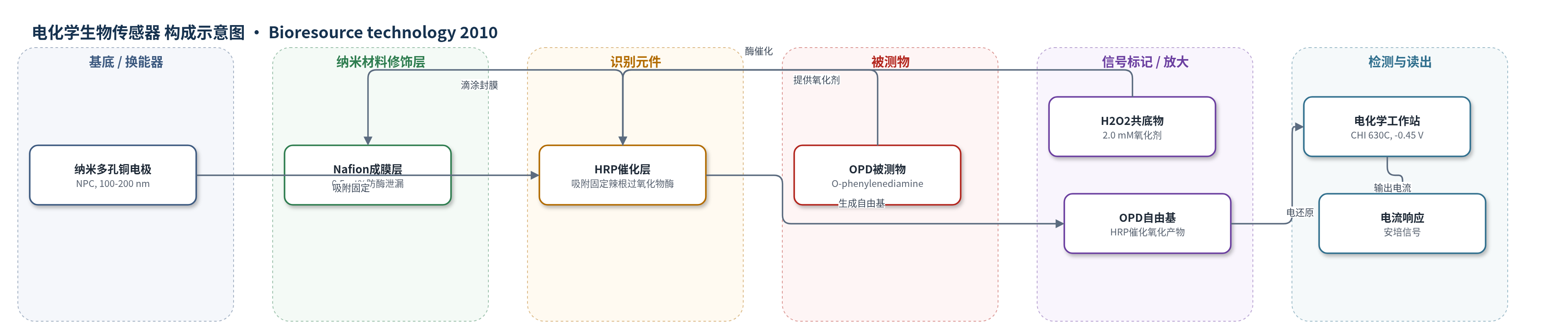
该传感器以纳米多孔铜(NPC)为工作电极,辣根过氧化物酶(HRP)吸附固定于NPC表面。在过量H2O2存在下,被测物O-苯二胺(OPD)被HRP催化氧化为OPD自由基。NPC具有较大比表面积和脱合金形成的缺陷位点,对OPD自由基具有较强电催化还原能力,使还原峰电位较普通铜盘电极正移。在-0.45 V恒电位安培检测时,OPD自由基在电极表面被还原,产生与OPD浓度成正比的电流响应。因此,随着OPD浓度增加,HRP催化生成的自由基增多,电极电流线性增大。
检测灵敏度
LOD: 0.04 μM (S/N = 3);线性范围: 0.5 μM-14.5 μM;灵敏度: 0.37 μA μM^-1;R = 0.997
效应效果
传感器响应较快,加入OPD后约10 s达到稳态电流的95%。在-0.45 V下连续工作200 s,对10 μM OPD的电流响应保持约80%;经循环伏安活化后,连续10 d存储使用仍保留约92%响应。同一电极连续检测10 μM OPD的RSD为3.7%,五个独立电极RSD为4.5%。与HRP修饰铜盘电极相比,NPC电极因更大有效面积和更强电催化活性而响应显著增强。固定化HRP在50 ℃孵育2 h后保留约90%活性,重复使用5次后保留约65%,4 ℃存储1个月保留约90%。文中未报告选择性、抗干扰及实际样品回收率,作者认为NPC低成本、易制备,适合规模化传感应用。
传感器的构成
- 基底/换能器电极:纳米多孔铜(NPC)电极,由Al60Cu40合金在5 wt% HCl中脱合金制备,孔径100-200 nm,提供导电性与电催化活性
- 识别/催化元件:辣根过氧化物酶(HRP),吸附固定于NPC表面,催化OPD在H2O2存在下氧化
- 防泄漏成膜层:Nafion(0.5 wt%)滴涂于HRP-NPC表面,干燥成膜,防止酶泄漏
- 反应介质:磷酸-柠檬酸缓冲液(pH 5.8),维持酶活性与电化学测量环境
- 共底物:H2O2(2.0 mM),作为HRP催化氧化OPD的氧化剂
- 信号产物:OPD自由基,由HRP催化生成并在NPC电极上被电化学还原
中文摘要
通过5 wt% HCl溶液对Al60Cu40合金进行脱合金,制备了孔径100-200 nm的纳米多孔铜(NPC),并用扫描电镜和氮气吸附法表征。辣根过氧化物酶(HRP)通过吸附法固定在NPC上。由于酶分子与NPC表面存在多点结合,固定化酶的热稳定性显著提高:50 ℃孵育2 h后,固定化HRP保留约90%初始活性,而游离酶仅保留约10%。固定化使HRP的Km由0.43 mM增至0.80 mM,Kcat由8.1×10^3 min^-1降至2.2×10^3 min^-1。基于NPC电极良好的导电性和电催化活性,构建了检测O-苯二胺(OPD)的电化学生物传感器。传感器对OPD在0.5-14.5 μM范围内线性响应,灵敏度为0.37 μA μM^-1;在-0.45 V下连续工作200 s,对10 μM OPD的电流响应保持约80%;五个电极的RSD约4.5%。结果表明NPC是HRP固定化的优良载体,其低成本有利于规模化应用。
英文摘要
Nanoporous copper (NPC) with a pore size of 100-200 nm was prepared by simply dealloying Al(60)Cu(40) alloy in a 5 wt.% HCl solution. The NPC was characterized by scanning electron microscopy and nitrogen adsorption techniques. Horseradish peroxidase (HRP) was immobilized on NPC by adsorption. Compared with free enzyme, the thermal stability of the immobilized enzyme was greatly improved due to the multiple attachments between the enzyme molecule and the NPC surface. After 2h incubation at 50 degrees C, the immobilized HRP retained ca. 90% of the initial activity while only ca. 10% initial activity remained for the free enzyme. The interaction between HRP and the porous surface also made the K(m) and K(cat) values of the immobilized enzyme increase (from 0.43 to 0.80 mM) and decrease (from 8.1 x 10(3) to 2.2 x 10(3)min(-1)), respectively. Based on the good electric conductivity and electrocatalytic activity of the NPC electrode, an electrochemical biosensor for O-phenylenediamine (OPD) was made. The calibration curve of the biosensor was linear from 0.5 microM to 14.5 microM OPD with a sensitivity of 0.37 microA microM(-1). The stability and reproducibility of the biosensor were also demonstrated to be good. When positioned at -0.45 V for 200 s, its current response toward 10 microM OPD remained ca. 80% of its initial value. For five HRP-loaded NPC electrodes, the relative standard deviation (RSD) of the current response toward 10 microM OPD was ca. 4.5%. All these results indicated that NPC was a good support for the HRP immobilization and its low price would facilitate its large-scale application.