组成图示
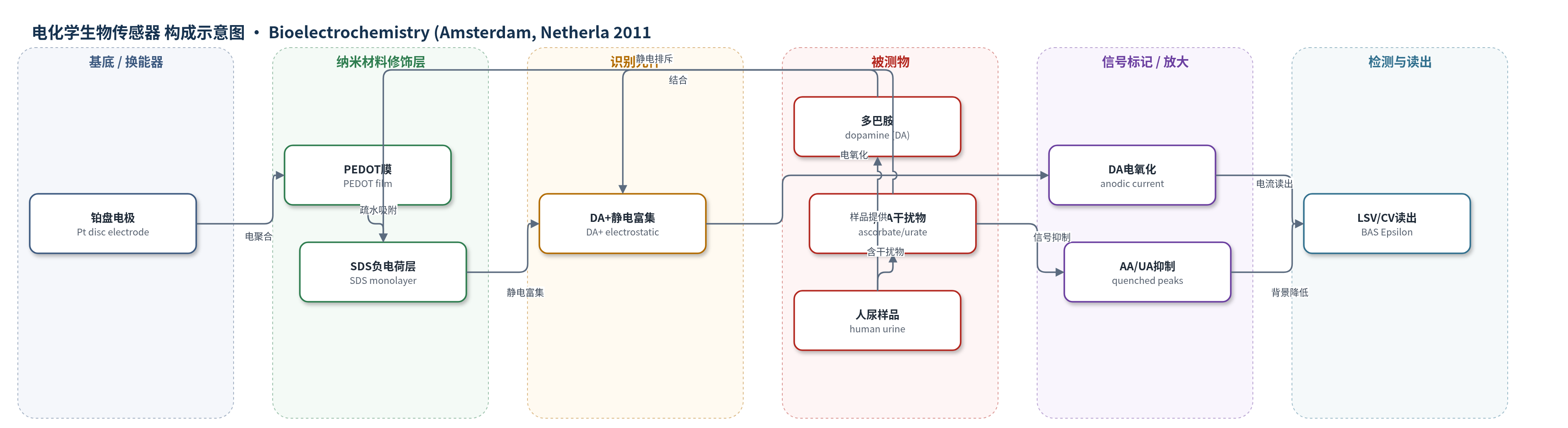
点击图片查看大图 · 依据论文自动绘制
传感器类型
电化学生物传感器
检测对象
多巴胺(dopamine, DA);样品基质:人尿(human urine)、B-R 缓冲液模拟样品
检测原理
该传感器以 PEDOT/Pt 为导电基底,SDS 通过疏水作用吸附在 PEDOT 表面,形成负电荷端朝外的界面层。在 pH 7.4 的 B-R 缓冲液中,DA 的 pKa 约为 8.87,主要以质子化阳离子 DA+ 形式存在;AA 和 UA 的 pKa 分别约为 4.10 和 5.4,主要以阴离子形式存在。因此,DA+ 与 SDS 负电荷界面发生静电吸引并被预富集,而 AA 和 UA 受到静电排斥,难以接近电极表面。LSV 扫描时,富集在界面的 DA 发生直接电氧化,阳极峰电流随 DA 浓度升高而增大;同时 AA/UA 的氧化峰被抑制,实现选择性检测。EIS 显示 SDS 使电荷转移电阻降低,说明界面电子转移加快。该过程无需酶或外源标记物,主要依靠静电预富集和界面电荷选择性放大 DA 信号。
检测灵敏度
缓冲液(摘要)LOD: 61 nmol L−1 和 86 nmol L−1;线性范围: 0.5 to 25 μmol L−1 和 30 μmol L−1 to 0.1 mmol L−1;r = 0.998 和 0.993;高干扰条件下 LOD: 81 nmol L−1 和 89 nmol L−1;线性范围: 0.5 to 25 μmol L−1 和 30 μmol L−1 to 0.1 mmol L−1;r = 0.997 和 0.995;人尿中 LOD: 6.7×10⁻⁸ mol L−1;线性范围: 0.5×10⁻⁶–1.0×10⁻³ mol L−1;r = 0.994;slope: 0.0221
效应效果
该电极在 pH 7.4 下对 DA 选择性良好:500 μmol L−1 AA(约为 DA 的 1000 倍)和 50 μmol L−1 UA(约为 DA 的 100 倍)未造成明显干扰;SDS 使 DA 阳极峰电流提高约 1.5 倍,AA 氧化峰基本消失,UA 峰明显降低。EIS 显示极化电阻由 28.2 kΩ cm−2 降至 15.8 kΩ cm−2,双电层电容由 4.7 μF cm−2 增至 7.8 μF cm−2。连续 20 次循环伏安测试无明显衰减,室温保存 1 周和 2 周电流响应分别下降约 2% 和 6.1%。人尿加标回收率为 98.1%–100.0%,表明可用于实际生物样品中 DA 的灵敏、稳定检测。
传感器的构成
- 基底/换能器电极:铂盘电极(Pt,直径 1.5 mm),提供导电基底并作为电化学换能器。
- 聚合物修饰层:聚(3,4-乙烯二氧噻吩)(PEDOT),由 EDOT 在 Pt 表面循环伏安电聚合形成,降低过电位并改善电子转移。
- 表面活性剂修饰层:十二烷基硫酸钠(SDS),疏水吸附于 PEDOT 表面形成负电荷单分子层/表面胶束,选择性富集质子化 DA 并排斥 AA/UA。
- 识别/富集界面:SDS 负电荷界面与质子化多巴胺(DA+)的静电相互作用,实现 DA 的选择性预富集。
- 信号标记物:无外源标记物,DA 自身电活性氧化产生阳极电流信号。
- 检测介质:B-R 缓冲液(pH 7.4 或 2.3),维持 DA 质子化状态并提供离子环境。
中文摘要
本文报道了一种基于聚(3,4-乙烯二氧噻吩)(PEDOT)修饰铂(Pt)电极的新型电化学传感器,用于在高浓度抗坏血酸(AA)和尿酸(UA)存在下选择性测定多巴胺(DA),AA 与 DA 的最大摩尔比可达 1/1000,UA 与 DA 的最大摩尔比可达 1/100。十二烷基硫酸钠(SDS)通过疏水作用吸附于 PEDOT 表面,形成负电荷端朝外的单分子层或表面胶束;在 pH 7.4 条件下,质子化 DA 带正电荷,可经静电作用在电极界面富集,从而增强 DA 的氧化电流。同时,AA 和 UA 在该 pH 下呈阴离子形式,与 SDS 负电荷界面发生静电排斥,其氧化信号被抑制,因此原本重叠的 AA、UA 和 DA 氧化峰得以分辨。采用线性扫描伏安法在 PEDOT/Pt 电极上测定 DA,线性范围为 0.5–25 μmol L−1 和 30 μmol L−1–0.1 mmol L−1,相关系数分别为 0.998 和 0.993,检出限分别为 61 nmol L−1 和 86 nmol L−1。该方法还成功用于人尿样品中 DA 的测定,验证了其在实际生物样品分析中的可行性。
英文摘要
A novel biosensor using poly(3,4-ethylene dioxythiophene) (PEDOT) modified Pt electrode was developed for selective determination of dopamine (DA) in presence of high concentrations of ascorbic acid (AA) and uric acid (UA) with a maximum molar ratio of 1/1000, and 1/100 in the presence of sodium dodecyl sulfate (SDS). SDS forms a monolayer on PEDOT surface with a high density of negatively charged end directed outside the electrode. The electrochemical response of dopamine was improved by SDS due to the enhanced accumulation of protonated dopamine via electrostatic interactions. The common overlapped oxidation peaks of AA, UA and DA can be resolved by using SDS as the DA current signal increases while the corresponding signals for AA and UA are quenched. The use of SDS in the electrochemical determination of dopamine using linear sweep voltammetry at modified electrode PEDOT/Pt resulted in detecting dopamine at relatively lower concentrations. The DA concentration could be measured in the linear range of 0.5 to 25μmol L(-1) and 30μmol L(-1) to 0.1mmol L(-1) with correlation coefficients of 0.998 and 0.993 and detection limits 61nmol L(-1) and 86nmol L(-1), respectively. The validity of using this method in the determination of dopamine in human urine was also demonstrated.