组成图示
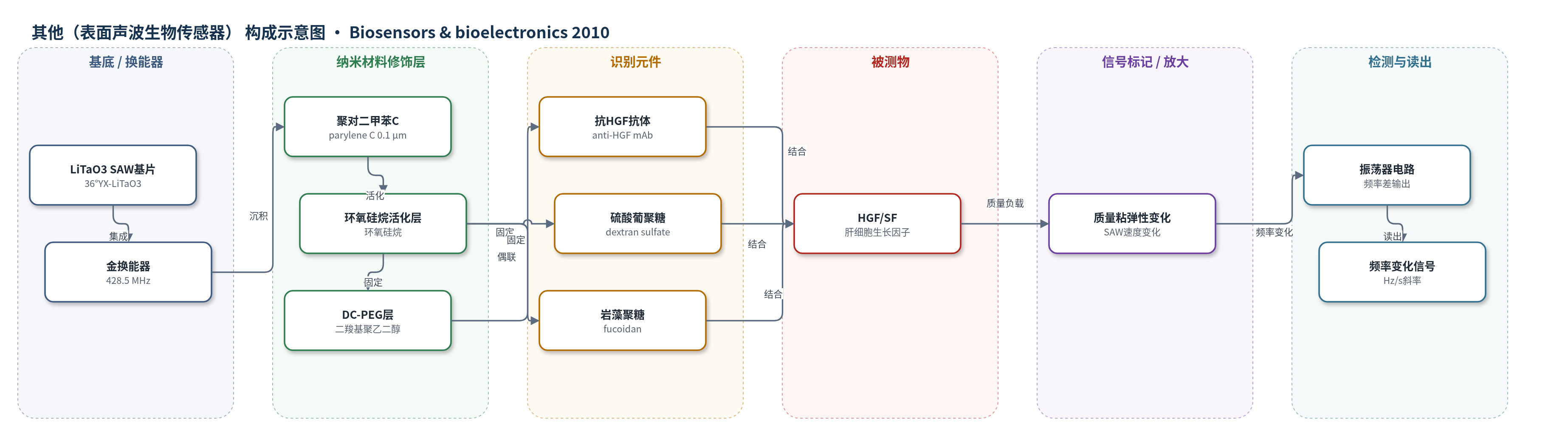
点击图片查看大图 · 依据论文自动绘制
传感器类型
其他(表面声波生物传感器)
检测对象
肝细胞生长因子/分散因子(hepatocyte growth factor/scatter factor, HGF/SF);样品基质:含血清细胞培养基(Eagle's MEM + 10% FCS + 1%青霉素/链霉素),用于肝细胞培养生物反应器
检测原理
该传感器采用表面声波(SAW)质量敏感机制。HGF/SF在流动注射过程中与传感器表面的抗HGF抗体或硫酸化多糖(硫酸葡聚糖、岩藻聚糖)特异性结合。结合事件使传感层质量负载增加,并改变其粘弹性,从而改变SAW在LiTaO3基片表面的传播速度。SAW谐振器作为振荡器频率决定元件,传播速度变化被转换为频率差信号。由于传感层结合容量高,HGF结合处于扩散限制区,响应曲线线性段的斜率与HGF浓度成正比,因此通过斜率校准可定量。37°C下HGF扩散系数增大,岩藻聚糖涂层校准斜率由室温15.7±1.0 (Hz/s)/(μg/ml)提高到23.9±0.5 (Hz/s)/(μg/ml)。
检测灵敏度
灵敏度斜率: anti-HGF (10.5 ± 0.8) (Hz/s)/(μg/ml);dextran sulfate (8.0 ± 1.1) (Hz/s)/(μg/ml);fucoidan 室温 (15.7 ± 1.0) (Hz/s)/(μg/ml);fucoidan 37°C (23.9 ± 0.5) (Hz/s)/(μg/ml)
效应效果
三种涂层均实现HGF的扩散限制结合,可在不再生条件下连续测定多个浓度,校准曲线线性,表明培养基中其他蛋白未造成明显干扰,传感器具有良好选择性。岩藻聚糖涂层灵敏度最高,37°C下斜率为23.9±0.5 (Hz/s)/(μg/ml),高于室温15.7±1.0 (Hz/s)/(μg/ml);抗HGF和硫酸葡聚糖涂层斜率分别为10.5±0.8和8.0±1.1 (Hz/s)/(μg/ml)。硫酸化多糖涂层可4°C保存1个月。作者认为岩藻聚糖涂层是抗体的低成本替代,适合连接生物反应器进行肝细胞培养过程的在线监测。
传感器的构成
- 基底/换能器:36°YX-LiTaO3 SAW谐振器与金换能器,428.5 MHz,压电换能并产生表面声波
- 保护层:0.1 μm聚对二甲苯C(parylene C),保护换能器并提供可活化表面
- 活化层:等离子氧化后用(3-glycidyloxypropyl)trimethoxysilane硅烷化,引入环氧基团用于共价固定
- 修饰层A:二羧基聚乙二醇(DC-PEG,Mr 2000)中间层,减少非特异结合并提供偶联位点
- 识别元件A:抗HGF单克隆抗体(anti-HGF,clone 24612.111),经EDC/NHS偶联,特异性捕获HGF
- 识别层B:硫酸葡聚糖(dextran sulfate,Mr 100,000)或岩藻聚糖(fucoidan,Mr 100,000–150,000),利用HGF肝素结合域特异性结合
- 样品基质/封闭:含血清细胞培养基(Eagle's MEM + 10% FCS + 1%青霉素/链霉素),预冲洗1 h作为封闭并模拟生物反应器环境
- 信号读出:自制振荡器电路与约434 MHz参考振荡器,输出频率差,分辨率1 Hz
中文摘要
细胞培养生物反应器的过程控制方法包括对蛋白浓度的在线监测。生物反应器样品通常含有大量不同蛋白,在如此复杂介质中直接检测单一蛋白是开发无标记生物传感器的挑战。本文报道了一种基于表面声波(SAW)的质量敏感生物传感器,用于在培养肝细胞的小型生物反应器含血清培养基中检测肝细胞生长因子/分散因子(HGF/SF)。传感器特异性通过两种策略实现:第一种将抗HGF抗体经二羧基聚乙二醇(DC-PEG)中间层共价固定于传感器表面;第二种利用HGF可特异性结合硫酸化多糖的特性,采用硫酸葡聚糖和岩藻聚糖作为传感器涂层。HGF检测结果显示,硫酸葡聚糖涂层传感器与抗HGF涂层传感器结果相似;岩藻聚糖涂层可获得更高信号,尤其在37°C下。因此,基于生物特异性硫酸化多糖的涂层为替代常用抗体涂层提供了简单且节省成本的方案。
英文摘要
Process control methods for cell culture bioreactors include on-line monitoring of protein concentrations. Bioreactor samples typically contain high amounts of different proteins. The direct detection of a single protein in this complex medium is a challenging task within the development of biosensors with label-free detection. We introduce the development of a mass-sensitive biosensor based on surface acoustic waves (SAW) for the detection of hepatocyte growth factor/scatter factor (HGF/SF) in the serum containing medium of a miniaturized bioreactor for culturing hepatocytes. The specificity of the biosensor was obtained following two approaches. In the first approach, antibodies against HGF (anti-HGF) were immobilized covalently via an intermediate layer of dicarboxy polyethylene glycol on the biosensor surface. In the second approach, dextran sulfate and fucoidan were used as sensor coatings exploiting the fact that HGF binds specifically to those sulfated polysaccharides. Performing HGF assays, similar results were obtained using biosensors coated with dextran sulfate and biosensors coated with anti-HGF. Even higher sensor signals were obtained using biosensors coated with fucoidan, particularly at 37°C. Therefore, biosensor coatings based on biospecific sulfated polysaccharides offer a simple and cost-saving alternative compared to the commonly used coating with antibodies.