组成图示
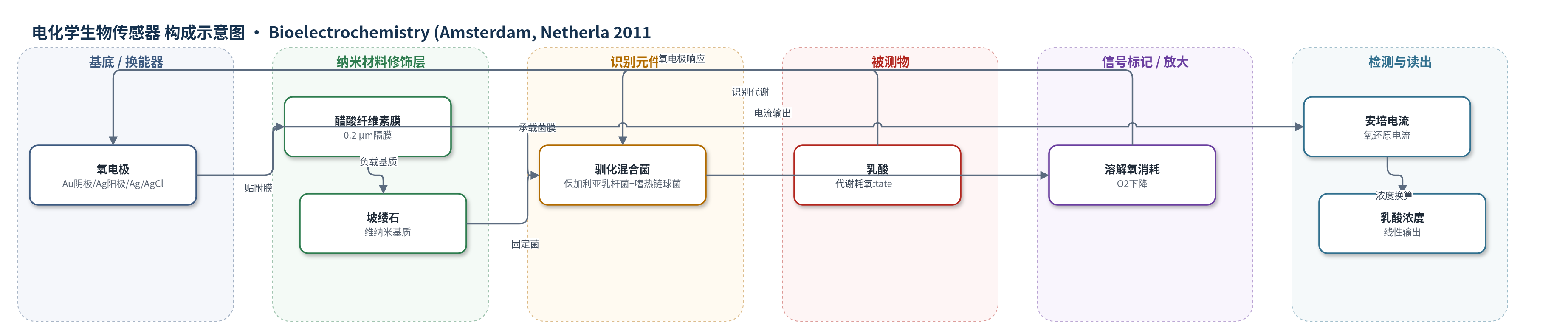
点击图片查看大图 · 依据论文自动绘制
传感器类型
电化学生物传感器
检测对象
乳酸(lactate/lactic acid);样品基质:PBS缓冲液、乳制品、血液样品
检测原理
传感器以驯化混合菌为生物识别元件,乳酸进入生物膜后被菌体代谢,首先氧化为丙酮酸并生成过氧化氢,丙酮酸进一步氧化为CO2和H2O,整个过程消耗溶解氧。由于氧电极在约0.7 V下对溶解氧还原电流敏感,乳酸浓度升高使菌体耗氧速率增加,电极稳态电流下降;以加样前后稳态电流差作为响应信号。醋酸纤维素膜限制抗坏血酸、尿酸等干扰物到达电极,坡缕石提供一维纳米固定基质,维持菌体活性与膜完整性。因此响应电流随乳酸浓度增加而增大,在0–300 μmol/L内线性。
检测灵敏度
线性范围: 0–300 μmol L−1;灵敏度: 1.87 mA mol−1 L;R = 0.9952
效应效果
该传感器选择性良好:100 μmol/L下乳酸响应为乙醇的44.8倍、葡萄糖的11.9倍,醋酸纤维素膜可阻挡抗坏血酸和尿酸。120 μmol/L标准样六个电极RSD为3.2%,三天内五个浓度斜率重现性为4.1%。10、50、250 μmol/L响应时间分别约40、60、220 s,95%稳态约225 s,测量时间小于4 min,短于商业试剂盒10 min。传感器可连续工作至少13 h,重复使用15次后响应不低于初始90%,4 ℃保存46 d保持93%活性。乳制品与血液样品结果与商业乳酸试剂盒一致,乳制品回归R=0.9786,作者认为可用于发酵过程在线监测和商业分析。
传感器的构成
- 换能器电极:一体化氧电极(Au阴极、Ag阳极、Ag/AgCl参比电极),通过氧还原电流检测溶解氧变化
- 隔膜/修饰层:醋酸纤维素膜(acetyl cellulose membrane,孔径0.2 μm),承载生物膜并阻挡抗坏血酸、尿酸等干扰物
- 纳米固定基质:坡缕石(palygorskite,一维纳米硅酸盐),吸附固定细菌并提高膜稳定性
- 识别元件:驯化混合菌(Lactobacillus bulgaricus与Streptococcus thermophilus 1:1混合培养),代谢乳酸并消耗溶解氧
- 信号换能介质:溶解氧(O2),随乳酸代谢消耗而降低,引起氧电极电流变化
中文摘要
本文制备了一种高灵敏细菌生物传感器,用于痕量乳酸的检测。将具有共生互作关系的保加利亚乳杆菌(Lactobacillus bulgaricus)与嗜热链球菌(Streptococcus thermophilus)混合培养物,以及作为细菌固定化优良基质的坡缕石(palygorskite),共同固定于氧电极表面。通过以乳酸为碳源进行240天驯化,使混合菌获得对乳酸的选择性识别能力和较强代谢活力。采用动态安培法在线监测乳酸代谢伴随的溶解氧浓度变化,电流响应可灵敏反映乳酸浓度变化。电化学结果表明,响应电流与乳酸浓度在0–300 μmol/L范围内线性相关,响应时间不超过240 s,相关系数R=0.9952,灵敏度为1.87 mA mol−1 L。该传感器具有良好选择性、较高灵敏度和较长使用寿命,可用于乳酸发酵过程等长时间在线监测。
英文摘要
A sensitive bacteria biosensor was prepared for the detection of trace lactate. The sensitive bioelement, Lactobacillus bulgaricus and Streptococcus thermophilus mixed culture, and palygorskite, a perfect matrix for bacteria, was co-immobilized on the surface of oxygen electrode. The biosensor possesses fine selective specificity, good sensitivity and longer operational life time, which were due to the mutual help relationship of symbiotic bacteria and 240 days acclimation with lactate as the carbon source. Hydrodynamic amperometry, an advanced electrochemical method, is suitable for on-line monitoring the concentration change of dissolved oxygen that is closely accompanied with the metabolism of lactate. Electrochemical data show that the current is very sensitive to the changes of the concentration of lactate. The response current was linear with lactic acid concentration in the range from 0 to 300μmol L(-1), where the response time is no more than 240 s (R=0.9952), and the sensitivity was 1.87mA mol(-1)L. Experiments show the biosensor is also very useful for long time on-line monitoring of lactate, such as fermentation progress.