组成图示
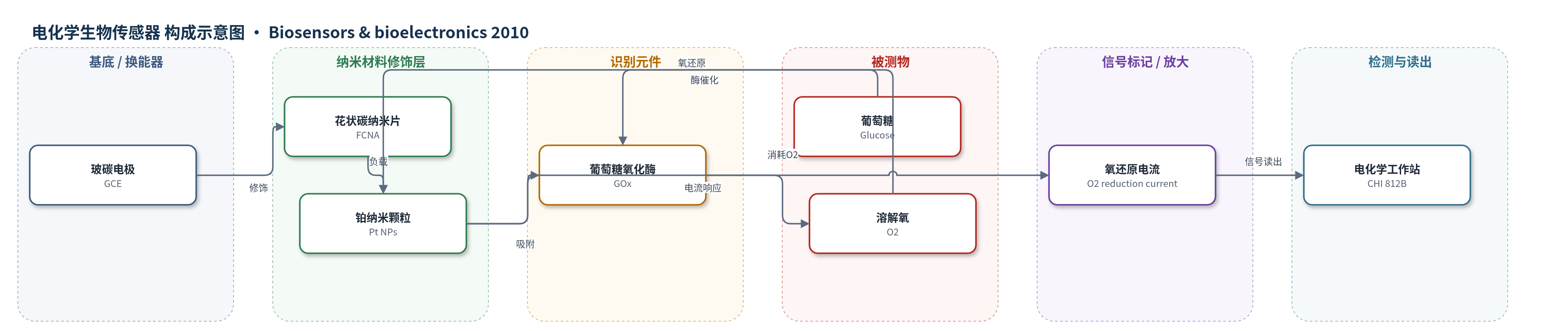
点击图片查看大图 · 依据论文自动绘制
传感器类型
电化学生物传感器
检测对象
葡萄糖(glucose),样品基质:0.1 M pH 7.0 磷酸盐缓冲液(PBS)与人血清(human serum)
检测原理
葡萄糖氧化酶(GOx)作为识别元件,催化葡萄糖氧化并消耗溶解氧(O2)。随着葡萄糖浓度升高,电极表面O2浓度下降。铂纳米颗粒(Pt NPs)分散在花状碳纳米片聚集体(FCNA)上,可在低过电位下高效催化O2还原,FCNA提供导电通道并促进电子转移。因此,在-0.08 V下,氧还原电流随葡萄糖浓度增加而线性降低,通过安培或循环伏安读出电流变化即可定量葡萄糖。该策略未采用额外信号放大,主要依靠酶催化消耗O2与Pt电催化氧还原的协同,实现低电位检测并减少干扰。
检测灵敏度
葡萄糖:LOD: 0.3 mM(S/N=3);线性范围: 0.5–8.0 mM;灵敏度: 6.0 μA mM−1 cm−2。氧:线性范围: 6.3–69.3 μM;灵敏度: 4.1 mA cm−2 mM−1。
效应效果
该传感器在低工作电位下抗干扰能力强,3.0 mM尿酸或抗坏血酸对1.0 mM葡萄糖电流响应仅增加2.4%和3.1%。人血清无需预处理,加标2.0 mM葡萄糖回收率为98.6%和103.7%,与分光光度法结果一致。连续10次检测4.0 mM葡萄糖RSD为6.0%,5个独立制备电极RSD为3.4%;50次循环后保留95.7%响应,4℃保存10天和20天分别保留97%和94%。氧检测重复性RSD为3.1%和2.4%,制备重现性RSD为3.2%。作者认为可用于血糖监测。
传感器的构成
- 基底电极:玻碳电极(GCE),提供导电基底与电子转界面
- 纳米支撑层:花状碳纳米片聚集体(FCNA),提供高比表面积、导电性并分散Pt NPs
- 催化修饰层:铂纳米颗粒(Pt NPs),低过电位催化溶解氧还原
- 识别元件:葡萄糖氧化酶(GOx),催化葡萄糖氧化并消耗O2
- 检测介质:溶解氧(O2),其浓度变化引起氧还原电流变化
中文摘要
本文通过一步乙二醇法制备了铂纳米颗粒(Pt NPs)修饰的花状碳纳米片聚集体(FCNA),并用扫描电镜、X射线光电子能谱、X射线衍射和电化学阻抗谱对其进行了表征。将FCNA修饰于玻碳电极后,碳纳米片上密集分散的Pt NPs兼具FCNA的良好导电性与Pt NPs对氧还原的低过电位催化活性,使电极可在低过电位下实现氧的电化学检测,线性范围为6.3–69.3 μM。以葡萄糖氧化酶(GOx)为模型,构建的GOx/Pt/FCNA纳米复合安培型生物传感器对葡萄糖在0.5–8.0 mM范围内呈线性响应,检出限为0.3 mM(信噪比3)。该传感器具有高选择性、可接受的回收率和良好重复性,可成功用于人血清中葡萄糖的检测。FCNA有望作为制备其他金属纳米颗粒分散聚集体和生物传感应用的载体。
英文摘要
A Pt nanoparticle-decorated flower-like carbon nanosheet aggregation (FCNA) was prepared via one-step ethylene glycol method. The aggregation was characterized with scanning electron micrographs, X-ray photoelectron spectra, X-ray diffraction and electrochemical impedance spectra. When the aggregation was immobilized on a glassy carbon electrode, the dense dispersion of Pt nanoparticles (Pt NPs) on the carbon nanosheets of FCNA could combine the good conductivity of FCNA with the excellent catalytic activity of Pt NPs for the electroreduction of oxygen at a low overpotential, which led to a method for electrochemical detection of oxygen from 6.3 to 69.3 μM. Using glucose oxidase (GOx) as a model, the resulting GOx/Pt/FCNA nanocomposite-based amperometric biosensor showed a linear response to glucose ranging from 0.5 to 8.0 mM with a detection limit of 0.3 mM at a S/N ratio of 3. The designed biosensor was of excellent performance with high selectivity, acceptable recovery and good repeatability, and could be successfully applied in the detection of glucose in human serum. The FCNA could be expected as a carrier for the preparation of other metal nanoparticle-dispersed aggregations and biosensing applications.