组成图示
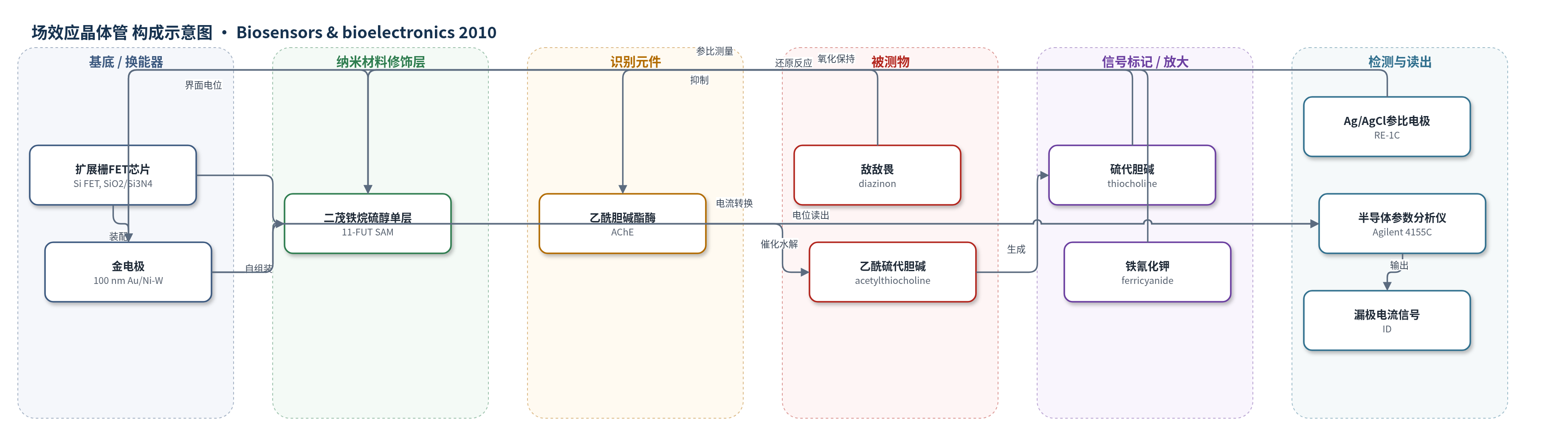
点击图片查看大图 · 依据论文自动绘制
传感器类型
场效应晶体管(FET)生物传感器
检测对象
硫代胆碱(thiocholine,酶催化产物,PBS缓冲液)、敌敌畏(diazinon,农药,PBS缓冲液)、6-羟基-1-己硫醇(6-hydroxy-1-hexanethiol,模型化合物,PBS缓冲液)
检测原理
传感器采用电位保持法直接检测酶催化产物。先用铁氰化钾氧化金电极表面的二茂铁分子,使其处于确定的氧化态,界面电位被设定为高电位;由于FET输入阻抗高,该电位在测量前基本保持。样品中AChE催化乙酰硫代胆碱生成硫代胆碱,产物作为还原剂直接还原金表面二茂铁,使氧化态/还原态比例改变,界面电位按Nernst方程下降。扩展栅FET将金电极界面电位变化转换为漏极电流变化,由半导体参数分析仪读出。农药敌敌畏抑制AChE活性,减少硫代胆碱生成,导致电位变化幅度减小,从而实现定性检测。
检测灵敏度
LOD: 约1 μM;线性范围: 10−5 M–10−2 M;灵敏度斜率: 59.2 mV/decade;R^2 = 0.9932;diazinon: 5 ppb 检出
效应效果
光照下带遮光掩膜扩展栅FET的VG–ID曲线差异小于5 mV;介体光还原使界面电位3 min内下降约16 mV。电位保持法氧化后界面电位311 mV(SD 6.3 mV),漂移7.0 mV/min(SD 1.3 mV/min)。模型化合物10−5–10−2 M呈Nernst响应,LOD约1 μM。5 ppb敌敌畏使AChE产物由85 μM降至5 μM;FET电位变化有农药−42.5 mV(SD 14.9 mV,n=3),无农药−174.3 mV(SD 24.3 mV,n=3),差值131.8 mV超过5倍SD,与Ellman比色法一致。5 ppb灵敏度满足食品敌敌畏残留(限值500 ppb)现场检测。
传感器的构成
- 基底/换能器:扩展栅FET芯片(extended-gate FET sensor chip),n沟道耗尽型FET,SiO2/Si3N4栅绝缘层,将金电极界面电位变化转换为漏极电流变化
- 光屏蔽层:800 nm铝层(light-shielding mask),覆盖FET结构以屏蔽光照
- 传感电极:金电极(Au electrode,100 nm Au/Ni-W粘附层,400 μm×400 μm),作为界面电位传感界面
- 修饰层:11-二茂铁基-1-十一烷硫醇(11-FUT)自组装单层,固定二茂铁分子作为氧化还原信号元件
- 识别元件:乙酰胆碱酯酶(AChE),在样品溶液中催化乙酰硫代胆碱生成硫代胆碱,并受农药抑制
- 氧化剂/电位保持试剂:铁氰化钾(ferricyanide),氧化二茂铁至确定氧化态并保持高电位
- 参考电极:Ag/AgCl参比电极(RE-1C,饱和KCl),用于施加和测量界面电位
中文摘要
本文报道了一种基于二茂铁修饰金电极的场效应晶体管(FET)生物传感器。该传感器利用介体将酶反应产生的电子传递至传感器,从而检测酶催化产物。带遮光掩膜的扩展栅FET传感器无需遮光箱即可工作,有望实现小型便携式仪器。然而,在光照条件下使用介体检测酶催化产物时,介体发生光还原,导致测量波动和灵敏度下降。为降低波动并提高灵敏度,作者提出不使用介体的直接检测方法。其关键是电位保持法:用铁氰化钾溶液氧化FET传感器的修饰电极,使其表面每次均处于相同高电位,并依靠FET结构的高输入阻抗将该高电位保持至测量阶段。应用该方法后,金电极上固定的二茂铁分子与酶催化产物直接反应,使金电极界面电位随产物量增加而下降。光照条件下,产物模型化合物在10 μM至10 mM范围内可被检测,并呈现59.2 mV/decade的Nernst响应。该方法还用于基于酶抑制的农药检测,仅用传感器芯片即成功检测5 ppb敌敌畏。
英文摘要
An FET-based biosensor with a ferrocene-modified gold electrode detects the enzyme-produced electrons by using mediators that transfer the electrons from the enzyme to the sensor. Since an extended-gate FET sensor with a light-shielding mask can be operated without a light-shielding box, a small portable instrument will soon be realised. However, when the FET sensor detected enzyme-catalyzed products with the mediators under light conditions, measurements fluctuated due to photo-reduction of the mediators, resulting in decreased sensitivity. To improve sensitivity by reducing the fluctuation, we developed a procedure for directly detecting enzyme-catalyzed products without using the mediators. The key technique used in this procedure was a measurement technique using our developed potential-keeping method, in which the modified electrode of the FET sensor was oxidised by ferricyanide solution to make its surface the same high potential every time, and this high potential was kept until measurement because of the high input impedance of the FET structure. After this method was applied, the interfacial potential of the gold electrode decreased depending on the amount of enzyme-catalyzed products due to the ferrocene molecules immobilised on the gold electrode directly reacting with the products. The results obtained in light conditions indicated that model compounds of the products were detected from 10 μM to 10 mM with the Nernstian response of 59.2 mV/decade. Also, this method was applied to pesticide detection by using the enzyme inhibition by pesticide, and 5 ppb of diazinon was successfully detected by using only a sensor chip.