组成图示
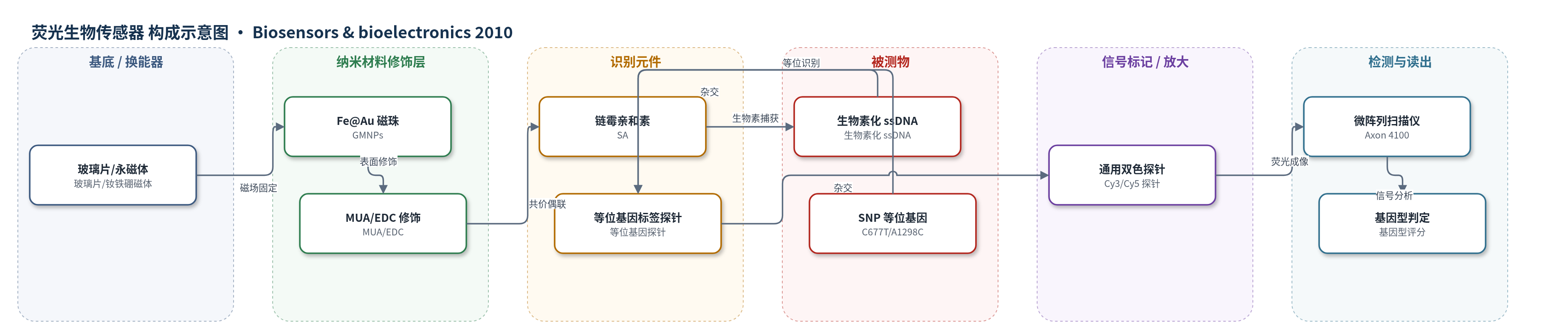
点击图片查看大图 · 依据论文自动绘制
传感器类型
荧光生物传感器
检测对象
MTHFR 基因 C677T 单核苷酸多态性(MTHFR C677T SNP, rs1801133)、MTHFR 基因 A1298C 单核苷酸多态性(MTHFR A1298C SNP, rs1801131);样品基质:个体基因组 DNA 样本(经不对称 PCR 扩增产物)
检测原理
不对称 PCR 使用生物素化引物扩增含 SNP 位点的单链 DNA(ssDNA)。链霉亲和素修饰的 Fe@Au 磁性纳米颗粒(SA-GMNPs)通过生物素-链霉亲和素高亲和作用直接捕获 ssDNA,形成 ssDNA-GMNP 复合物,无需纯化。复合物在磁场下固定于玻璃片,形成磁珠阵列。等位基因特异性标签探针与 ssDNA 杂交,其通用标签序列再与 Cy3 或 Cy5 标记的通用检测探针杂交。纯合野生型主要产生 Cy3 荧光,纯合突变型主要产生 Cy5 荧光,杂合型同时产生双色荧光。扫描仪采集荧光图像,计算等位分数 Cy3/(Cy3+Cy5) 判定基因型。目标 ssDNA 浓度越高,杂交形成的双色荧光信号越强,0.1 nM 可检出,10 nM 达到饱和。
检测灵敏度
LOD: 0.1 nM;饱和浓度: 10 nM
效应效果
磁珠阵列洗涤前后荧光强度变化在 8% 以内,无显著差异(t=10.630,df=1,p=0.06>0.05)。空白 GMNPs 背景低,检测限 0.1 nM,10 nM 饱和。C677T 杂交最佳温度野生型 39 ℃、突变型 37 ℃,后续采用 38 ℃;A1298C 为 37 ℃。12 个样本的三种基因型清晰区分,三点重复荧光模式高度可重复。C677T 突变型等位分数 0.08、0.12,野生型 0.85–0.91,杂合型 0.48;A1298C 野生型 G 值 0.87–0.92,杂合型 0.48、0.49。作者认为所有样品可在同一杂交室分析,仅需一对通用双色探针,降低成本并适合高通量基因分型。
传感器的构成
- 基底/换能器:玻璃片(glass slide)背面放置钕铁硼永磁体(Nd-B magnet),提供磁场以固定磁珠阵列
- 纳米材料修饰层:Fe@Au 磁性纳米颗粒(GMNPs),由 γ-Fe2O3 磁性纳米颗粒(MNPs)经 3-巯基丙基三乙氧基硅烷(MPTS)修饰并沉积胶体金形成,作为 DNA 载体
- 表面功能化层:11-巯基十一烷酸(MUA)在 GMNPs 表面引入羧基,经 EDC 活化后共价偶联链霉亲和素(streptavidin, SA)
- 识别元件:链霉亲和素(SA)通过生物素-链霉亲和素作用捕获生物素化单链 DNA(biotinylated ssDNA)
- 捕获模板:含 SNP 位点的生物素化单链 DNA(ssDNA),由不对称 PCR 扩增获得,固定于 GMNPs 上
- 杂交识别探针:等位基因特异性标签探针(allele-specific tag probes),与 SNP 等位基因杂交并携带通用标签
- 信号标记物:通用双色荧光检测探针(universal detectors),分别标记 Cy3 和 Cy5,与标签序列杂交产生荧光
- 杂交/洗涤体系:杂交液(hybridization solution)及 2× SSC/SDS、0.1× SSC/SDS、3× SSC 洗涤液,用于杂交和去除非特异结合
- 信号读出:微阵列扫描仪(Axon 4100 A)和 Genepix Pro 6.0 软件,采集 Cy3/Cy5 荧光并计算等位分数
中文摘要
本文报道了一种适用于单核苷酸多态性(SNP)基因分型的灵敏选择性生物传感器平台,采用 Fe@Au 磁性纳米颗粒(GMNPs)构建磁珠阵列。该平台整合磁性纳米颗粒载体的快速结合动力学、芯片多重编码能力和标签阵列技术。作为 DNA 传感器,生物素化单链 DNA 经不对称 PCR 扩增获得,并被链霉亲和素修饰的 GMNPs 捕获,形成 GMNP–ssDNA 复合物,无需进一步纯化。复合物在磁场下固定于载玻片形成磁珠阵列,再与各 SNP 位点的等位基因特异性标签探针杂交,并采用一对通用检测探针分析。利用磁珠阵列,所有样品可在同一杂交室中分析,降低成本;利用通用标签,仅需一对标记荧光基团的通用双色探针即可实现多重基因分型。该方法无需繁琐洗脱,过程简单、可重复且易于操作。平台成功区分 12 个个体样本中两个 SNP 位点的基因型,显示两个位点等位基因间具有预期评分和良好区分度。总之,该集成平台具有适应性和通用性,可满足基因组研究和临床应用的高通量需求。
英文摘要
A sensitive and selective biosensor platform suited for SNP type using Fe@Au magnetic nanoparticles (GMNPs) to fabricate bead array is described. This new platform integrates the rapid binding kinetics of magnetic nanoparticles carriers, the multiplexing and encoding capabilities of chips, and tagged array. As a DNA sensor, the biotinylated single-stranded DNA was obtained by asymmetry PCR amplification, and then captured by GMNPs modified with streptavidin to form GMNP-ssDNA complexes without further purification. The complexes were immobilized on the slide to fabricate bead array through magnetic field. The bead array was hybridized with the corresponding allele-specific tag probes for each locus, and a pair of given universal detectors were applied to these markers analysis. Using bead array, all samples can be analyzed in one hybridization chamber which lowers the cost of the assay. Using universal tags, only a pair of universal dual-color probes labeled fluorophores was used for multiplex genotyping. Without the need of laborious and time-consuming elution, the experiment process was simple, reproducible and easy to handle. Two SNPs loci from 12 individual samples were discriminated using this platform and the results demonstrated that the expected scores and good discrimination were obtained between the two alleles from the two SNP loci. In summary, the integrated sensitive platform is adaptable and versatile, while offering a high-throughput capability needed for genome research and clinical applications.