组成图示
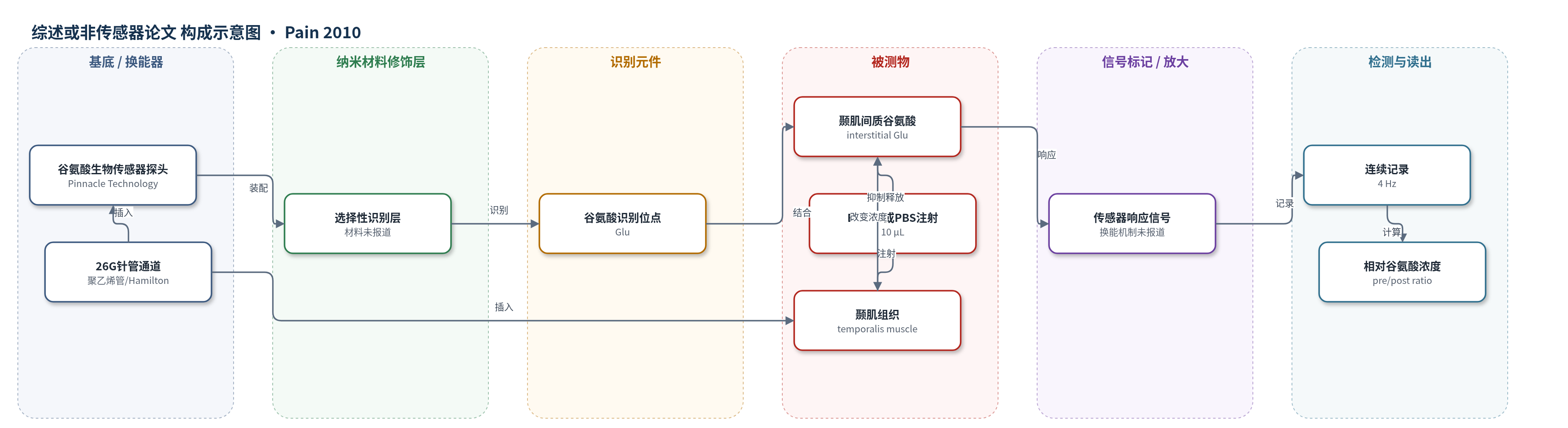
点击图片查看大图 · 依据论文自动绘制
传感器类型
综述或非传感器论文
检测对象
谷氨酸(glutamate, Glu),样品基质:大鼠颞肌间质(interstitial fluid of temporalis muscle)
检测原理
商品化谷氨酸生物传感器经体外校准后,通过 26 G 针管插入大鼠颞肌,探头尖端距注射针尖约 2 mm,稳定至少 60 min 后连续记录输出(4 Hz)。间质谷氨酸与探头选择性识别层作用,使传感器输出随谷氨酸浓度变化;注射 BoNTA 或 PBS 后,BoNTA 切割/降低 SNAP-25,抑制神经末梢囊泡释放,使颞肌间质谷氨酸下降,传感器输出相应降低。原文未报道具体酶、电极或信号放大机制,因此本文仅将其作为测量工具,而非新传感器。
检测灵敏度
原文未报告 LOD、线性范围、灵敏度斜率或相关系数。
效应效果
24 只大鼠中 BoNTA 与 PBS 组各 12 个颞肌痛觉纤维。BoNTA 在 2.5 h 和 3 h 显著提高相对机械阈值(P=0.033、0.024),不改变肌表温度,并减弱谷氨酸诱导的机械敏化;PBS 组谷氨酸使肌表温度升高约 2.5°C,BoNTA 组无变化。4 只大鼠中箭毒碱麻痹不复制效应。Western blot(n=5)显示 SNAP-25 降低(P=0.038)。谷氨酸生物传感器(n=4)显示 BoNTA 使间质谷氨酸约 2 h 降低 70%。免疫组化(n=6)显示约 70% PGP9.5 纤维表达 NR2B,约 50% NMDA 纤维共表达 SP/CGRP。APV 阻断机械敏化,CGRP 或 NMDA 拮抗剂减弱血管扩张。作者认为 BoNTA 通过抑制谷氨酸和 CGRP 释放预防偏头痛。
传感器的构成
- 基底/换能器:商品化谷氨酸生物传感器探头(Pinnacle Technology,具体电极材料未报道,用于连续测量间质谷氨酸)
- 识别元件:谷氨酸选择性识别层(原文仅称 glutamate selective biosensors,具体材料未报道)
- 样品接触/插入结构:26 G 注射针、聚乙烯管和 Hamilton 注射器(将探头插入颞肌并注射 BoNTA 或 PBS)
- 信号读出:连续记录(采样率 4 Hz,具体仪器未报道)
中文摘要
肉毒神经毒素A(BoNTA)肌内注射用于头面部肌肉以预防偏头痛的机制尚不清楚。本研究在雌性大鼠中采用盲法,观察 BoNTA 对颞肌单个痛觉感受器机械与化学反应性及肌肉神经源性血管扩张的影响。肌内注射 BoNTA 或载体后 3 h 内测量机械阈值,随后注射致痛物质谷氨酸 10 min 后继续测量。结果显示,BoNTA 显著提高肌肉痛觉感受器机械阈值,但不改变肌表温度,并阻断谷氨酸诱导的机械敏化和神经源性血管扩张;箭毒碱诱导的肌肉麻痹不能复制上述效应。Western blot 显示 BoNTA 显著降低颞肌 SNAP-25。谷氨酸生物传感器测量表明 BoNTA 显著降低间质谷氨酸浓度。免疫组化显示约半数表达 NMDA 受体的颞肌神经纤维共表达 P 物质或 CGRP。拮抗剂实验表明,谷氨酸诱导的机械敏化仅被 NMDA 受体拮抗剂阻断,而神经源性血管扩张可被 NMDA 或 CGRP 受体拮抗剂减弱。数据提示 BoNTA 通过抑制谷氨酸释放降低颞肌痛觉感受器机械敏感性,并减弱 CGRP 释放,从而减少偏头痛。
英文摘要
The mechanism by which intramuscular injection of BoNTA into the craniofacial muscles decreases migraine headaches is not known. In a blinded study, the effect of BoNTA on the mechanical and chemical responsiveness of individual temporalis muscle nociceptors and muscle neurogenic vasodilation was investigated in female rats. Mechanical threshold was measured for 3h following intramuscular injection of BoNTA or vehicle, and for 10 min after a subsequent injection of the algogen glutamate. Injection of BoNTA significantly increased the mechanical threshold of muscle nociceptors without altering the muscle surface temperature and blocked glutamate-induced mechanical sensitization and neurogenic vasodilation. None of these effects were reproduced by pancuronium-induced muscle paralysis. Western blot analysis of temporalis muscles indicated that BoNTA significantly decreased SNAP-25. Measurement of interstitial glutamate concentration with a glutamate biosensor indicated that BoNTA significantly reduced glutamate concentrations. The mechanical sensitivity of muscle nociceptors is modulated by glutamate concentration through activation of peripheral NMDA receptors. Immunohistochemical experiments were conducted and they indicated that half of the NMDA-expressing temporalis nerve fibers co-expressed substance P or CGRP. Additional electrophysiology experiments examined the effect of antagonists for NMDA, CGRP and NK1 receptors on glutamate-induced effects. Glutamate-induced mechanical sensitization was only blocked by the NMDA receptor antagonist, but muscle neurogenic vasodilation was attenuated by NMDA or CGRP receptor antagonists. These data suggest that injection of BoNTA into craniofacial muscles acts to decrease migraine headaches by rapidly decreasing the mechanical sensitivity of temporalis muscle nociceptors through inhibition of glutamate release and by attenuating the provoked release of CGRP from muscle nociceptors.