组成图示
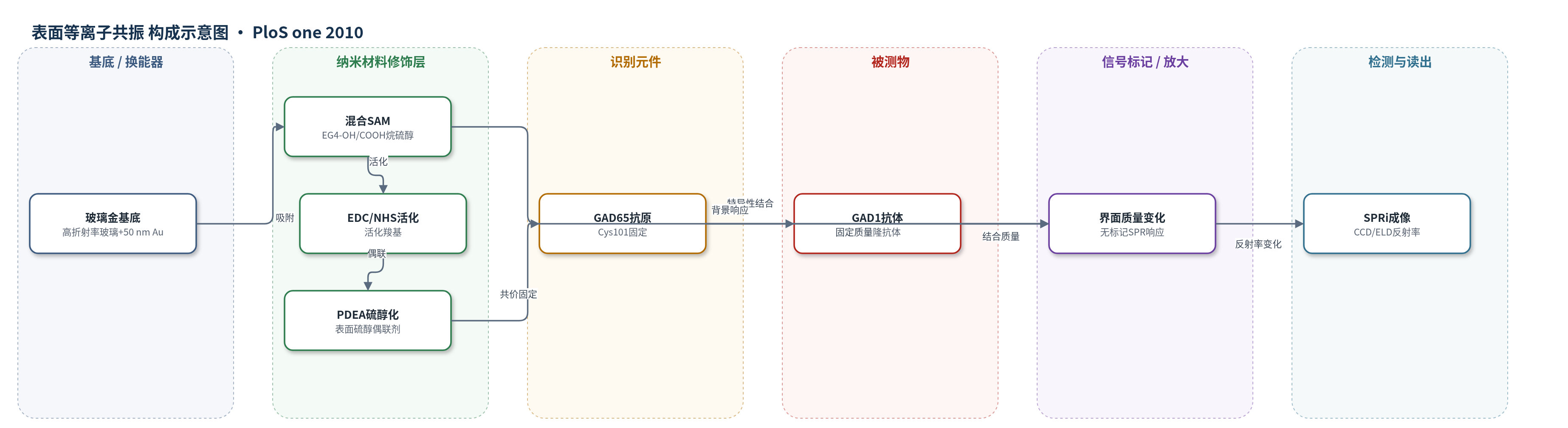
点击图片查看大图 · 依据论文自动绘制
传感器类型
表面等离子共振(SPR)生物传感器
检测对象
抗GAD65抗体(anti-GAD65 antibody,如GAD1单克隆抗体);样品基质:PBS缓冲液、人血清(非特异结合测试)
检测原理
传感器以金膜/玻璃棱镜为SPR换能基底,混合烷硫醇SAM提供抗污界面,GAD65经Cys101与PDEA共价固定于表面。当含抗GAD65抗体的样品流过时,抗体与固定GAD65特异性结合,使斑点处界面质量与折射率增加。入射光在金/介质界面激发表面等离子体,结合事件改变共振条件,导致反射率随时间下降。CCD对整面微阵列成像,提取各斑点反射率变化曲线;结合量随抗体浓度增加而增大,按Langmuir模型拟合可得kon、koff和Kd。方法无标记、无酶放大,依靠低非特异结合提高信噪比。
检测灵敏度
LOD: around 30 to 40 ng/ml of protein in solution;反射率变化: approximately 0.01%;定量: antibody at 4 nM concentration in solution
效应效果
该表面有效消除含固定GAD65斑点的非特异性结合,背景低,避免背景扣除。与人血清(终浓度0.6 mg/ml)测试相比,GLISS表面较经典十一烷酸SAM显著降低非特异吸附。4.8 nM GAD1抗体下,拟合得koff=1.29±0.02×10^-3 s^-1、kon=9.41±0.29×10^5 M^-1 s^-1、Kd=1.37±0.06 nM;48 nM时结合呈多相/双相,提示多种结合模式。作者称SPRi比ELISA/RIA能更详细表征动力学,可作为ITC的竞争性替代,并适用于1型糖尿病GAD65自身抗体多重免疫检测。
传感器的构成
- 基底/换能器:高折射率玻璃棱镜(n≈1.7),经RIE活化并热蒸镀50 nm Au层,形成SPR成像界面
- 自组装单分子层:混合烷硫醇SAM,HS(CH2)11(OCH2CH2)4OH与HS(CH2)11(OCH2CH2)6-COOH,提供抗污羟基/羧基端基
- 活化层:EDC(200 mM)与NHS(50 nM)活化羧基,生成可偶联界面
- 偶联层:PDEA(2-(2-pyridinyldithio) ethaneamine hydrochloride,175 mM)引入表面硫醇,用于GAD65共价固定
- 识别元件:重组人GAD65(N端截短、C端His标签),经Cys101与PDEA偶联固定,作为抗原靶标
- 封闭剂:乙醇胺(1 M,pH 8.5)封闭未反应活化羧基;蛋白固定后未反应基团按文献方法封闭
- 信号标记物:无标记(label-free),依赖抗体结合引起界面质量/折射率变化
- 读出系统:GenOptics SPRi装置,单色偏振电致发光二极管、CCD相机与微流控样品池,实时监测反射率变化
中文摘要
非特异性结合是生物传感器表面定量分析分析物选择性保留的主要障碍。尽管已有多种抗污单分子层,许多大分子相互作用仍难以分析。本文利用自组装单分子层形成过程的动态特性,优化其物理和化学性质,显著降低非特异性结合,使分析物与固定靶分子的特异性结合得以分析。作者以人谷氨酸脱羧酶65 kDa亚型(GAD65)与人类单克隆抗体的特异性蛋白微阵列为例,证明该方法有效消除了含固定GAD65表面的非特异性相互作用。该策略避免了背景扣除,可获得更准确的动力学和平衡参数;提高信噪比,增强利用SPR测定动力学常数并进行van’t Hoff分析的可靠性,使其成为ITC的竞争性替代方法;测量精度还允许使用比简单Langmuir单相位结合更复杂的相互作用模型。结果表明,SPRi能比ELISA/RIA更详细地表征1型糖尿病自身抗原GAD65的抗体结合动力学,并适用于基于GAD65蛋白的多重免疫分析及其他生物标志物检测。
英文摘要
BACKGROUND: Non-specific binding to biosensor surfaces is a major obstacle to quantitative analysis of selective retention of analytes at immobilized target molecules. Although a range of chemical antifouling monolayers has been developed to address this problem, many macromolecular interactions still remain refractory to analysis due to the prevalent high degree of non-specific binding. We describe how we use the dynamic process of the formation of self assembling monolayers and optimise physical and chemical properties thus reducing considerably non-specific binding and allowing analysis of specific binding of analytes to immobilized target molecules.
METHODOLOGY/PRINCIPAL FINDINGS: We illustrate this approach by the production of specific protein arrays for the analysis of interactions between the 65kDa isoform of human glutamate decarboxylase (GAD65) and a human monoclonal antibody. Our data illustrate that we have effectively eliminated non-specific interactions with the surface containing the immobilised GAD65 molecules. The findings have several implications. First, this approach obviates the dubious process of background subtraction and gives access to more accurate kinetic and equilibrium values that are no longer contaminated by multiphase non-specific binding. Second, an enhanced signal to noise ratio increases not only the sensitivity but also confidence in the use of SPR to generate kinetic constants that may then be inserted into van't Hoff type analyses to provide comparative DeltaG, DeltaS and DeltaH values, making this an efficient, rapid and competitive alternative to ITC measurements used in drug and macromolecular-interaction mechanistic studies. Third, the accuracy of the measurements allows the application of more intricate interaction models than simple Langmuir monophasic binding.
CONCLUSIONS: The detection and measurement of antibody binding by the type 1 diabetes autoantigen GAD65 represents an example of an antibody-antigen interaction where good structural, mechanistic and immunological data are available. Using SPRi we were able to characterise the kinetics of the interaction in greater detail than ELISA/RIA methods. Furthermore, our data indicate that SPRi is well suited to a multiplexed immunoassay using GAD65 proteins, and may be applicable to other biomarkers.