组成图示
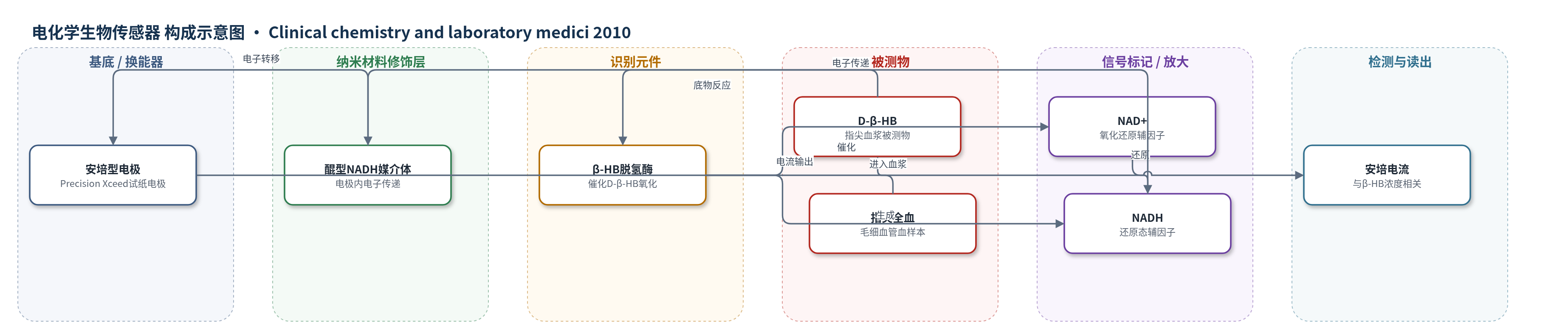
点击图片查看大图 · 依据论文自动绘制
传感器类型
电化学生物传感器
检测对象
β-羟基丁酸(β-hydroxybutyrate, β-HB;主要为 D-β-HB),样品基质:指尖毛细血管全血(实际为血浆)
检测原理
Precision Xceed 酮体试纸为酶促安培型生物传感器。指尖全血中的 D-β-羟基丁酸(D-β-HB)进入试纸血浆相,在 β-羟基丁酸脱氢酶催化下被氧化为乙酰乙酸,同时 NAD+ 接受电子被还原为 NADH。NADH 将电子经电极内醌型 NADH 氧化还原媒介体传递至安培型电极,产生与 D-β-HB 浓度成正比的电流,仪器据此换算浓度。该过程无核酸或酶催化沉积放大;高浓度时因试剂量不足、安培检测器非线性或乙酰乙酸/媒介体抑制,可出现饱和。
检测灵敏度
线性范围: 0.0–6.0 mmol/L(0.0–10.0 mmol/L 加标中 >6.0 mmol/L 饱和);斜率: 1.20(95% CI 1.13–1.33)/1.25(95% CI 1.20–1.30);R^2 = 0.97(n=59)/0.997(n=18)
效应效果
68 份患者指尖血中,Precision Xceed 与 LC-MS/MS 在 0.0–6.0 mmol/L 一致性良好,斜率 1.20(95% CI 1.13–1.33),截距无显著差异,R^2=0.97(n=59)。加标实验(n=20)LC-MS/MS 回收率 95%–108%,Precision 斜率 1.25(95% CI 1.20–1.30),R^2=0.997(n=18)。>6.0 mmol/L 时非线性并完全饱和,读数 3.0–6.5 mmol/L 波动,个体差异大;未报告 RSD、稳定性或选择性。作者建议 >3.0 mmol/L 报告为 >3.0 mmol/L,认为适用于 0.0–3.0 mmol/L 临床范围,可用于急诊糖尿病酮症酸中毒筛查。
传感器的构成
- 试纸载体/基底:Precision Xceed 酮体试纸(ketone test strip),承载酶、NAD+ 和氧化还原媒介体,接触指尖全血
- 换能器电极:安培型生物传感器电极(amperometric biosensor electrode,具体电极材料原文未给出),将氧化还原反应产生的电子流转换为电流
- 电子媒介体:醌型 NADH 氧化还原媒介体(quinoid NADH redox mediator),整合于电极中传递电子
- 识别/催化元件:β-羟基丁酸脱氢酶(β-HB dehydrogenase),催化 D-β-HB 氧化为乙酰乙酸
- 辅因子/电子传递物:NAD+/NADH(烟酰胺腺嘌呤二核苷酸/还原型),NAD+ 被还原为 NADH 并传递电子
- 其他辅因子:脂质(lipids)等,与酶和 NAD+ 共同维持反应过量
中文摘要
背景:Precision(Abbott Diabetes Care)即时检测生物传感器试纸广泛用于糖尿病患者和临床实验室,通过指尖毛细血管血测定血浆β-羟基丁酸(β-HB)浓度。既往验证仅以静脉血浆酶法为参照。方法:本研究将 Precision Xceed 与液相色谱-串联质谱(LC-MS/MS)测定干血斑中 β-HB 进行比较,血斑取自同一指尖血样本;线性通过向 EDTA 静脉全血基质加入不同量标准品检验。结果:在 0.0–6.0 mmol/L 范围内,Precision 与 LC-MS/MS 一致性良好(Passing-Bablok 回归斜率 1.20,截距无显著差异,R^2=0.97,n=59)。出乎意料的是,浓度高于 6.0 mmol/L 时出现非线性并完全饱和,加标实验证实;饱和水平读数在 3.0–6.5 mmol/L 间波动。结论:Precision β-HB 试纸与 LC-MS/MS 比较良好,但饱和水平个体差异大,建议将 >3.0 mmol/L 报告为 >3.0 mmol/L;该试纸适用于 0.0–3.0 mmol/L 临床相关范围。
英文摘要
BACKGROUND: The Precision(®) (Abbott Diabetes Care) point-of-care biosensor test strips are widely used by patients with diabetes and clinical laboratories for measurement of plasma β-hydroxybutyrate (β-HB) concentrations in capillary blood samples obtained by fingerstick. In the literature, this procedure has been validated only against the enzymatic determination of β-HB in venous plasma, i.e., the method to which the Precision(®) has been calibrated.
METHODS: In this study, the Precision(®) Xceed was compared to a methodologically different and superior procedure: determination of β-HB by liquid chromatography tandem-mass spectrometry (LC-MS/MS) in capillary blood spots. Blood spots were obtained from the same fingerstick sample from out of which Precision(®) measurements were performed. Linearity was tested by adding varying amounts of standard to an EDTA venous whole blood matrix.
RESULTS: The Precision(®) was in good agreement with LC-MS/MS within the measuring range of 0.0-6.0 mmol/L (Passing and Bablok regression: slope=1.20 and no significant intercept, R=0.97, n=59). Surprisingly, the Precision(®) showed non-linearity and full saturation at concentrations above 6.0 mmol/L, which were confirmed by a standard addition experiment. Results obtained at the saturation level varied between 3.0 and 6.5 mmol/L.
CONCLUSIONS: The Precision(®) β-HB test strips demonstrate good comparison with LC-MS/MS. Inter-individual variation around the saturation level, however, is large. Therefore, we advise reporting readings above 3.0 as >3.0 mmol/L. The test is valid for use in the clinically relevant range of 0.0-3.0 mmol/L.