组成图示
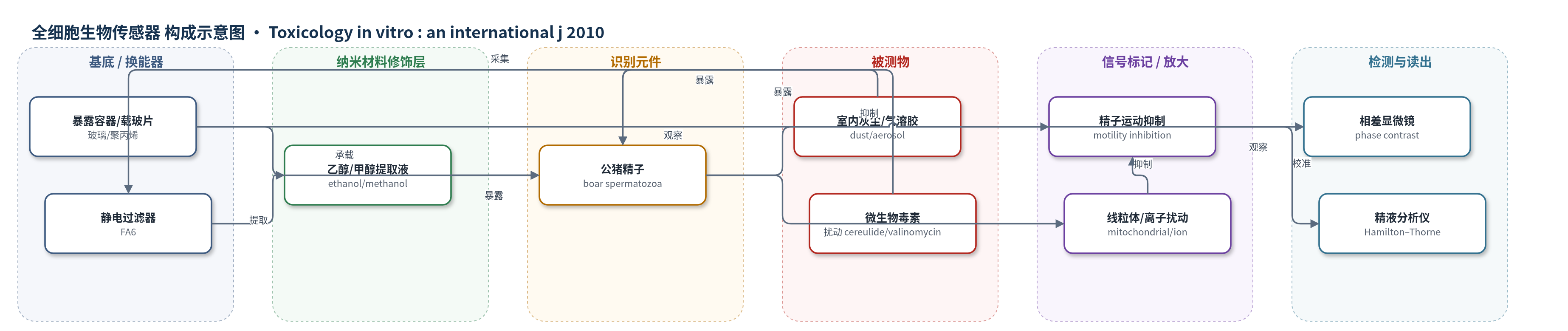
点击图片查看大图 · 依据论文自动绘制
传感器类型
全细胞生物传感器
检测对象
室内灰尘/气溶胶中的有毒物质(toxic substances in indoor dust and aerosols),包括cereulide、amylosin、valinomycin、stephacidin B;样品基质为室内灰尘、气溶胶、乙醇/甲醇提取物及建筑/室内材料。
检测原理
该传感器以公猪精子为全细胞识别与换能元件。室内灰尘或气溶胶经乙醇/甲醇提取后,与精子共同暴露。若样品中含有破坏细胞离子稳态、能量生成或线粒体功能的毒性物质,精子鞭毛摆动和前进运动会下降。暴露30分钟、1天或3–4天后,将样品在37°C预热以激活运动,再用倒置相差显微镜计数运动精子比例。信号随毒性物质浓度升高而增强,以EC50表示使超过50%精子运动受抑制的最低浓度。方法不依赖化学标记或酶放大,而通过延长暴露时间和阳性参考毒物校准提高可靠性;所有接触材料需预测试以避免浸出假阳性。
检测灵敏度
未报告LOD、线性范围、灵敏度斜率、相关系数;原文仅报告EC50(μg/mL)及SD<40%。
效应效果
25个场所中18个有建筑相关健康投诉,11个高毒性气溶胶场所均与已知或疑似健康问题相关;无投诉场所EC50多为20–>50 μg/mL。16个毒性样品培养后11个混合培养物高毒(1天EC50 0.03–6 μg/mL),42个产毒株中11个被鉴定。四种毒素3–4天EC50为0.0002–0.2 μg/mL,SD<40%。流通室valinomycin出口滤膜0.4 μg(100 ng/cm²)、内壁52 μg(14.6 ng/cm²)。11块投诉住宅乙烯基地砖4块释放毒性,2块浸提EC50<5 μg/mL,可识别病态建筑。
传感器的构成
- 指示细胞层:商业公猪精液(boar spermatozoa),约27×10^6 cells/mL,作为对离子稳态和线粒体毒素敏感的识别/响应元件
- 暴露介质:乙醇或甲醇(ethanol/methanol)提取液,溶解并递送室内灰尘/气溶胶中的脂溶性毒性物质
- 样品采集层:静电过滤器(FA6 electrostatic filter)、棉球擦拭、真空吸尘器尘袋/HEPA滤膜及电脑内部擦拭,富集室内气溶胶和灰尘
- 前处理容器:预测试无毒聚丙烯管(polypropene tubes)、玻璃瓶和0.45 μm PTFE滤膜,避免浸出物造成假阳性
- 温度激活层:37°C预热的载玻片、盖玻片、毛细管和显微镜台,使精子恢复运动以便读数
- 光学换能层:40×倒置相差显微镜(inverted phase contrast objective),将精子运动变化转换为可观察/可计数信号
- 校准与质控层:Hamilton–Thorne精液分析仪及阳性参考毒物(valinomycin、3,5-dichlorophenol),用于运动评估校准和毒性验证
中文摘要
本研究在疑似建筑相关健康症状的潮湿受损室内环境及无健康投诉的参考场所中,调查潜在有毒空气物质的存在、数量和来源。作者将公猪精子作为毒性传感器,从幼儿园、学校、办公室和住宅(n=25)通过静电过滤、真空吸尘、擦拭高处表面及电脑内部收集室内气溶胶和灰尘。毒性以灰尘和气溶胶的乙醇或甲醇提取物测定,EC50表示在30分钟、1天或3–4天暴露后,使超过50%精子运动受抑制的最低空气物质浓度。11个场所发现高毒性气溶胶(EC50≤6 μg/mL),均存在已知或疑似建筑相关健康问题。从毒性气溶胶/灰尘子样本中获得毒性微生物培养物,并鉴定出cereulide、amylosin、valinomycin及新室内毒素stephacidin B,同时测定其毒性。利用流通室评估Streptomyces griseus培养物中valinomycin的空气传播,LC–MS和精子运动试验显示14天后主要回收于流通室内表面。
英文摘要
The presence, quantity and origins of potentially toxic airborne substances were searched in moisture damaged indoor environments, where building related ill health symptoms were suspected and reference sites with no health complaints. Boar spermatozoa were used as the toxicity sensor. Indoor aerosols and dusts were collected from kindergartens, schools, offices and residences (n=25) by electrostatic filtering, vacuuming, wiping from elevated surfaces and from the interior of personal computers. Toxicity was measured from the ethanol or methanol extracts of the dusts and aerosols. EC(50) was expressed as the lowest concentration of the airborne substance that inhibited motility of >50% of the exposed sperm cells compared to vehicle control, within 30 min, 1 day or 3-4 days of exposure. Remarkably toxic aerosols (EC(50) <or=6 μg ml(-1)) were found from 11 sites, all of these were sites with known or suspected for building related ill health. Toxic microbial cultures were obtained from subsamples of the toxic aerosols/dusts. From these cereulide, amylosin, valinomycin and a novel indoor toxin, stephacidin B were identified and toxicities measured. Airborn dispersal of valinomycin from Streptomyces griseus cultures was evaluated using a flow-through chamber. Significant amounts of valinomycin (LC-MS assay) and toxicity (boar sperm motility assay) were carried by air and were after 14 days mainly recovered from the interior surfaces of the flow chamber.