组成图示
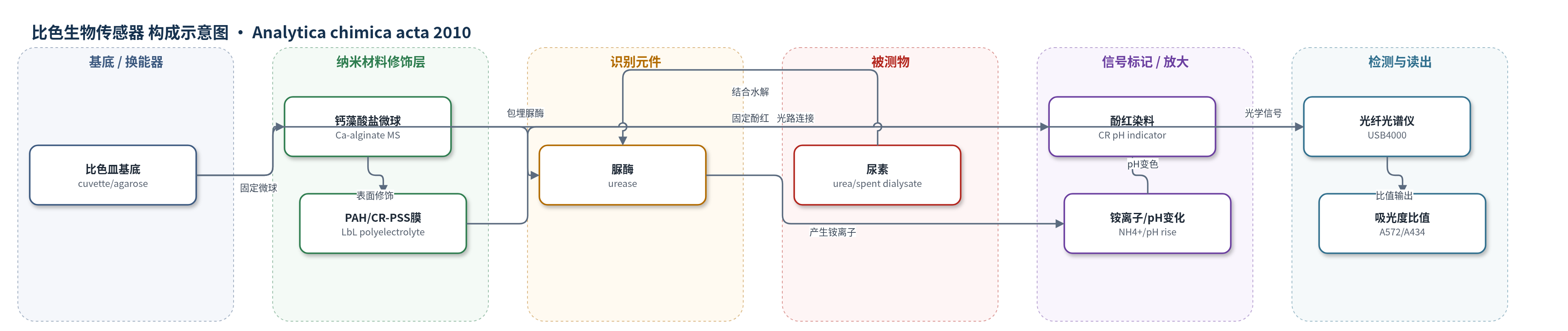
点击图片查看大图 · 依据论文自动绘制
传感器类型
比色生物传感器
检测对象
尿素(urea,DUN);样品基质:废透析液(spent dialysate)
检测原理
废透析液中的尿素进入传感层后,被钙藻酸盐微球内包埋的脲酶催化水解,生成铵离子(NH4+)和碳酸氢根/碳酸根,使微球周围局部 pH 升高。表面 LbL 聚电解质膜中固定的酚红(CR)作为 pH 指示剂,其质子化形式(HR)与去质子化形式(R−)比例随 pH 改变,导致 434 nm 和 572 nm 处吸光度发生相反方向变化。系统采用双波长吸光度比值进行 ratiometric 光学读出,可抵消染料装载不均、光路漂移和仪器误差。尿素浓度越高,酶促反应产生的 pH 上升越大,吸光度比值变化越大;通过 8 min 响应时间内的比值变化或 pH 变化定量尿素。
检测灵敏度
检测范围: 0.1–60 mg dL−1;灵敏度: 0.09 pH units/min;最小可辨变化: 0.005 ratio units;相关方程: y = 1.0008x − 0.1703;r = 0.988
效应效果
传感器在 0.1–60 mg dL−1 尿素范围内可重复,单次流动池连续 4 次测量 RSD 为 2.4%;12 个器件间吸光度比值 RSD 4%、pH RSD 1%。响应时间 8 min,操作稳定性约 40 min,储存 1 个月后脲酶残余活性约 65%。未报告选择性/抗干扰数据。临床废透析液与 Quantichrom 尿素试剂盒参考法比较,相关方程 y=1.0008x−0.1703,r=0.988,t 检验 95% 置信水平无显著差异。作者认为可用于在线监测透析并计算 Kt/V、PRU、TUR、PCRn 等参数。
传感器的构成
- 基底/固定层:塑料比色皿(cuvette)内表面浇铸 0.1% 琼脂糖(agarose)凝胶,固定微球并形成允许尿素透过的传感层
- 微球载体/酶包埋层:低粘度海藻酸钠(sodium alginate)与氯化钙(CaCl2)交联形成钙藻酸盐微球(calcium alginate microspheres),包埋脲酶(urease, EC 3.5.1.5)
- 聚电解质修饰层:聚烯丙基胺盐酸盐(PAH)阳离子层与酚红-聚苯乙烯磺酸钠(CR-PSS)阴离子层经 LbL 自组装形成 PAH/(CR-PSS) 双层
- 识别/催化元件:脲酶(urease),催化尿素水解生成铵离子(NH4+)和碳酸氢根/碳酸根,引起局部 pH 升高
- 信号标记/光学换能元件:酚红(cresol red, CR),pH 指示剂,质子化与去质子化形式分别在 434 和 572 nm 产生吸收变化
- 流动池/样品接触层:琼脂糖凝胶固定层、PTFE 管路与注射泵构成流动池,使废透析液以 0.5 mL/min 流过传感层
- 读出装置:白色 LED 光源、光纤和 USB4000 光纤光谱仪,测量 434/572 nm 吸光度比值
中文摘要
本文报道了一种用于估算血液透析参数的纳米工程光学尿素生物传感器。该传感器以包埋脲酶的钙藻酸盐微球为核心,微球表面通过层-by-layer(LbL)自组装技术沉积主要由酚红(CR)染料组成的聚电解质纳米膜,酚红作为 pH 敏感光学换能元件。作者将微球固定在比色皿内并连接光纤光谱仪,构建流动池,用于测定不同浓度标准尿素溶液的响应。通过监测脲酶水解尿素引起局部 pH 变化以及酚红在 434 和 572 nm 处吸光度比值随时间的变化,可测量废透析液中的尿素浓度,并进一步计算透析器清除率 Kt/V、尿素去除率 PRU 等参数。结果表明,该传感器具有 pH 可逆性,灵敏度为 0.09 pH 单位/min,可检测 0.1–60 mg/dL 范围内 0.005 比值单位的尿素浓度变化,响应时间为 8 min,检测范围覆盖废透析液中的尿素水平。生物样品分析结果与参考方法一致,在 95% 置信水平下无显著差异。
英文摘要
An optical biosensing scheme based on urease encapsulated calcium alginate microspheres which are coated with polyelectrolyte nanofilms predominantly composed of cresol red (CR) dye is demonstrated in this paper. The dye molecules within the nanofilms are deposited via the layer-by-layer (LbL) self-assembly technique on the microspheres and used as the optical transducer. A flow through cell constructed using a cuvette attached to a fiber optic spectrometer was used to determine the response of the biosensor to standard urea solutions of different concentrations. The change in pH and the absorbance ratio was monitored with time and these results were used for measurements of urea concentrations in the spent dialysate fluid. The biological parameters controlling hemodialysis such as dialyzer clearance or Kt/V and percent removed urea (PRU) have also been reported. The results demonstrate that the urea biosensor is pH reversible with a sensitivity of 0.09 pH units/min and is able to detect a change of 0.005 ratio units in urea concentration ranging 0.1-60 mg dL(-1). The response time of the sensor was calculated as 8 min while the detection range of urea covered the levels that are present in the spent dialysate fluid. The results obtained in the analysis of biological samples were in good agreement with those obtained by a reference method, showing no significant differences at a confidence level of 95%.