组成图示
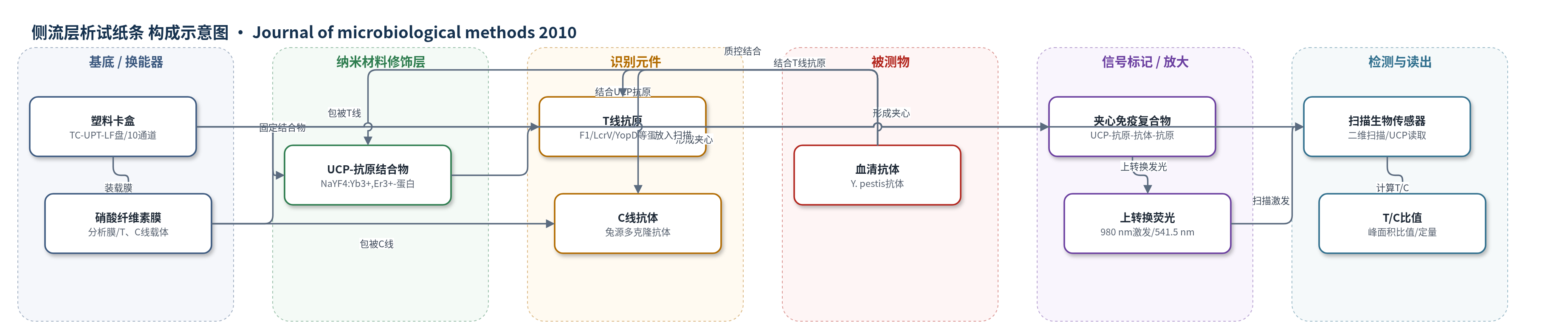
点击图片查看大图 · 依据论文自动绘制
传感器类型
侧流层析试纸条
检测对象
鼠疫耶尔森菌抗体(Yersinia pestis antibodies,包括F1、LcrV、YopD、YPO3827、YPO2131、YPO1089、YPO1303、YPO1435、YPO1613、YPO2118抗体);样品基质:猴血清、人/患者血清。
检测原理
该检测采用双抗原夹心免疫层析与上转换荧光读取。结合垫中的UCP-抗原结合物随样品层析,样品中鼠疫耶尔森菌抗体与UCP-抗原结合,并被硝酸纤维素膜T线上固定的相应抗原捕获,形成UCP-抗原-抗体-抗原夹心复合物;C线抗体捕获抗体用于质控。980 nm红外光激发UCP后,其产生541.5 nm可见上转换荧光,T线荧光峰面积随抗体浓度升高而增大,以T/C峰面积比进行定量。UCP具有窄发射带、抗光漂白和较大反Stokes位移,可提高信噪比和重复分析能力;10通道盘通过排水件同步分配样品,实现一次加样多重检测。
检测灵敏度
检测灵敏度(μg/ml): YPO3827 18.20;YPO2131 7.67;LcrV 0.97;YPO1089 0.41;YPO1303 2.75;YopD 97.11;YPO1435 3.90;YPO1613 30.36;F1 0.37;YPO2118 3.39;R^2: 0.93–0.99。
效应效果
TC-UPT-LF盘在37 °C加速老化下整体稳定10天,平均CV为10.3%;单条试纸条平均CV为11.9%,定量曲线平均CV为7.1%–15.0%。与ELISA相比,其敏感性和定性结果相当;在13份猴血清的130项检测中,以WB确证后TC-UPT-LF准确率为94.6%(123/130),ELISA为91.5%(119/130),差异无统计学意义。51份患者血清中,F1抗体阳性率100%,YopD为86.3%(44/51),LcrV为66.7%(34/51)。作者认为该平台可用于多重抗体检测、多病原筛查和疫苗靶点评价,LcrV与YopD是鼠疫潜在诊断标志物。
传感器的构成
- 塑料卡盒:底座与上盖组成10通道TC-UPT-LF盘,含排水件,使样品同步均匀分配至10条试纸条。
- 层析组件:玻璃纤维(GFCP20300)、滤纸(No.470/No.903)、硝酸纤维素膜(SHF 1350225)和吸水垫,构成样品垫、结合垫、分析膜与吸水垫。
- 信号标记物:上转换荧光纳米颗粒UCP(NaYF4:Yb3+,Er3+,200–300 nm,980 nm激发/541.5 nm发射),共价偶联鼠疫蛋白后固定于结合垫。
- 识别元件(T线):10种鼠疫耶尔森菌蛋白(F1、LcrV、YopD、YPO3827、YPO2131、YPO1089、YPO1303、YPO1435、YPO1613、YPO2118)包被于硝酸纤维素膜,捕获血清中相应抗体。
- 识别元件(C线):与10种蛋白对应的兔源多克隆抗体包被于硝酸纤维素膜,用于质控。
- 样品缓冲液:0.03 M磷酸缓冲液含2% BSA、0.1% SDS、0.1% Triton X-100,pH7.2,用于10倍稀释血清样品。
- 读取换能器:TC-UPT扫描生物传感器,二维扫描系统激发UCP并采集10条T/C荧光峰面积,2 min内完成。
中文摘要
本研究开发了一种基于上转换荧光纳米颗粒(UCP)技术的10通道侧流层析(TC-UPT-LF)检测系统,用于鼠疫耶尔森菌(Yersinia pestis)抗体的多重谱分析。将10种表达的鼠疫蛋白共价偶联到UCP颗粒上,制备双抗原夹心免疫层析试纸条,以检测血清中相应抗体。经逐条优化后,10条试纸条被集成到TC-UPT-LF盘中,实现同一样品中不同抗体的同步检测,并配套开发扫描生物传感器读取结果。该方法使用标准样品和猴血清进行评价,并检测了51份鼠疫患者血清。TC-UPT-LF盘在37 °C下可稳定保存10天,平均变异系数为10.3%;其敏感性和定性结果与ELISA相当,不同抗体检测的线性拟合决定系数R^2为0.93–0.99。除F1抗体外,LcrV和YopD抗体阳性率更高,在猴血清中分别为100%(13/13)和92%(12/13),在患者血清中分别为86.3%(44/51)和66.7%(34/51)。结果表明,TC-UPT-LF可用于多重抗体检测,LcrV和YopD可作为鼠疫潜在诊断标志物。
英文摘要
In this study, a 10-channel up-converting phosphor technology-based lateral flow (TC-UPT-LF) assay was developed to profile antibodies against Yersinia pestis. Ten expressed Y. pestis proteins were covalently conjugated with an up-converting phosphor particle to develop double-antigen sandwich immunochromatographic strips to detect corresponding antibodies. After optimization one by one, each strip was integrated into a TC-UPT-LF disc for simultaneously detection of different antibodies. A scanning biosensor was also developed to acquire the results. The performance of the TC-UPT-LF assay was evaluated by using standard samples and plague monkey serum samples. Fifty-one patient serum samples were detected by the TC-UPT-LF assay. The TC-UPT-LF disc could be stable for 10 days at 37°C with an average CV of 10.3%. Its sensitivity and qualitative results are comparable to those of ELISA. Its linearity fitting coefficient of determination (R2) for different antibody detection is between 0.93 and 0.99. Besides F1 antibody, the LcrV and YopD antibodies also showed higher positive ratio than the other seven antibodies, as 100% (13/13) and 92% (12/13) in monkey sera and 86.3% (44/51) and 66.7% (34/51) in patient sera, respectively. It is suggested that the TC-UPT-LF assay has been successfully developed for multi-detection and LcrV and YopD can be the potential diagnostic markers of the plague.