组成图示
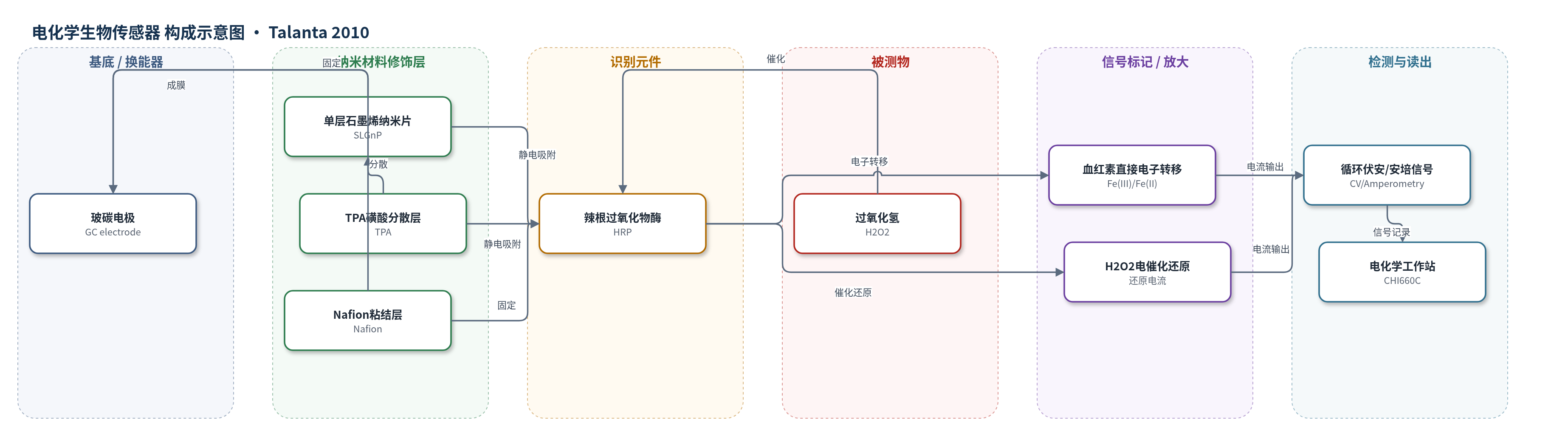
点击图片查看大图 · 依据论文自动绘制
传感器类型
电化学生物传感器
检测对象
过氧化氢(hydrogen peroxide, H2O2);样品基质:磷酸盐缓冲液(PBS, pH 7.4)
检测原理
传感器以玻碳电极为基底,SLGnP–TPA复合膜作为导电修饰层。TPA磺酸基使SLGnP带负电,pH 5.0下HRP带正电,二者静电复合,使酶保持天然结构并靠近电极。SLGnP作为电子导线缩短HRP血红素Fe中心与电极距离,实现Fe(III)/Fe(II)直接电子转移,峰电位差约38 mV。加入H2O2后,HRP催化其还原,电子经SLGnP传递至GC,产生还原电流;电流随H2O2浓度增加而线性增大,高浓度下因酶失活出现平台并下降。
检测灵敏度
LOD: 1.05 × 10⁻⁷ M(S/N=3);线性范围: 6.3 × 10⁻⁷–1.68 × 10⁻⁵ M;灵敏度斜率: 0.0212 μA/μM;R^2 = 0.996
效应效果
该传感器响应快速,加入H2O2后<1 s达到稳态电流的95%。4 ℃保存10 d后仍保持约92%初始灵敏度;在2.1 μM H2O2下重现性RSD为4.48%(n=8)。抗干扰方面,在含10.5 μM H2O2的pH 7.4缓冲液中,加入20倍于H2O2浓度的抗坏血酸仅产生可忽略的额外安培信号。其LOD低于HRP–黏土–壳聚糖–金纳米粒(9×10⁻⁶ M)和HRP–甲苯胺蓝–多壁碳纳米管(1.7×10⁻⁶ M)体系;表观Michaelis–Menten常数11.02 μM,低于HRP–SG–CNT的1350 μM,表明对H2O2亲和力更高。作者认为该体系可推广至葡萄糖氧化酶、过氧化氢酶和黄嘌呤氧化酶等,为无中介体生物传感器提供新途径。
传感器的构成
- 基底/换能器电极:玻碳电极(GC electrode),经抛光清洗,提供电子转移界面
- 纳米材料修饰层:单层石墨烯纳米片–四钠1,3,6,8-芘四磺酸(SLGnP–TPA)复合膜,提供导电通道、生物相容微环境并缩短电子转移距离
- 识别/催化元件:辣根过氧化物酶(HRP),通过静电作用与SLGnP–TPA复合,催化H2O2还原并实现血红素直接电子转移
- 粘结/封闭层:Nafion(0.1%),滴加于复合膜表面,作为粘结剂固定膜层
中文摘要
本文报道了一种基于直接电化学的过氧化氢生物传感器。该传感器以单层石墨烯纳米片(SLGnP)为导电与生物相容性修饰材料,利用四钠1,3,6,8-芘四磺酸(TPA)分散石墨形成SLGnP–TPA,并与辣根过氧化物酶(HRP)静电复合成膜,再用Nafion固定于玻碳电极。循环伏安显示复合膜出现HRP血红素Fe(III)/Fe(II)可逆氧化还原峰,表明SLGnP显著促进酶与电极间的直接电子转移。电化学阻抗谱和扫描电镜证实石墨烯与酶之间存在静电相互作用,紫外可见光谱表明酶保持天然二级结构。与多层石墨烯相比,单层石墨烯具有更小的峰电位差和更快电子转移速率。复合膜对H2O2的电催化还原表现出灵敏、快速的电流响应,具有发展第三代无中介体生物传感器的潜力。
英文摘要
A novel electrochemical sensing system for direct electrochemistry-based hydrogen peroxide biosensor was developed that relied on the virtues of excellent biocompatibility, conductivity and high sensitivity to the local perturbations of single-layer graphene nanoplatelet (SLGnP). To demonstrate the concept, the horseradish peroxidase (HRP) enzyme was selected as a model to form the SLGnP-TPA (tetrasodium 1,3,6,8-pyrenetetrasulfonic acid)-HRP composite film. The single-layer graphene composite film displayed a pair of well-defined and good reversible cyclic voltammetric peak for Fe(III)/Fe(II) redox couple of HRP, reflecting the enhancement for the direct electron transfer between the enzyme and the electrode surface. Analysis using electrochemical impedance spectroscopy (EIS) revealed that electrostatic attractions existed between graphene monolayers and enzyme molecules. The intimate graphene and enzyme interaction was also observed using scanning electron microscopy (SEM), which resulted in the special properties of the composite film. Ultraviolet visible spectroscopy (UV-vis) indicated the enzyme in the composite film retained its secondary structure similar to the native state. The composite film demonstrated excellent electrochemical responses for the electrocatalytic reduction of hydrogen peroxide (H(2)O(2)), thus suggesting its great potential applications in direct electrochemistry-based biosensors.