组成图示
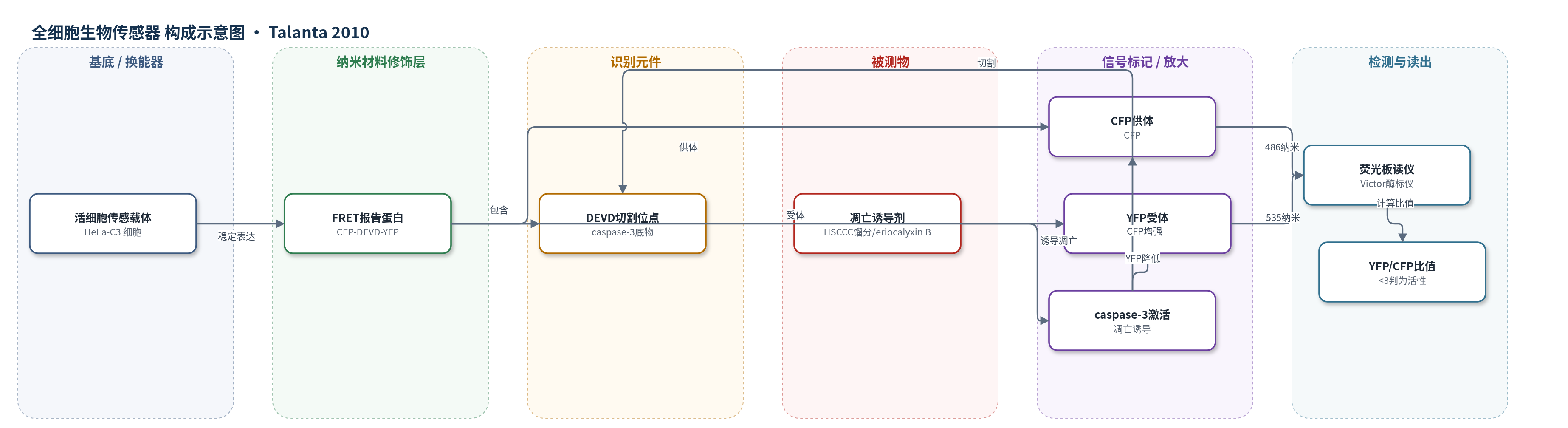
点击图片查看大图 · 依据论文自动绘制
传感器类型
全细胞生物传感器
检测对象
凋亡/caspase-3 激活(apoptosis/caspase-3 activation);实际应用被测物为凋亡诱导剂(apoptosis inducer,主要为 eriocalyxin B);样品基质为 Isodon eriocalyx 粗提物的 HSCCC 分离馏分/子馏分,溶于 DMSO 后加入 HeLa-C3 细胞培养基
检测原理
HeLa-C3 细胞稳定表达 CFP-DEVD-YFP FRET 报告蛋白。未发生凋亡时,caspase-3 未激活,CFP 与 YFP 保持接近,激发 CFP 后能量通过 FRET 转移至 YFP,YFP 发射较强。当凋亡诱导剂进入细胞并诱导凋亡时,caspase-3 被激活并切割 DEVD 肽,使 CFP 与 YFP 分离,FRET 效率下降,YFP 发射降低而 CFP 发射升高,YFP/CFP 发射比值下降。比值低于 3 判定为凋亡诱导剂。被测物浓度越高或促凋亡活性越强,caspase-3 激活越充分,比值下降越快、越低。细胞内凋亡级联反应使 caspase-3 持续激活,对荧光信号变化产生放大效应。
检测灵敏度
未报告 LOD、线性范围、灵敏度斜率、相关系数;活性判定阈值:YFP/CFP emission ratio < 3;测试浓度:10 μg/ml、5 μg/ml;阳性对照:500 nM taxol
效应效果
该平台将 HSCCC 分馏与 caspase-3 荧光生物传感器联用,实现中药活性成分快速筛选。首次分离回收率达 95%,分析型 HSCCC 子馏分回收率约 90%,且无需固体固定相,减少样品吸附和失活。水溶性部分 23 个馏分在 10 μg/mL 下无凋亡活性,说明活性成分非水溶性。12 个子馏分中,24.3–24.5、24.7、24.8 在 10 μg/mL 下 YFP/CFP<3;5 μg/mL 下仅 24.4 和 24.5 仍活性,且 30 h 内比值低于 3,强于 500 nM taxol(比值约 5)。最终鉴定为 eriocalyxin B,作者认为该平台适用于中药抗癌活性成分高通量发现。
传感器的构成
- 传感载体:HeLa-C3 活细胞,稳定表达 FRET 报告蛋白,作为全细胞传感基底
- 报告蛋白修饰层:CFP-DEVD-YFP 融合蛋白,由 CFP、DEVD 肽和 YFP 组成,介导 FRET 荧光信号
- 识别元件:细胞内 caspase-3 与 DEVD 切割位点,caspase-3 响应凋亡并切割 DEVD 肽
- 信号标记物:CFP 供体与 YFP 受体,切割后 FRET 消失导致 YFP/CFP 比值下降
- 样品基质:MEM 培养基含 10% FBS、青霉素、链霉素,维持细胞存活与凋亡检测
- 对照体系:0.1% DMSO 阴性对照、500 nM taxol 阳性对照,用于判定凋亡活性
中文摘要
分析型高速逆流色谱(HSCCC)是一种液-液分离技术,可快速、高效、高回收地分馏中药活性成分。本文建立了一种基于荧光共振能量转移(FRET)的 caspase-3 生物传感器高通量筛选方法,用于选择性检测活细胞凋亡,并证明其对多种已知抗癌药诱导的凋亡具有较高敏感性。将该生物传感器与分析型 HSCCC 首次结合,形成药物发现平台,用于快速鉴定中药毛叶香茶菜(Isodon eriocalyx)中最强凋亡诱导成分。分离采用正己烷/乙酸乙酯/甲醇/水双相溶剂体系,先以 3:5:3:5 检查水溶性部分,再以 1:1:1:1 分离目标化合物。在凋亡检测指导下,活性馏分经 HSCCC 连续追踪和纯化;使用 16 mL 微型线圈柱、少于 50 mL 双相溶剂和约 50 mg 活性馏分,最终鉴定出最强凋亡诱导剂 eriocalyxin B。
英文摘要
Analytical high-speed counter-current chromatography (HSCCC), a unique liquid-to-liquid separation technology, has an inherent capability to provide perfect fractionation for tracking active ingredients of medicinal herbs, in a quick, efficient, and high-recovery manner. A high throughput screening (HTS) method which utilizes a novel biosensor that selectively detects apoptosis based on the fluorescence resonance energy transfer (FRET) technique, was newly established and proved to be very sensitive in detecting apoptosis induced by various known anticancer drugs. The first combination of both advanced techniques formed an efficient platform for drug discovery and succeeded in quickly identifying the most potent apoptotic constituent of a Chinese herb namely Isodon eriocalyx. The system of n-hexane/ethyl acetate/methanol/water was used as the separation solvent. The solvent ratio was first set at 3:5:3:5 to check the water-soluble part of the crude extract, and then 1:1:1:1 was used to isolate the target compounds. The active fraction was tracked and purified continuously using HSCCC which was guided by the apoptosis detection at gradually decreased drug concentrations. As a result, the most potent apoptosis inducer in this herb was discovered by analytical HSCCC equipped with a 16 ml mini-coil column, using less than 50 ml diphase solvent, from about 50mg active fraction. It was identified as eriocalyxin B, a well-known antitumor natural product, by NMR analysis of the HSCCC purified fraction.