组成图示
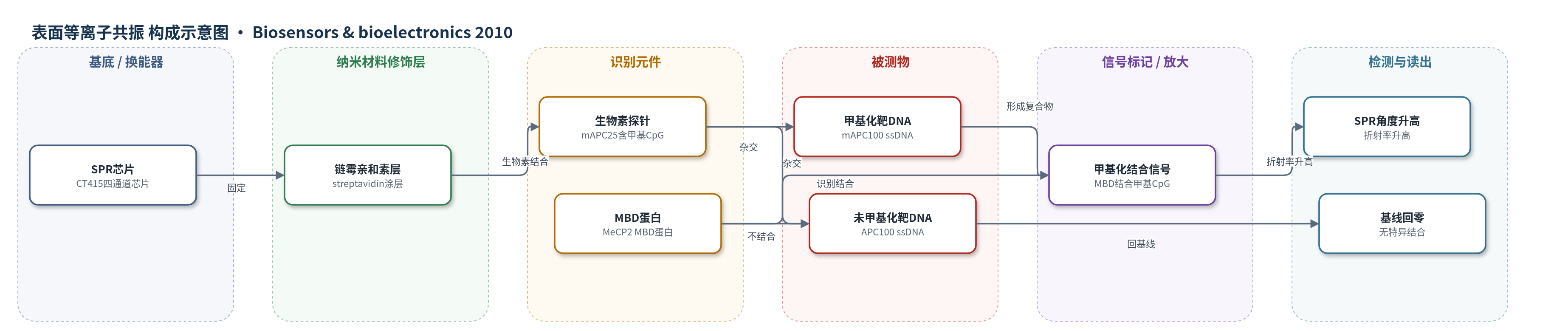
点击图片查看大图 · 依据论文自动绘制
传感器类型
表面等离子共振(SPR)生物传感器
检测对象
甲基化APC启动子1A DNA(methylated APC promoter 1A DNA, mAPC100)、未甲基化APC启动子1A DNA(APC100);样品基质为合成DNA溶液(非基因组DNA)
检测原理
该传感器采用无标记SPR双重识别机制。首先,5'-生物素标记的mAPC25探针通过生物素-链霉亲和素作用固定在SPR芯片表面;随后,变性后的单链靶DNA mAPC100注入通道,与探针互补杂交,形成含对称甲基化CpG位点的杂交复合物。接着,重组MBD蛋白流经表面,特异性识别并结合对称甲基化CpG位点。MBD结合使芯片界面质量与折射率升高,导致SPR共振角度变化;未甲基化DNA因不能被MBD结合,在洗脱后信号回基线。信号大小取决于甲基化靶DNA与MBD的结合量,无需酶促或核酸放大。
检测灵敏度
未报告LOD、线性范围、灵敏度斜率和相关系数;原文报告:仪器最小检测限1 pg/mm2;5 pmol甲基化APC启动子DNA可被检测
效应效果
选择性方面,重组MBD蛋白仅与甲基化poly(mCGA)结合,SPR角度增加75 m°,而与未甲基化poly(CGA)及BSA均无结合;在双重识别实验中,等量mAPC100和APC100均可被探针捕获,加入MBD后甲基化样品曲线快速上升,洗脱后仍比注入前高60 m°,未甲基化样品仅轻微上升并回基线。重复4次,最终SPR角度上升均值56.4 m°,标准差14.1 m°。方法可在1 h内自动完成,避免亚硫酸氢盐处理和甲基化敏感限制消化;与Maki纳米线法相比,杂交在芯片上完成,且MBD可识别对称甲基化CpG位点,有利于定位甲基化位点。未报告实际样品回收率、长期稳定性和与ELISA/qPCR的对比。
传感器的构成
- SPR换能芯片:CT415四通道SPR芯片,提供表面等离子共振检测界面,角度分辨率<0.5 m°,最小检测限1 pg/mm2
- 亲和固定层:链霉亲和素(streptavidin)涂层,用于固定生物素标记寡核苷酸探针
- 序列识别探针:5'-生物素标记25 nt寡核苷酸mAPC25,含4个甲基化CpG位点,捕获互补靶DNA
- 甲基化识别蛋白:重组MeCP2 MBD蛋白,大肠杆菌表达并经Ni亲和层析纯化,特异性结合对称甲基化CpG
- 反应缓冲体系:HBS-EP(10 mM HEPES、150 mM NaCl、3 mM EDTA、0.005% P20)、3×SSPE/PEG 6000杂交缓冲、MBD缓冲(20 mM HEPES、5%甘油、0.1% Triton X-100、0.1 M NaCl),维持反应并洗脱非特异结合
- 信号换能:无标记SPR光学检测,MBD结合使界面折射率升高,产生SPR角度变化
- 芯片再生:1 mM HCl处理1 min,去除结合物并恢复芯片表面
中文摘要
DNA甲基化在维持细胞功能中起重要作用,多种人类疾病尤其是癌症与异常DNA甲基化相关,但现有甲基化检测方法复杂且耗时。本研究以肿瘤抑制基因腺瘤性息肉病基因(APC)启动子作为靶DNA序列,利用寡核苷酸探针杂交与特异性蛋白结合实现双重识别。首先,互补靶DNA被固定在表面等离子共振(SPR)芯片上的探针捕获;随后,重组甲基-CpG结合域(MBD)蛋白流经芯片表面,识别并结合甲基化CpG位点。结合事件引起界面折射率升高,从而产生可检测的光学信号。该方法可检测5 pmol甲基化APC启动子DNA,整个检测可在1 h内完成。这是首个基于SPR的DNA甲基化检测技术,具有简单、特异、快速的特点,避免了亚硫酸氢盐处理和甲基化敏感限制性消化,有助于提高DNA甲基化检测能力并促进对基因调控和疾病机制的理解。
英文摘要
DNA methylation plays an essential role in maintenance of cellular function. A growing number of human diseases have been found to be associated with aberrant DNA methylation, especially cancer. However, current technologies used in DNA methylation detection are complicated and time consuming. A promotor of the Adenomatous polyposis coli (APC) gene, a well-studied tumor suppressor gene, was used as the detection target DNA sequence. The double recognition mechanism was realized with oligonucleotide probe hybridization and specific protein binding. First, complementary target DNA was captured by the probe immobilized onto a surface plasmon resonance (SPR) sensor chip. Then, the recombinant methyl-CpG binding domain (MBD) protein was passed over the surface to recognize and bind to methylated CpG sites. Binding resulted in an increase in the refractive index, and a detectable optical signal was generated. Five picomoles of methylated APC promotor DNA could be easily detected with this method. The entire detection could be completed within 1h. This work represents the first SPR based biosensor technology, which achieves simple and specific DNA methylation detection and avoids complicated bisulfite treatment and methylation-sensitive restriction digestion. It will improve our ability to detect DNA methylation specifically and rapidly, and promote our understanding of the role of DNA methylation in gene regulation and diseases.