组成图示
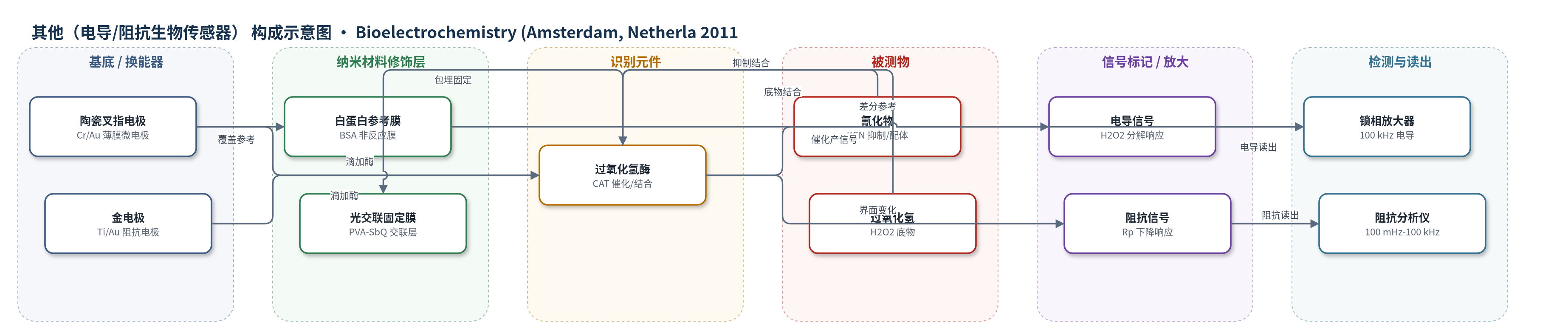
点击图片查看大图 · 依据论文自动绘制
传感器类型
其他(电导/阻抗生物传感器)
检测对象
氰化物(cyanide, KCN)、过氧化氢(hydrogen peroxide, H2O2);样品基质:磷酸盐缓冲液(PBS)/5 mM 磷酸盐缓冲液
检测原理
CAT 固定于 PVA-SbQ 光交联膜中,作为识别与催化元件。H2O2 扩散进入膜后被 CAT 催化分解为水和氧气,改变电极表面离子迁移与电导;差分叉指电极在 100 kHz 交流场下测得电导随 H2O2 浓度升高而增加,初始电导变化率与 H2O2 消耗速率成正比,遵循 Michaelis–Menten 动力学。氰化物与 CAT 非竞争性结合,改变酶构象和界面电荷分布,使界面极化电阻 Rp 下降;在 4–50 μM 范围内 Rp 下降量与 KCN 浓度线性相关。阻抗法无需外源标记和底物,通过拟合 Randles 等效电路读出信号。
检测灵敏度
H2O2(电导): LOD: 6 μM;线性范围: 0–100 mM;斜率: 1.00±0.08 μS/mM;r=0.9992。氰化物(电导): LOD: 6 μM;线性范围: 0–50 μM;斜率: −0.47±0.15 μS/μM;r=0.9879。氰化物(阻抗): LOD: 4 μM;线性范围: 4–50 μM;斜率: 0.037±0.007 kΩ/μM;r=0.9813。
效应效果
电导传感器对 H2O2 的线性范围(0–100 mM)宽于此前报道的 CAT 电化学传感器,线性域内变异系数 0.5%–1.6%,重现性良好;H2O2 检出限 6 μM,略高于文献值。用于氰化物检测时,响应在 0–50 μM 内线性下降,变异系数 0.4%–1.5%;与基于细胞色素氧化酶、辣根过氧化物酶或酪氨酸酶的安培型氰化物传感器相比,检出限 6 μM 优于已报道 CAT 抑制传感器(LOD 57 μM,线性范围 0.19–7.7 mM)。阻抗法无标记、无底物,I50 为 24.3 μM,与电导法 24.9 μM 一致,显示两种方法互补,可用于氰化物定量分析。
传感器的构成
- 基底/换能器电极:陶瓷基底上 Cr(50 nm)/Au(150 nm) 叉指薄膜微电极,用于电导差分测量;SiO2/Si 基底上 Ti(30 nm)/Au(300 nm) 金电极,用于阻抗测量
- 参考电极修饰层:BSA 非反应膜覆盖参考叉指电极,提供差分参考并封闭非特异位点
- 识别/催化元件:牛肝过氧化氢酶 CAT(4% m/v)与 BSA、甘油混合液滴加于工作电极,催化 H2O2 分解并作为氰化物结合位点
- 固定/封闭膜:含光聚合苯乙烯吡啶鎓基团的聚乙烯醇 PVA-SbQ(10% m/v)覆盖,365 nm 紫外光交联 20 min,固定 CAT 并形成生物膜
- 信号标记物:无外源标记,H2O2 分解改变电导,氰化物结合改变界面阻抗
- 介质/氧化还原探针:磷酸盐缓冲液 PBS 或 5 mM 磷酸盐缓冲液提供离子环境;CV 表征使用 K3Fe(CN)6/K4Fe(CN)6 探针
- 读出装置:锁相放大器(100 kHz)读取电导,Voltalab 80 阻抗分析仪读取阻抗
中文摘要
本研究通过光交联聚乙烯醇(PVA)膜将牛肝过氧化氢酶(CAT)固定于电导换能器表面,构建了一种新型生物传感器,用于研究 CAT–H2O2 反应动力学及氰化物抑制。固定 CAT 在低 H2O2 浓度(<100 mM)下呈 Michaelis–Menten 行为,表观米氏常数 KMapp=84±3 mM,最大初始速率 VMapp=13.4 μS min−1。氰化物对 CAT 的抑制为非竞争性,抑制结合常数 Ki=13.9±0.3 μM。电导响应随氰化物浓度升高而线性下降,至 50 μM,氰化物检测限为 6 μM。同时采用循环伏安法和阻抗谱研究 CAT/PVA 生物膜及其与氰化物相互作用。生物膜修饰使金电极界面极化电阻 Rp 显著增加;氰化物结合使 Rp 下降,且在 4–50 μM 范围内与 KCN 浓度成正比。无标记、无底物的阻抗法所得 I50 为 24.3 μM,与底物依赖电导生物传感器所得 24.9 μM 一致。
英文摘要
In this work, a new biosensor was prepared through immobilization of bovine liver catalase in a photoreticulated poly (vinyl alcohol) membrane at the surface of a conductometric transducer. This biosensor was used to study the kinetics of catalase-H(2)0(2) reaction and its inhibition by cyanide. Immobilized catalase exhibited a Michaelis-Menten behaviour at low H(2)0(2) concentrations (<100mM) with apparent constant K(M)(app)=84±3mM and maximal initial velocity V(M)(app)=13.4μS min(-1). Inhibition by cyanide was found to be non-competitive and inhibition binding constant K(i) was 13.9±0.3μM. The decrease of the biosensor response by increasing cyanide concentration was linear up to 50μM, with a cyanide detection limit of 6μM. In parallel, electrochemical characteristics of the catalase/PVA biomembrane and its interaction with cyanide were studied by cyclic voltammetry and impedance spectroscopy. Addition of the biomembrane onto the gold electrodes induced a significant increase of the interfacial polarization resistance R(P). On the contrary, cyanide binding resulted in a decrease of Rp proportional to KCN concentration in the 4 to 50μM range. Inhibition coefficient I(50) calculated by this powerful label-free and substrate-free technique (24.3μM) was in good agreement with that determined from the substrate-dependent conductometric biosensor (24.9μM).