组成图示
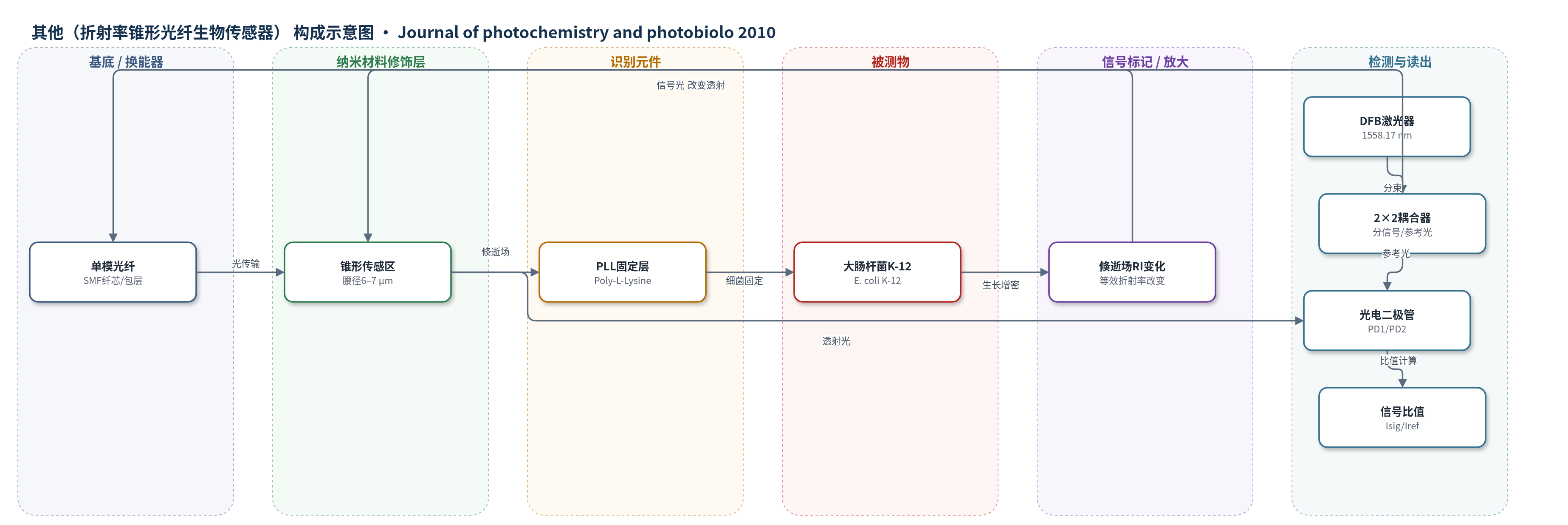
点击图片查看大图 · 依据论文自动绘制
传感器类型
其他(折射率锥形光纤生物传感器)
检测对象
大肠杆菌K-12(Escherichia coli K-12, E. coli K-12)生长/表面密度;样品基质:PBS-A、酵母提取物和葡萄糖组成的非染色水相培养基
检测原理
该传感器以单模光纤锥形区为换能器。1558.17 nm DFB激光经2×2耦合器注入光纤,锥形处芯模V数小于1,光场扩展至包层并增强倏逝场。PLL涂覆层通过静电作用固定大肠杆菌;细菌在表面生长使平均表面密度升高,细胞壁(nw≈1.42)和原生质(np≈1.355)相对于水溶液(nsol≈1.33)改变锥形区等效折射率。折射率变化改变倏逝场穿透深度、模式耦合和光损耗,使透射光强下降。光电二极管分别测量信号光Isig和参考光Iref,计算S=Isig/Iref。指数生长期ln(I/I0)=bλt,斜率与比生长速率成正比,从而实时反映细菌浓度变化。
检测灵敏度
LOD: 60 E. coli mm^-2(detection limit of 10 bacteria;dry-mass loading 17 × 10^-12 g mm^-2);背景斜率: 0.10 h^-1;传感器响应斜率 bl: -0.17 ± 0.01 h^-1;菌落计数比生长速率: 0.33 ± 0.02 h^-1;b: -0.5
效应效果
在室温1.6 h内,锥形光纤传感器测得大肠杆菌比生长速率相关斜率为-0.17±0.01 h^-1,菌落计数法为0.33±0.02 h^-1,二者趋势一致,说明透射光强下降可反映细菌表面密度增加。传感器检出限为60 E. coli mm^-2,相当于锥形表面约10个细菌或17×10^-12 g mm^-2干质量负载。对照实验显示1558.17 nm、50 μW激光照射4 h对细菌存活无显著影响。作者认为该方法具有体积小、实时、无标记、样品量小(700–800 μL)等优点,可替代或补充平板计数、光密度和干重法,用于食品工业中细菌污染的快速分析。
传感器的构成
- 基底/换能器:单模光纤(SMF),Ge掺杂二氧化硅纤芯与纯二氧化硅包层,传输1558.17 nm光并产生倏逝场
- 锥形传感区:热拉锥形光纤(tapered fiber),腰径6–7 μm、腰长3 mm,增强倏逝场并与外部介质相互作用
- 固定/识别层:聚-L-赖氨酸(Poly-L-Lysine, PLL),0.1%溶液涂覆,带正电氨基通过离子键固定负电细菌
- 被测生物体:大肠杆菌K-12(Escherichia coli K-12, E. coli K-12),在PBS-A、酵母提取物和葡萄糖培养基中生长
- 样品池:厚有机玻璃(Plexiglass)微反应器,体积700–800 μL,容纳培养液并固定锥形光纤
- 光源:1558.17 nm分布式反馈激光器(DFB laser, Anritsu D54035),输出50 μW,提供探测光
- 光路元件:双级隔离器与2×2耦合器,隔离反向光并将激光分为信号光和参考光
- 检测读出:两个相同光电二极管(PD1/PD2)、A/D转换器与LabVIEW软件,测量Isig/Iref信号
中文摘要
本研究报道一种单模锥形光纤折射率生物传感器,用于水相中大肠杆菌K-12生长的实时监测。锥形光纤通过CO2激光热拉法制备,腰径为6–7 μm,腰长为3 mm。利用聚-L-赖氨酸(Poly-L-Lysine, PLL)将细菌固定于锥形表面;在适宜培养条件下,细菌在锥形表面增殖使平均表面密度升高,进而改变锥形区的等效折射率。细菌吸附与生长引起锥形光纤倏逝场和光传输特性变化,表现为透射光强改变。实验采用1558.17 nm分布式反馈(DFB)激光器作为光源,通过监测透射光强随时间变化,在室温下获得细菌比生长速率,并与菌落计数法结果进行比较。结果表明,透射光强下降与细菌表面浓度增加相关。该无标记、实时、小体积方法有望用于食品和环境样品中细菌污染的快速分析。
英文摘要
A single-mode tapered fiber optic biosensor was utilized for real-time monitoring of the Escherichia coli (E. coli K-12) growth in an aqueous medium. The applied fiber tapers were fabricated using heat-pulling method with waist diameter and length of 6-7μm and 3mm, respectively. The bacteria were immobilized on the tapered surface using Poly-l-Lysine. By providing the proper condition, bacterial population growth on the tapered surface increases the average surface density of the cells and consequently the refractive index (RI) of the tapered region would increase. The adsorption of the cells on the tapered fiber leads to changes in the optical characteristics of the taper. This affects the evanescent field leading to changes in optical throughput. The bacterial growth rate was monitored at room temperature by transmission of a 1558.17nm distributed feedback (DFB) laser through the tapered fiber. At the same condition, after determining the growth rate of E. coli by means of colony counting method, we compared the results with that obtained from the fiber sensor measurements. This novel sensing method, promises new application such as rapid analysis of the presence of bacteria.