组成图示
点击图片查看大图 · 依据论文自动绘制
传感器类型
综述或非传感器论文
检测对象
假单胞菌铜蓝蛋白(Pseudomonas aeruginosa azurin, AZ);样品基质:4.4 mM 磷酸钾缓冲液(KPB,pH 7.0,I=10 mM)
检测原理
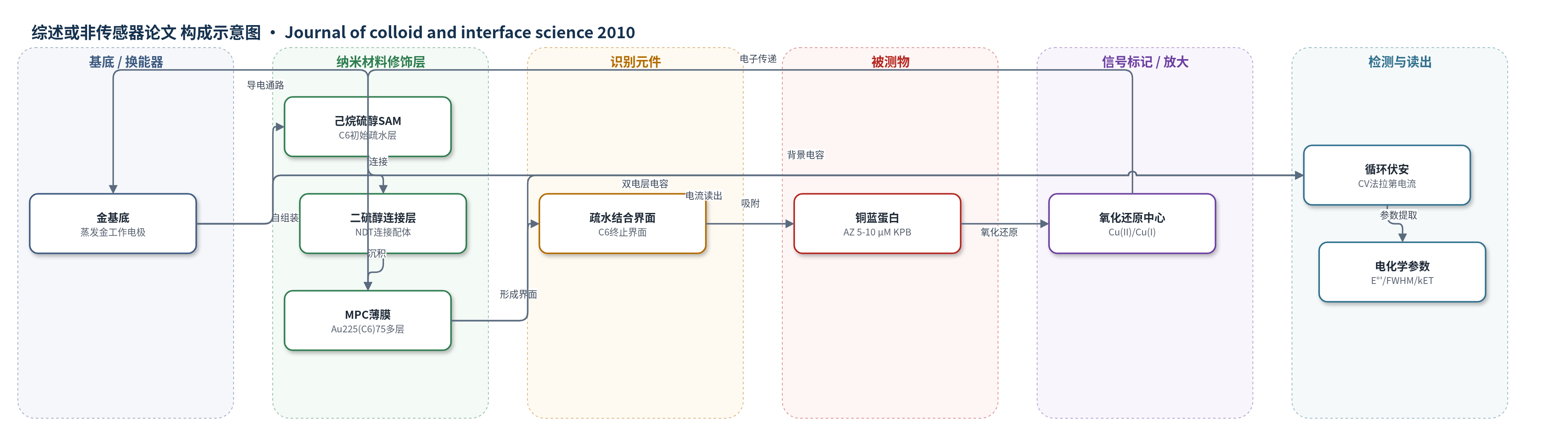
AZ 通过疏水作用吸附于 C6 终止的 SAM 或 MPC 薄膜表面,形成近单层氧化还原蛋白。AZ 分子中的铜中心可在 Cu(II)/Cu(I) 之间可逆电子转移;在循环伏安扫描中,电子经 C6 配体、MPC 金核/金电极或 SAM 金电极传递,产生法拉第电流峰。峰面积积分并按 Q=nFAΓ 计算表面覆盖度 Γ;峰宽 FWHM 反映吸附位点均一性,理想均一单层约 90 mV。形式电位 E°' 和电子转移速率常数 kET 由不同扫速下峰分裂按 Laviron 模型获得。MPC 薄膜通过掩蔽金基底台阶、沟槽等形貌缺陷,减少 SAM 缺陷导致的异质吸附,使 AZ 伏安峰更窄、参数更稳定。该体系未使用 HCR、RCA 或酶催化沉积等信号放大策略。
检测灵敏度
原文未报告 LOD、线性范围、灵敏度斜率或相关系数。
效应效果
与 SAM 相比,MPC 薄膜显著改善 AZ 伏安峰形:MPC 体系 FWHM 多为 100–110 mV,部分接近理想 90 mV;SAM 短链约 120–130 mV,C16 SAM 为 152±6.7 mV。表面覆盖度方面,SAM 平均 11.1±3.0 pmol/cm²,MPC 平均 7.5±1.5 pmol/cm²,均接近单层且对膜厚依赖较小。形式电位约 +0.045 V vs Ag/AgCl,随膜厚变化很小。系统乙醇脱附(5%–30% v/v)显示,SAM 上 AZ 随弱结合组分去除出现 E°' 负移约 15 mV、FWHM 下降和 kET 增加,提示异质吸附;MPC 上 FWHM 与 kET(约 5–10 s⁻¹)基本不变,E°' 无明显负移。AFM 显示 MPC 均匀覆盖金/云母并掩蔽台阶与沟槽。作者认为 MPC 薄膜可提升 PME 界面控制,有利于生物电子转移研究和生物传感器开发。
传感器的构成
- 基底/工作电极:蒸发金(Au)基底,几何面积 0.32 cm²,提供电子转导界面。
- 初始自组装单分子层:己烷硫醇(C6)SAM,修饰金表面并提供疏水结合位点。
- 连接配体层:1,9-壬二硫醇(NDT),通过双硫醇锚定并连接 MPC 形成网络薄膜。
- 纳米材料修饰层:己烷硫醇保护单分子层保护团簇(C6 MPC,平均 Au225(C6)75)多层薄膜,掩蔽金形貌并提供均一吸附界面。
- 吸附蛋白:假单胞菌铜蓝蛋白(AZ),经疏水作用吸附于 C6 终止界面,作为氧化还原蛋白。
- 电解液:4.4 mM 磷酸钾缓冲液(KPB,pH 7.0,I=10 mM),提供离子导电环境。
- 电化学池/电极:Ag/AgCl 参比电极与 Pt 对电极,配合恒电位仪进行循环伏安读出。
中文摘要
本文研究假单胞菌铜蓝蛋白(azurin, AZ)在单分子层保护团簇(monolayer-protected clusters, MPC)薄膜修饰电极上的蛋白单层电化学(PME)热力学与吸附性质,评估此类纳米颗粒薄膜是否比传统自组装单分子层(SAM)修饰电极提供更均一的蛋白吸附界面。作者以电化学方法考察表面覆盖度、形式电位、伏安峰宽和电子转移动力学随膜厚的变化。结果表明,二硫醇连接的 Au225(C6)75 MPC 薄膜为 AZ 提供了更均匀的结合界面,循环伏安峰宽小于 110 mV,而 SAM 体系通常大于 120–130 mV。原子力显微镜显示 MPC 薄膜能均匀覆盖金基底形貌;系统脱附实验进一步表明 MPC 薄膜上吸附的 AZ 群体更均一。这些结果说明 MPC 薄膜组装体可用于 PME,以在分子水平上更好地控制蛋白吸附界面,对研究生物电子转移过程及推进生物传感器技术具有潜在应用价值。
英文摘要
Thermodynamic and adsorption properties of protein monolayer electrochemistry (PME) are examined for Pseudomonas aeruginosa azurin (AZ) immobilized at an electrode modified with a networked film of monolayer-protected clusters (MPCs) to assess if nanoparticle films of this nature offer a more homogeneous adsorption interface compared to traditional self-assembled monolayer (SAM) modified electrodes. Specifically, electrochemistry is used to assess properties of surface coverage, formal potential, peak broadening, and electron transfer (ET) kinetics as a function of film thickness. The modification of a surface with dithiol-linked films of MPCs (Au(225)C6(75)) provides a more uniform binding interface for AZ that results in voltammetry with less peak broadening (<110mV) compared to SAMs (>120-130mV). Improved homogeneity of the MPC interface for protein adsorption is confirmed by atomic force microscopy imaging that shows uniform coverage of the gold substrate topography and by electrochemical analysis of film properties during systematic desorption of AZ, which indicates a more homogeneous population of adsorbed protein at MPC films. These results suggest MPC film assemblies may be used in PME to provide greater molecular level control of the protein adsorption interface, a development with applications for strategies to study biological ET processes as well as the advancement of biosensor technologies.