组成图示
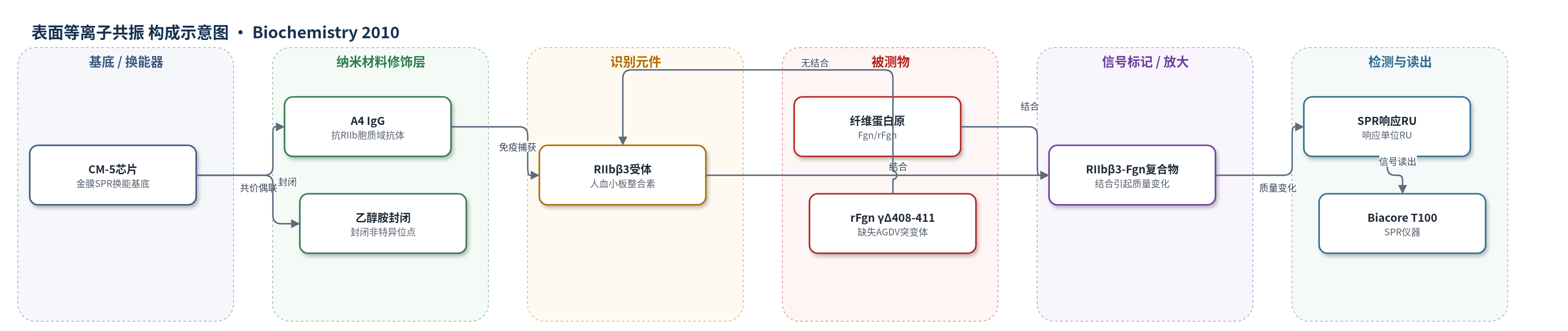
点击图片查看大图 · 依据论文自动绘制
传感器类型
表面等离子共振(SPR)生物传感器
检测对象
纤维蛋白原(fibrinogen, Fgn;含正常血浆纤维蛋白原、重组纤维蛋白原 rFgn 及突变体 rFgn γΔ408-411);样品基质为 HSCM/HSCM-T 缓冲液(含 Ca2+/Mg2+)
检测原理
CM-5金膜芯片上共价固定A4 IgG,捕获人血小板来源的RIIbβ3。依替巴肽先与RIIbβ3结合,使其从静息态转为开放/预激构象;随后纤维蛋白原γ模块羧基末端AGDV序列与β3亚基MIDAS Mg2+及RIIb Asp224形成静电/盐桥接触,形成RIIbβ3-Fgn复合物。复合物在芯片表面增加质量与折射率,使SPR共振角偏移,以响应单位RU记录结合与解离时间曲线。信号随纤维蛋白原浓度升高而增大,经1:1结合模型拟合得到kon、koff和Kd。静息RIIbβ3或rFgn γΔ408-411不产生有效结合信号。
检测灵敏度
原文未报告 LOD、线性范围、灵敏度斜率或 R^2。
效应效果
SPR显示纤维蛋白原仅与依替巴肽预激RIIbβ3结合,静息受体在150 nM下无信号,说明选择性依赖受体激活。依替巴肽竞争性抑制预激受体结合,Ki约0.4 nM,100 nM时接近完全抑制;γC肽HHLGGAKQAGDV仅弱抑制,Ki>10 μM。正常rFgn结合参数与血浆纤维蛋白原相近,rFgn γΔ408-411无结合,证实AGDV位点关键。37℃下ka约1.90×10^4 L mol^-1 s^-1、kd约8.41×10^-5 s^-1、Kd约4.42 nM;15℃结合约4倍更紧。固相实验预激受体结合中点2.0±0.4 nM,较静息受体紧约100倍。作者认为该机制可解释止血中血小板相互作用定位于血管损伤处。
传感器的构成
- 基底/换能器:CM-5 SPR芯片(Biacore T100),金膜表面提供表面等离子共振换能
- 捕获识别层:A4 IgG(抗RIIb胞质域单克隆抗体),共价偶联于CM-5芯片,用于捕获RIIbβ3
- 封闭层:乙醇胺(ethanolamine),封闭芯片非特异性结合位点
- 受体识别层:RIIbβ3(人血小板整合素),被A4 IgG捕获,作为纤维蛋白原结合受体
- 预激调节剂:依替巴肽(eptifibatide),诱导RIIbβ3进入可结合纤维蛋白原的开放构象
中文摘要
本研究证明两个正交事件调控整合素RIIbβ3与其主要生理配体纤维蛋白原的相互作用:RIIb-β3界面构象变化,以及纤维蛋白原γ模块羧基末端柔性。作者将RIIbβ3捕获于生物传感器表面,用表面等离子共振(SPR)检测结合。依替巴肽预激的RIIbβ3在37℃下与纤维蛋白原结合的kon约2×10^4 L mol^-1 s^-1,koff约8×10^-5 s^-1;静息RIIbβ3即使150 nM纤维蛋白原也未检出结合。依替巴肽竞争性抑制该结合(Ki约0.4 nM),合成γ模块肽HHLGGAKQAGDV仅弱抑制(Ki>10 μM)。正常重组纤维蛋白原rFgn快速、紧密、特异性结合预激RIIbβ3,而缺失γ链AGDV位点的rFgn γΔ408-411无相互作用。平衡与过渡态热力学显示,结合虽焓有利,但需克服熵主导的活化能垒。该焓驱动机制与结构数据一致,表明γ-C肽和依替巴肽与RIIbβ3胞外域形成相似静电接触。纤维蛋白原靶向序列本征无序可解释限制结合速率的熵罚。在止血环境中,整合素须先激活才能结合最丰富配体,可能使血小板相互作用定位到血管损伤部位。
英文摘要
This study demonstrates that two orthogonal events regulate integrin αIIbβ3's interactions with fibrinogen, its primary physiological ligand: (1) conformational changes at the αIIb-β3 interface and (2) flexibility in the carboxy terminus of fibrinogen's γ-module. The first postulate was tested by capturing αIIbβ3 on a biosensor and measuring binding by surface plasmon resonance. Binding of fibrinogen to eptifibatide-primed αIIbβ3 was characterized by a k(on) of ~2 × 10(4) L mol(-1) s(-1) and a k(off) of ~8 × 10(-5) s(-1) at 37 °C. In contrast, even at 150 nM fibrinogen, no binding was detected with resting αIIbβ3. Eptifibatide competitively inhibited fibrinogen's interactions with primed αIIbβ3 (K(i) ~0.4 nM), while a synthetic γ-module peptide (HHLGGAKQAGDV) was only weakly inhibitory (K(i) > 10 μM). The second postulate was tested by measuring αIIbβ3's interactions with recombinant fibrinogen, both normal (rFgn) and a deletion mutant lacking the γ-chain AGDV sites (rFgn γΔ408-411). Normal rFgn bound rapidly, tightly, and specifically to primed αIIbβ3; no interaction was detected with rFgn γΔ408-411. Equilibrium and transition-state thermodynamic data indicated that binding of fibrinogen to primed αIIbβ3, while enthalpy-favorable, must overcome an entropy-dominated activation energy barrier. The hypothesis that fibrinogen binding is enthalpy-driven fits with structural data showing that its γ-C peptide and eptifibatide exhibit comparable electrostatic contacts with αIIbβ3's ectodomain. The concept that fibrinogen's αIIbβ3 targeting sequence is intrinsically disordered may explain the entropy penalty that limits its binding rate. In the hemostatic milieu, platelet-platelet interactions may be localized to vascular injury sites because integrins must be activated before they can bind their most abundant ligand.