组成图示
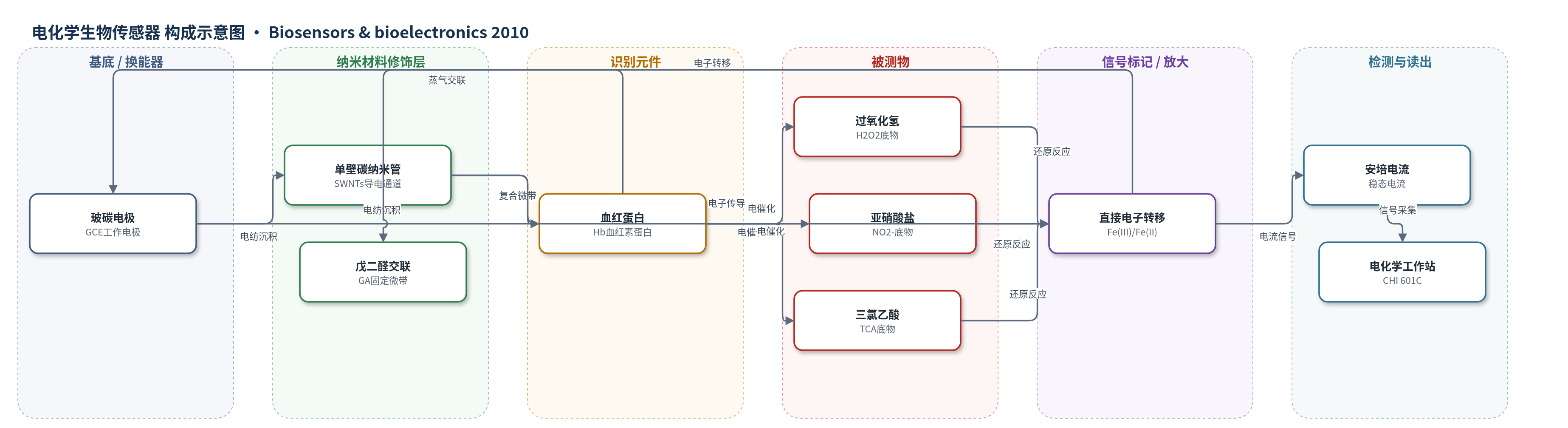
点击图片查看大图 · 依据论文自动绘制
传感器类型
电化学生物传感器
检测对象
三氯乙酸(TCA)、亚硝酸盐(NO2−)、过氧化氢(H2O2);样品基质为磷酸盐缓冲液、Britton–Robinson缓冲液及加标自来水
检测原理
SWNTs与Hb共电纺形成多孔复合微带并直接修饰GCE,SWNTs作为导电通道嵌入Hb微带中,Hb血红素Fe(III)/Fe(II)中心可在电极表面发生直接电子转移。当H2O2、NO2−或TCA扩散进入微带孔隙并到达Hb活性位点时,发生无中介体电催化还原:H2O2在约−0.364 V被还原,NO2−和TCA在约−0.65 V被还原,Hb在反应中被再生。电子经SWNTs网络传递至GCE,产生稳态安培电流。电流随被测物浓度增加而增大,低浓度呈线性,高浓度出现Michaelis–Menten平台。多孔微带降低扩散阻力,SWNTs增强电子转移,从而实现灵敏检测。
检测灵敏度
H2O2: LOD: 0.22 μM (S/N = 3);线性范围: 至 2.73 × 10⁻⁵ M;灵敏度斜率: 261.72 μA/mM cm2;R^2 = 0.991
NO2−: LOD: 0.30 μM (S/N = 3);线性范围: 至 2.07 × 10⁻⁴ M;灵敏度斜率: 84.84 μA/mM cm2;R^2 = 0.994
TCA: LOD: 2.41 μM (S/N = 3);线性范围: 1.2 × 10⁻⁵–1.08 × 10⁻⁴ M;灵敏度斜率: 28.577 μA/mM cm2
效应效果
该传感器响应迅速,H2O2在10 s内达95%稳态电流。重现性良好:H2O2、NO2−、TCA电极间RSD分别为9.35%、7.64%、8.39%,电极内RSD分别为4.71%、3.89%、7.54%。低电位下尿酸和抗坏血酸不干扰H2O2;4 mM KNO3、MgCl2、NaI、Na2CO3、NaCl不干扰20 μM NO2−。2周内对2.5 μM H2O2、20 μM NO2−、100 μM TCA响应仅下降10.4%、4.8%、8.3%。加标自来水响应与缓冲液几乎一致。H2O2灵敏度为纯Hb微带7.7倍,LOD约低3倍;TCA LOD比此前报道低约3个数量级。
传感器的构成
- 基底/换能器电极:玻碳电极(GCE),抛光清洗后作为工作电极,提供电子传导界面
- 纳米材料修饰层:单壁碳纳米管(SWNTs)与血红蛋白(Hb)共电纺形成的SWNTs–Hb复合微带,SWNTs提供导电通道,微带多孔结构降低扩散阻力
- 识别/电催化元件:血红蛋白(Hb),血红素Fe(III)/Fe(II)中心直接电子转移并电催化还原H2O2、NO2−、TCA
- 交联固定层:戊二醛(GA)蒸气交联,使SWNTs–Hb微带水不溶并增强稳定性
- 信号产生层:无外加标记物,Hb血红素Fe(III)/Fe(II)直接电子转移产生安培电流
- 支持电解质:0.1 M磷酸盐缓冲液(pH 7.0)或0.05 M pH 4.0 Britton–Robinson(BR)缓冲液,提供离子导电环境
- 读出体系:Ag/AgCl参比电极、铂丝辅助电极和CHI 601C电化学工作站,用于CV与安培检测
中文摘要
作者将单壁碳纳米管(SWNTs)与血红蛋白(Hb)在2,2,2-三氟乙醇中混合后直接电纺至玻碳电极表面,制备SWNTs–Hb复合微带修饰电极,并经戊二醛蒸气交联固定。傅里叶变换红外光谱表明微带中Hb保持天然二级结构,拉曼光谱证实SWNTs成功掺入。循环伏安法显示该复合微带具有明显的Hb血红素Fe(III)/Fe(II)直接电化学响应,峰电位约−0.281 V,且峰电流与扫描速率线性相关,表明表面控制过程。该电极对三氯乙酸(TCA)、亚硝酸盐(NO2−)和过氧化氢(H2O2)表现出无中介体电催化还原能力,安培响应迅速。检测限分别为2.41 μM(TCA)、0.30 μM(NO2−)和0.22 μM(H2O2,S/N=3),表观Michaelis–Menten常数分别为0.24、0.491和0.070 mM。加标自来水实验表明其具有实际水样检测潜力。
英文摘要
Single-walled carbon nanotubes (SWNTs) and hemoglobin (Hb) were co-electrospun to generate SWNTs-Hb microbelts, a novel composite material combining the advantages of excellent electron transfer property of SWNTs, electrocatalytic capability of redox Hb proteins, and highly porous structure of microbelts. FT-IR spectra confirmed that Hb in the microbelts kept its native conformational structure and Raman spectra demonstrated the successful incorporation of SWNTs in the microbelts. The direct electrochemistry of SWNTs-Hb composite microbelts was investigated and its application for electrocatalytic reductions and sensitive detections of three compounds, trichloroacetic acid (TCA), nitrite, and hydrogen peroxide (H2O2) was also conducted. The SWNTs-Hb composite microbelts based amperometric biosensor showed fast responses to the analytes with excellent detection limits of 2.41 μM for TCA, 0.30 μM for nitrite, and 0.22 μM for H2O2 (S/N=3), and superior apparent Michaelis-Menten constants of 0.24, 0.491 and 0.070 mM for TCA, nitrite and H2O2, respectively. Its application for spiked tap water was also demonstrated. The comparison of the SWNTs-Hb composite microbelts modified electrode with other reported electrodes in the literature indicates that the incorporation of SWNTs into Hb microbelts can significantly enhance the direct electrochemistry of Hb and the SWNTs-Hb microbelts based biosensor has great potential application in the mediator-free detection of various analytes.