组成图示
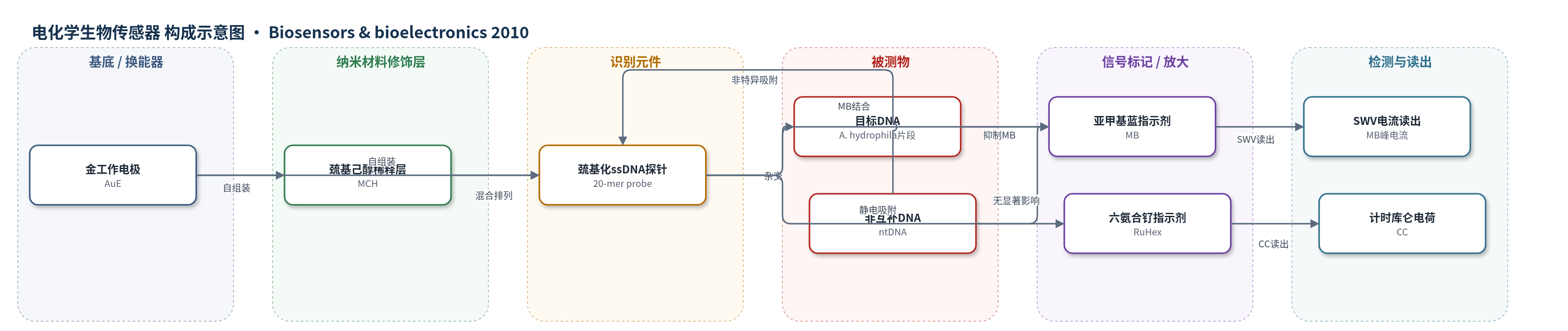
点击图片查看大图 · 依据论文自动绘制
传感器类型
电化学生物传感器
检测对象
嗜水气单胞菌(Aeromonas hydrophila)aerolysin基因特异性DNA片段(target DNA);样品基质:细菌DNA溶液(A. hydrophila基因组DNA/PCR产物,参考细菌DNA)
检测原理
传感器以金电极为基底,巯基化ssDNA探针与MCH共同自组装形成混合SAM,MCH降低界面缺陷并减少非特异吸附。目标DNA与探针互补杂交形成dsDNA。亚甲基蓝(MB)作为电活性指示剂优先结合ssDNA中的游离鸟嘌呤,杂交后dsDNA对MB的积累能力下降,因此SWV峰电流随目标DNA浓度升高而降低;在1–10 μM范围内MB信号降低率与目标DNA浓度呈线性(R=0.99)。六氨合钌(RuHex)通过静电作用结合DNA,计时库仑电荷随表面DNA覆盖量增加,用于定量杂交程度。非互补DNA不能形成dsDNA,MB信号基本不变,从而实现对A. hydrophila特异性核酸片段的识别。
检测灵敏度
线性范围: 1–10 μM;R = 0.99
效应效果
该传感器对非互补DNA具有良好抗干扰性:10 μM非互补DNA处理后MB信号为1.17 μA,与未杂交ssDNA/MCH电极的1.12 μA相近,CC显示非特异吸附仅11.5×10^7 molecules cm−2。重现性方面,ssDNA/MCH界面双电层电容4.0 μF cm−2(RSD 27%),ssDNA覆盖量8.5×10^11 molecules cm−2(RSD 41%),MB信号RSD为8%–41%。实际样品中,传感器可区分2.5 μg cm−3的A. hydrophila DNA(MB信号降至0.78 μA,RSD 8%)与4.0 μg cm−3的Propionibacterium jenseni DNA(MB信号1.25 μA,RSD 21%)。作者认为其制备比QCM基因传感器更简单,并能通过电化学工具监测DNA形式,具有食品病原菌快速检测潜力。
传感器的构成
- 基底/换能器电极:金工作电极(AuE,直径1.2 mm),经氧化铝抛光和电化学刻蚀,作为DNA自组装与电化学换能基底。
- 修饰层:巯基己醇(MCH)稀释剂,与ssDNA形成混合自组装单分子层(mixed SAM),降低界面缺陷和非特异吸附。
- 识别元件:巯基化单链DNA探针(ssDNA probe,20-mer,3′-巯基丙基连接),通过Au-S自组装固定,识别A. hydrophila aerolysin基因片段。
- 信号指示剂:亚甲基蓝(MB,12.5 μM),电活性氧化还原染料,优先结合ssDNA,杂交形成dsDNA后积累减少,用于SWV检测。
- 定量指示剂:六氨合钌(III)氯化物(RuHex),阳离子氧化还原分子,静电结合DNA,用于计时库仑(CC)定量表面DNA。
- 电化学缓冲体系:磷酸盐缓冲液(pH 7.6)和Tris-HCl缓冲液(pH 7.4),用于固定、杂交、清洗和SWV/CC测量。
- 参比/对电极:Ag/AgCl(3 M KCl)参比电极和铂丝对电极,构成三电极电化学测量体系。
中文摘要
本文报道了一种用于检测食品病原菌嗜水气单胞菌(Aeromonas hydrophila)的电化学 DNA 杂交生物传感器。该菌为新兴食品危害,可产生细胞毒性肠毒素气溶素(aerolysin)。传感器识别层由巯基化单链 DNA 探针(ssDNA)与巯基乙醇(MCE)、巯基己醇(MCH)或巯基壬醇(MCN)组成的混合自组装单分子层(SAM)构成。循环伏安法双电层电容和计时库仑法 DNA 定量表明,ssDNA/MCH 混合单分子层缺陷最低,双电层电容为 4.0 μF cm−2,ssDNA 探针表面覆盖量达 8.5×10^11 molecules cm−2。通过计时库仑法和方波伏安法(SWV)测量亚甲基蓝(MB)信号,研究了杂交时间、目标 DNA 浓度及非互补 DNA 对电化学响应的影响。该传感器能够区分浓度为 2.5 μg cm−3 的 A. hydrophila DNA 与其他微生物 DNA。
英文摘要
The paper describes an electrochemical DNA biosensor used for the detection of Aeromonas hydrophila. This opportunistic pathogen is recognized as an emerging foodborne hazard and is associated with a variety of virulence factors including production of cytotoxic enterotoxin aerolysin. The genosensor recognition layer was prepared using mixed self-assembled monolayer (SAM) consisting of thiolated single-stranded DNA probe (ssDNA) and diluent molecules--mercaptoalcohol: mercaptoethanol (MCE) or mercaptohexanol (MCH) or mercaptononanol (MCN). The voltammetric examination of double-layer capacitance of biosensor recognition interface supported by chronocoulometric quantitation of DNA present on the electrode surface showed that mixed ssDNA and MCH monolayer revealed the lowest defectiveness. Its double-layer capacitance equaled 4.0 μF cm(-2) and ssDNA probe surface coverage reached 8.5×10(11) molecules cm(-2) of gold electrode surface. Chronocoulometric quantitation of DNA and square wave voltammetry (SWV) measurements of electroactive indicator, methylene blue (MB) were performed to investigate the influence of hybridization reaction time, concentration of target DNA fragments, and presence of non-complementary DNA on the electrochemical response of genosensor recognition interface. The biosensor enabled distinction between the DNA samples isolated from A. hydrophila (present at the concentration of 2.5 μg cm(-3)) and other microbial DNA.