组成图示
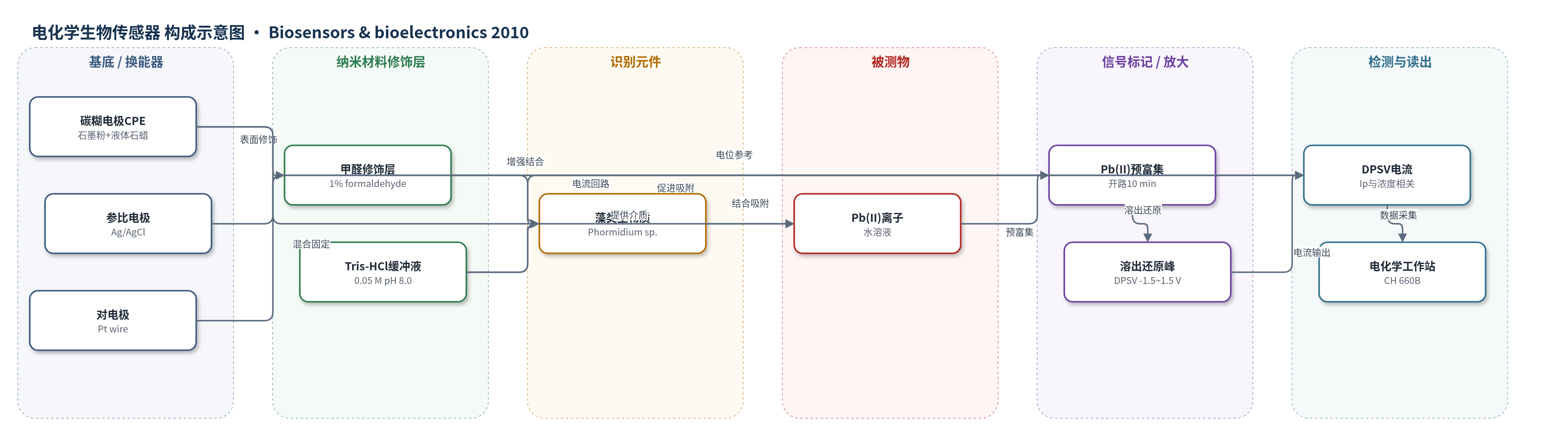
点击图片查看大图 · 依据论文自动绘制
传感器类型
电化学生物传感器
检测对象
铅离子(Pb(II)),水溶液(环境水样/缓冲液)
检测原理
该传感器以热干燥 Phormidium sp. 生物质作为生物识别元件,其细胞表面羧基、亚砜和醇羟基等官能团可与水溶液中的 Pb(II) 发生配位/静电吸附。检测时先将电极浸入含 Pb(II) 的 0.05 M Tris–HCl 缓冲液(pH 8.0),在开路条件下预富集 10 min,使 Pb(II) 在电极表面富集。随后采用 DPSV 从 −1.5 V 扫描至 1.5 V,富集的 Pb(II) 在阴极区被还原溶出,产生与浓度成正比的峰电流。甲醛修饰可改变生物质表面结构、增加有效结合位点并改善电极界面,从而放大溶出电流。
检测灵敏度
LOD: 2.5 × 10⁻⁸ M;线性范围: 5.0 × 10⁻⁸ M–2.0 × 10⁻⁵ M Pb(II)(0.01–4.0 mg L−1);校准方程: y = 1.1878x;R^2 = 0.9901
效应效果
该传感器对 Pb(II) 具有明显响应,而对 Co(II)、Cu(II)、Ni(II)、Zn(II) 单独存在时无溶出峰。等摩尔共存时,Pb(II)+Co(II)、Pb(II)+Ni(II)、Pb(II)+Zn(II) 的活性分别降至 47%、45%、56%,Pb(II)+Cu(II) 升至 121%;五种离子 5 μM 共存时活性为 76%,10 μM 共存时为 58%,说明抗干扰有限。1.0×10⁻⁵ M Pb(II) 重复 8 次,平均电流 10.09±1.32 μA,RSD 13.08%,CV 1.63%。甲醛修饰使响应约提高一倍。作者认为其成本低、制备简单,LOD 低于许多碳糊电极 Pb(II) 传感器及 EPA 限值,适合水样铅检测。
传感器的构成
- 换能器电极:碳糊电极(CPE),由石墨粉(graphite powder)与液体石蜡(paraffin liquid)混合制成,提供导电界面
- 生物识别层:热干燥 Phormidium sp. 藻类生物质(heat-dried algal biomass),含羧基、亚砜、醇羟基等,选择性吸附 Pb(II)
- 化学修饰层:1% 甲醛(formaldehyde)处理生物质或电极表面,增加结合位点并增强电化学响应
- 支持电解质:0.05 M Tris–HCl 缓冲液(pH 8.0),维持离子环境并促进 Pb(II) 吸附
- 参比电极:Ag/AgCl(饱和 KCl),提供稳定电位参考
- 对电极:铂丝(Pt wire),完成三电极体系
中文摘要
本文报道了一种基于 Phormidium sp. 修饰碳糊电极的伏安藻类传感器,用于水溶液中 Pb(II) 的测定,并系统考察了生物质对 Pb(II) 的选择性。作者采用循环伏安(CV)和差分脉冲溶出伏安(DPSV)优化分析条件:在开路条件下预富集 Pb(II),随后以 −1.5 至 1.5 V 扫描,所得电流与 Pb(II) 浓度相关。最佳条件为 pH 8.0、0.05 M Tris–HCl 缓冲液,预富集时间 10 min。传感器在 5.0×10⁻⁸ M 至 2.0×10⁻⁵ M Pb(II)(0.01–4.0 mg/L)范围内呈线性,检出限为 2.5×10⁻⁸ M。FTIR-ATR 分析表明,参与 Pb(II) 积累的官能团主要为羧基、亚砜和醇羟基。经 1% 甲醛简单化学修饰后,Pb(II) 测定响应和结合官能团含量均提高。该 Phormidium sp. 使用形式无需复杂固定化和昂贵预处理。
英文摘要
It has been well documented that heavy metal accumulation in environment is harmful for living organisms at even trace levels. A new voltammetric algal sensor based on Phormidium sp. modification for Pb(II) determination from aqueous solutions was developed, and selectivity of the biomass to Pb(II) was investigated comprehensively. Many important experimental parameters were performed by using electrochemical techniques, including cyclic voltammetry and differential pulse stripping voltammetry. The preconcentrated ions at open circuit were reduced by scanning the potential from -1.5 to 1.5 V and current values obtained were related to the concentration of Pb(II) in the solutions. The best peak values belonging to Pb(II) were achieved at pH 8.0 with 0.05 M Tris-HCl solution. Preconcentration time was selected as 10 min, and the sensor was found in a linear range from 5.0×10(-8) M to 2.0×10(-5) M Pb(II) (0.01-4.0 mg L(-1)) with a detection limit of 2.5×10(-8) M. Other analytical properties of the developed microbial biosensor were also investigated. According to the Fourier transform infrared attenuated total reflectance (FTIR-ATR) analyses, the possible functional groups involved in Pb(II) accumulation in the Phormidium sp. were defined as carboxyl, sulphoxide and alcoholic groups. A simple chemical modification by formaldehyde both enhanced Pb(II) determination and content of functional groups involving Pb(II) binding. The proposed usage form of Phormidium sp. does not need complicated immobilization procedures and expensive preliminary preparations.