组成图示
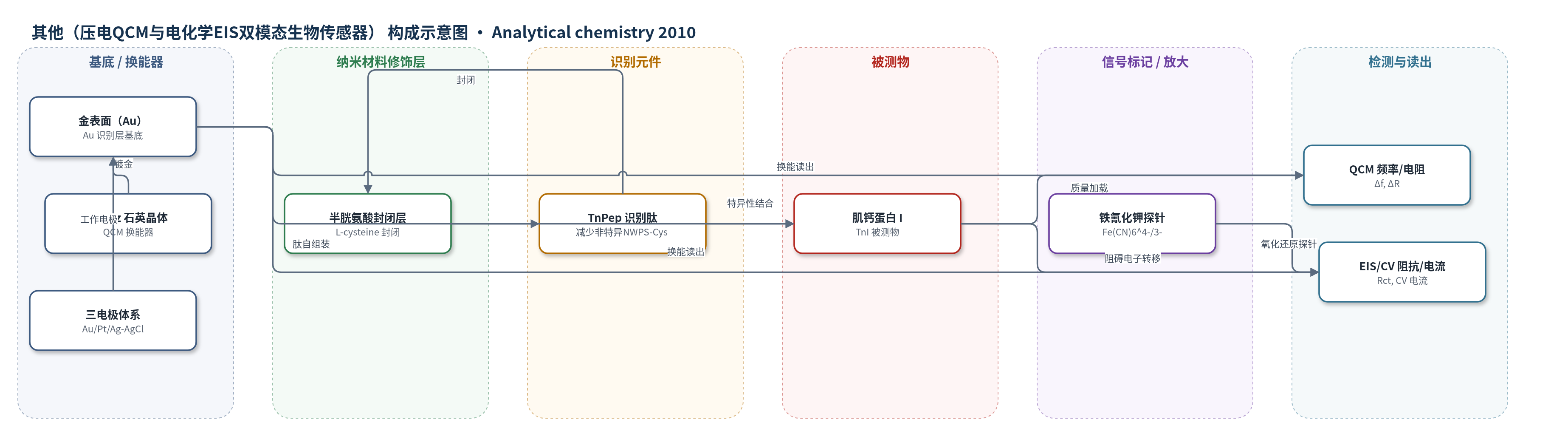
点击图片查看大图 · 依据论文自动绘制
传感器类型
其他(压电QCM与电化学EIS双模态生物传感器)
检测对象
心肌肌钙蛋白 I(cardiac troponin I, TnI);样品基质:PBS 缓冲液、MEM 细胞培养基(模拟心肌细胞培养上清)
检测原理
该传感器为无标记亲和传感。TnPep 经 C 端半胱氨酸自组装固定于金表面,形成识别层;L-半胱氨酸封闭裸露金位点,降低非特异吸附。当 TnI 与 TnPep 特异性结合后,QCM 表面质量增加,引起石英晶体谐振频率下降,按 Sauerbrey 方程换算结合质量,并用晶体电阻变化校正液体粘度/密度贡献。电化学体系中,TnI 结合使金电极界面钝化,阻碍 Fe(CN)6^4-/3- 氧化还原探针与电极间的电子转移,导致 CV 峰电流下降、EIS 电荷转移电阻 Rct 增大。TnI 浓度越高,结合量或界面阻碍越强,信号越大;QCM 在高浓度趋于饱和,EIS 在 0–10 µg/mL 内更线性。无酶催化或核酸放大。
检测灵敏度
LOD: 0.11 µg/mL(QCM);LOD: 0.34 µg/mL(EIS);灵敏度: 18 ± 1 Hz/(µg/mL)(QCM, <1 µg/mL);0.30 ± 0.030 normalized impedance/(µg/mL)(EIS, <3 µg/mL);线性范围: 0–10 µg/mL(EIS 更线性;QCM 低浓度 <1 µg/mL 线性)。
效应效果
该传感器对 TnI 选择性良好:以链霉亲和素(SA)和 SAPep 为对照,TnPep 对 SA 几乎无响应,TnI 结合则引起明显 QCM 频率变化和 EIS 阻抗增加。QCM 与 EIS 在 0–10 µg/mL 内可定量检测 TnI;QCM 检出限 0.11 µg/mL,低于 EIS 的 0.34 µg/mL,但 EIS 线性动态范围更大。空白响应较小,PBS 中 <4%,MEM 中 <10%;MEM 中 EIS 灵敏度高于 PBS,说明可在复杂培养介质中工作。CV 因表面高度钝化后电流过小,未能定量。未报告加标回收率与长期稳定性。与商业抗体 TnI 检测(LOD <0.1 ng/mL)相比,本文 LOD 较高,但作者认为肽-EIS 方案适合微流控心肌细胞培养中毒素诱导 TnI 释放的可部署检测,QCM 适合实验室实时监测。
传感器的构成
- 基底/换能器:金(Au)表面;QCM 采用 5 MHz 镀金石英晶体,电化学采用金线工作电极,分别提供质量与阻抗换能。
- 识别元件:TnI 结合肽 TnPep(FYSHSFHENWPS-Cys)经 C 端半胱氨酸自组装固定于 Au,特异性识别 TnI。
- 封闭层:L-半胱氨酸(L-cysteine, 1 mM)封闭裸露 Au 位点,降低非特异吸附并促进肽取向。
- 电化学探针:1 mM 铁氰化钾/亚铁氰化钾(Fe(CN)6^4-/3-)于 0.1 M NaClO4,作为氧化还原探针用于 CV/EIS 读出。
- 电化学三电极:金(Au)工作电极、铂网(Pt mesh)对电极、Ag/AgCl 参比电极,完成电位与阻抗测量。
- 检测介质:PBS 或 MEM 细胞培养基,用于 TnI 结合与定量检测,MEM 中 EIS 响应更高。
中文摘要
本研究将一种通过多价噬菌体展示库筛选获得、对心肌肌钙蛋白 I(TnI)具有纳摩尔亲和力的短合成肽固定于金表面,用于 TnI 检测。作者比较了金表面固定肽与噬菌体固定肽对 TnI 的结合亲和力,并采用石英晶体微天平(QCM)、循环伏安法(CV)和电化学阻抗谱(EIS)监测识别层制备及目标结合过程。三种方法均表明该肽对 TnI 的结合相对于链霉亲和素(SA)对照具有特异性。在 0–10 µg/mL TnI 浓度范围内,QCM 与 EIS 均获得响应曲线。EIS 灵敏度为 0.30 ± 0.030 归一化阻抗/(µg/mL),检出限为 0.34 µg/mL;QCM 灵敏度为 18 ± 1 Hz/(µg/mL),检出限为 0.11 µg/mL。QCM 检出限更低,但 EIS 线性动态范围更大。在最小必需培养基(MEM)中,EIS 灵敏度高于磷酸盐缓冲液(PBS)。QCM 动力学分析得到解离常数 KD 为 66 ± 4 nM 和 17 ± 8 nM,比多价噬菌体颗粒的 2.5 ± 0.1 nM 高约一个数量级。结果表明,噬菌体展示筛选的肽可作为生物传感器识别探针。
英文摘要
A small synthetic peptide with nanomolar affinity for cardiac troponin I (TnI), previously identified from a polyvalent phage displayed library, has been immobilized on a gold surface for TnI detection. The binding affinity of gold-immobilized peptides for TnI was studied and compared with that of phage-immobilized peptides. Quartz crystal microbalance (QCM), cyclic voltammetry, and electrochemical impedance spectroscopy (EIS) were used to monitor both the immobilization and target binding processes. All three techniques show that the binding is specific for TnI as compared to a streptavidin (SA) control. The response curves obtained at TnI concentrations ranging from 0 to 10 μg/mL, using both QCM and EIS, were also compared. For the EIS measurements, the sensitivity was 0.30 ± 0.030 normalized impedance/(μg/mL) and the limit of detection (LOD) was 0.34 μg/mL. Using the QCM, a sensitivity of 18 ± 1 Hz/(μg/mL) was obtained, corresponding to an LOD of 0.11 μg/mL. Although the QCM demonstrated a lower LOD as compared to EIS, the latter technique exhibited a larger linear dynamic range than QCM. In a relevant tissue culture milieu, Minimum Essential Media (MEM), the sensitivity of the EIS measurement was greater than that obtained in a phosphate buffer system (PBS). The kinetics of target binding using QCM were analyzed by two independent methods, and the dissociation constants (K(D) = 66 ± 4 nM and 17 ± 8 nM) were an order of magnitude higher than that calculated for the polyvalent phage particles (K(D) = 2.5 ± 0.1 nM). Even though the affinity of the immobilized peptides for TnI was somewhat reduced, overall, these results demonstrate that peptides obtained from the biopanning of phage display libraries can be readily used as sensing probes in biosensor development.