组成图示
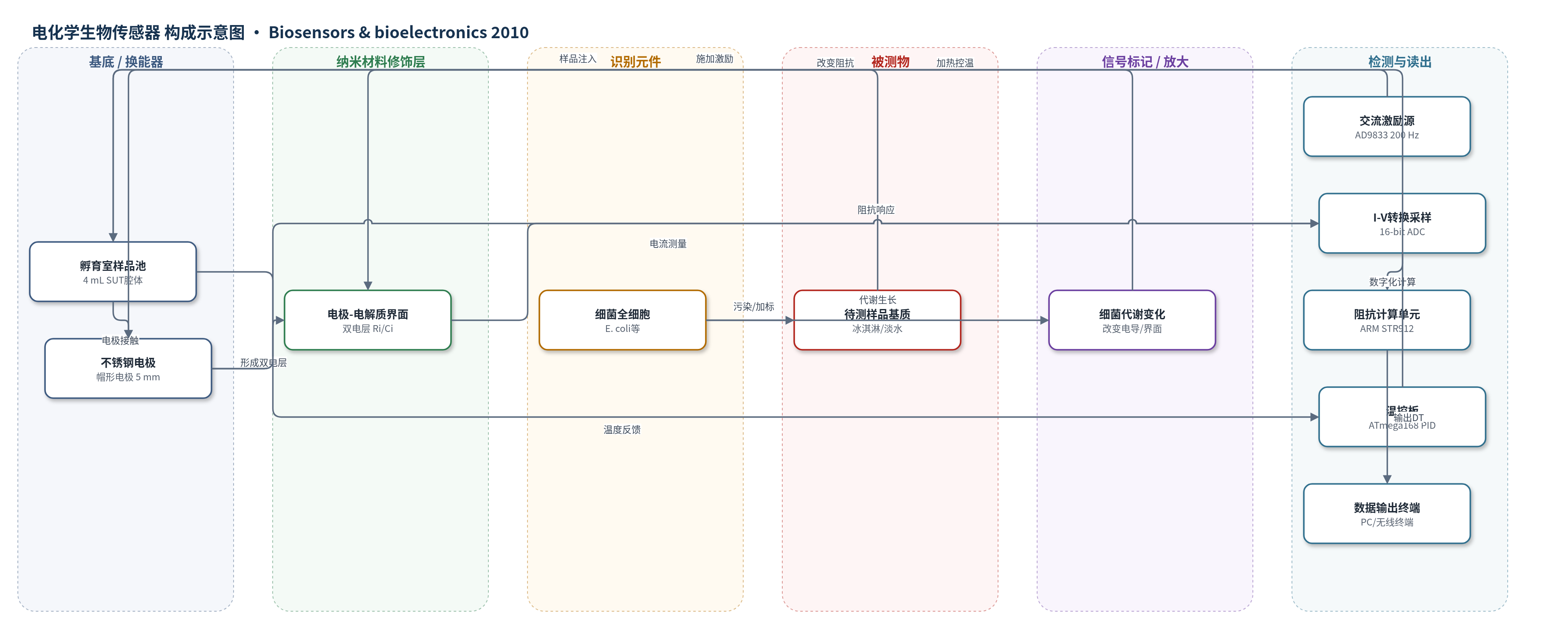
点击图片查看大图 · 依据论文自动绘制
传感器类型
电化学生物传感器
检测对象
细菌浓度(bacterial concentration,cfu/mL;总菌落数/微生物总数),样品基质:工业冰淇淋、淡水(加YE 3%酵母浸出液或MacConkey肉汤);加标菌包括大肠杆菌E. coli、金黄色葡萄球菌S. aureus、粪肠球菌E. faecalis、铜绿假单胞菌P. aeruginosa及大肠菌群coliforms。
检测原理
待测样品置于孵育室并在30–40 °C下培养,不锈钢电极对样品施加100 mV峰峰值、200 Hz正弦信号,每5 min测量阻抗。电极-电解质系统可等效为串联电阻Rs和电容Cs,分别反映介质电导和双电层界面特性。初始阶段参数稳定为基线;细菌生长代谢改变介质离子电导和界面状态,当细菌浓度达到约10^7 cfu/mL阈值时,Rs或Cs偏离基线超过5%。系统记录偏离时间DT,DT与初始细菌浓度对数呈线性关系,从而估算样品初始浓度。该过程以全细胞代谢作为识别与放大机制,无需特异性识别分子。
检测灵敏度
临界阈值: about 10^7 cfu/mL;高污染样品: 10^6 cfu/mL(3 h);回归方程: DT = -109.64 Log10(C0) + 733.65;R^2 = 0.71
效应效果
系统以SPC为参考进行验证。冰淇淋样品中,DT与SPC菌落数呈线性关系,回归R^2=0.71,平均代时TG=33 min;对约10^6 cfu/mL高污染样品,3 h阻抗测量即可给出结果,明显快于SPC的24–72 h。淡水样品加YE 3%后,Rs变化约25%、Cs约13%,TG分别为19.5 min和21.6 min,饱和浓度约10^9 cfu/mL;MacConkey肉汤用于大肠菌群选择性检测,终点浓度3×10^8 cfu/mL。铜绿假单胞菌在冰淇淋中相关较差(R^2<0.5),加YE 3%后改善。系统便携、低成本、无需专业微生物操作,适合食品工业和环境水样现场筛查。
传感器的构成
- 孵育室/样品池:4 mL容量腔体,容纳待测样品(SUT),提供细菌生长与孵育环境
- 换能电极:一对不锈钢帽形电极(直径5 mm、间距4.5 mm),直接接触样品,施加交流激励并测量阻抗
- 温度传感层:LM135三端精密温度传感器(默认)或PT100铂电阻温度传感器,连续监测样品温度
- 加热控温层:24 Ω、15 W、24 V 50 Hz功率电阻加热器贴于室外壁,配合温控板维持目标温度
- 温控板:ATmega168微控制器、DSP AN221E04信号调理、光耦-可控硅驱动,PID算法控制加热器,精度±0.15 °C
- 阻抗测量板:AD9833波形发生器产生100 mVpp 200 Hz信号,继电器G6J-2FS-Y切换电极,I-V转换器与10 kΩ数字电位器、16位ADC采样,ARM STR912计算Rs、Cs和DT
- 识别/信号元件:样品中的细菌(全细胞)通过代谢改变介质电导和电极-电解质界面特性,产生阻抗变化;无特异性抗体/适配体识别层
中文摘要
微生物筛查是食品、环境、医疗等领域的重要需求。传统标准平板计数(SPC)准确但耗时24–72 h,且依赖实验室和专业人员。阻抗技术(IT)通过监测细菌代谢引起待测样品电学特性的变化来估算细菌浓度,检测时间可缩短至3–12 h,并易于自动化。该方法的关键参数是细菌浓度达到约10^7 cfu/mL临界阈值、引起样品阻抗显著变化所需的时间;系统以100 mV峰峰值、200 Hz正弦信号激励,每5 min测量一次。本文报道一种嵌入式便携式阻抗生物传感器系统,由含待测样品的孵育室、温控板和阻抗测量板组成。实验表明,对高污染样品(约10^6 cfu/mL),3 h阻抗测量与SPC结果具有良好相关性。该系统成本低、操作简便,适用于工业和商业环境中的微生物快速筛查。
英文摘要
Microbial screening is a primary concern for many products. Traditional techniques based on standard plate count (SPC) are accurate, but time consuming. Furthermore, they require a laboratory environment and qualified personnel. The impedance technique (IT) looking for changes in the electrical characteristics of the sample under test (SUT) induced by bacterial metabolism represents an interesting alternative to SPC since it is faster (3-12h vs. 24-72 h for SPC) and can be easily implemented in automatic form. With this approach, the essential parameter is the time for bacteria concentration to reach a critical threshold value (about 10(7) cfu mL(-1)) capable of inducing significant variations in the SUT impedance, measured by applying a 100 mV peak-to-peak 200 Hz sinusoidal test signal at time intervals of 5 min. The results of this work show good correlation between data obtained with the SPC approach and with impedance measurements lasting only 3h, in the case of highly contaminated samples (10(6) cfu mL(-1)). Furthermore, this work introduces a portable system for impedance measurements composed of an incubation chamber containing the SUT, a thermoregulation board to control the target temperature and an impedance measurement board. The mix of cheap electronics and fast detection time provides a useful tool for microbial screening in industrial and commercial environments.