组成图示
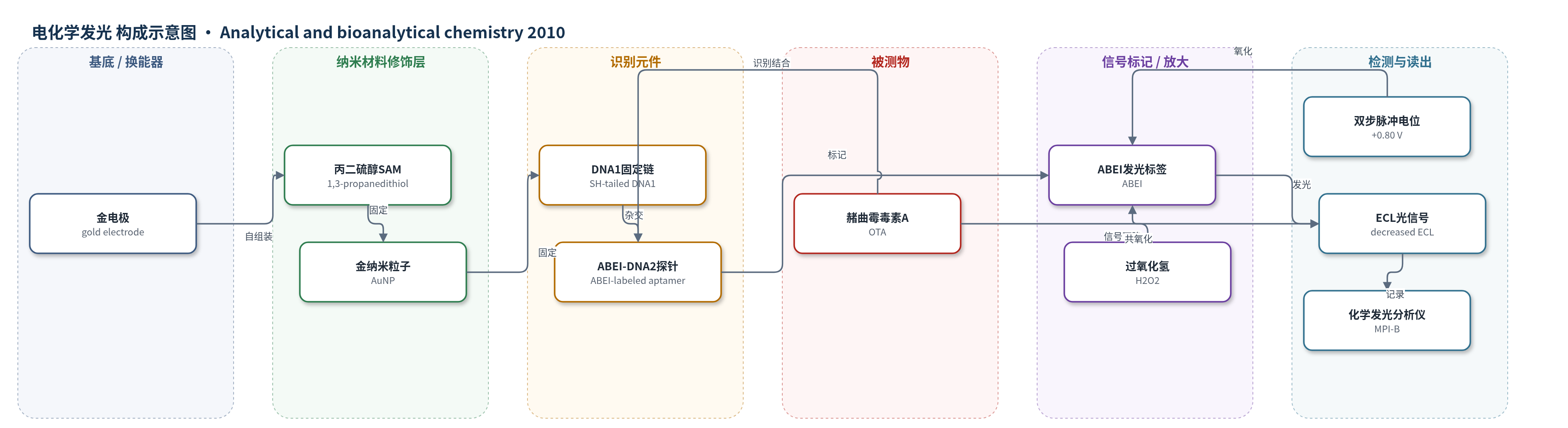
点击图片查看大图 · 依据论文自动绘制
传感器类型
电化学发光(ECL)生物传感器
检测对象
赭曲霉毒素A(Ochratoxin A, OTA);样品基质:小麦样品(wheat samples)及OTA标准溶液
检测原理
该传感器以AuNP修饰金电极为换能界面,DNA1-SH固定于AuNP,ABEI标记的OTA适配体DNA2与DNA1杂交后靠近电极。无OTA时,在pH 11.0 Na2CO3-NaHCO3介质、1.5 mM H2O2和+0.80 V双步脉冲电位下,ABEI被氧化并与H2O2发生共氧化反应,产生强ECL光信号。加入OTA后,适配体特异性结合OTA,诱导DNA2从DNA1解离并远离电极表面,电极附近ABEI数量减少,ECL强度下降。ΔIECL随OTA浓度升高而增大。AuNP对ABEI ECL具有催化作用,使信号较裸金电极增强约10倍,从而提高检测灵敏度。
检测灵敏度
LOD: 0.007 ng/mL;线性范围: 0.02–0.2 ng/mL;灵敏度斜率: 4347.90(ΔIECL = 4347.90C - 55.66);R^2 = 0.9996;非线性范围: 0.02–3.0 ng/mL;非线性方程: ΔIECL = -597.06C^2 + 3535.70C + 18.20;R^2 = 0.9993
效应效果
在0.2 ng/mL OTA下,相对标准偏差为3.8%(n=7)。与裸金电极相比,AuNP修饰使检测灵敏度提高约10倍,裸金电极线性范围为0.2–5.0 ng/mL,检出限为0.06 ng/mL。对20个天然污染小麦样品进行测定,与官方HPLC-荧光法结果比较,相关方程为Y=0.071+1.087X,r=0.9993,p<0.0001,无显著差异。加标回收率为82.0%–103.1%(n=5)。作者认为该方法步骤简单、快速、灵敏,适配体可特异性分离OTA,适用于农产品中小分子毒素的食品安全检测。
传感器的构成
- 基底/换能器电极:金电极(gold electrode),作为工作电极提供ECL反应界面
- 自组装单分子层:1,3-丙二硫醇(1,3-propanedithiol),形成硫醇SAM并固定AuNP
- 纳米材料修饰层:金纳米粒子(AuNP,约10 nm),催化增强ABEI的ECL信号
- 识别元件:DNA1(5′-TGT CCG ATG CTC CCT TTA CGC CAC CCA CAC CCG ATC-SH-3′),巯基尾端固定于AuNP,作为适配体互补链
- 识别/探针元件:DNA2(5′-NH2-GAT CGG GTG TGG GTG GCG TAA AGG GAG CAT CGG ACA-3′),OTA适配体,与DNA1杂交并识别OTA
- 信号标记物:N-(4-氨基丁基)-N-乙基异鲁米诺(ABEI),通过戊二醛法标记于DNA2氨基端,作为ECL发光标签
- 共反应物:过氧化氢(H2O2,1.5 mM),在碱性介质中作为共氧化剂增强ABEI ECL
- 检测介质:Na2CO3-NaHCO3缓冲液(pH 11.0)与结合缓冲液(10 mM Tris, pH 8.5, 120 mM NaCl, 5 mM KCl, 20 mM CaCl2),用于ECL反应和适配体-OTA结合
中文摘要
本文报道了一种用于检测肾毒性真菌毒素赭曲霉毒素A(OTA)的高选择性电化学发光(ECL)适配体生物传感器。该传感器以DNA适配体为识别元件,以N-(4-氨基丁基)-N-乙基异鲁米诺(ABEI)为发光信号化合物。将适配体互补链DNA1固定于金纳米粒子(AuNP)修饰的金电极表面,ABEI标记的适配体DNA2与DNA1杂交形成ECL探针。当目标OTA存在时,适配体识别OTA并诱导DNA2从DNA1上解离,使ABEI远离电极表面,ECL信号下降。在优化条件下,ECL强度下降与OTA浓度在0.02–3.0 ng/mL范围内呈比例关系,检出限为0.007 ng/mL;0.2 ng/mL时相对标准偏差为3.8%(n=7)。该方法用于天然污染小麦样品中OTA的测定,并经官方方法验证,表明适配体识别与ECL检测结合可用于小分子毒素分析。
英文摘要
A highly selective electrochemiluminescent biosensor for the detection of target nephrotoxic toxin, ochratoxin A (OTA), was developed using a DNA aptamer as the recognition element and N-(4-aminobutyl)-N-ethylisoluminol (ABEI) as the signal-producing compound. The electrochemiluminescent aptamer biosensor was fabricated by immobilizing aptamer complementary DNA 1 sequence onto the surface of a gold-nanoparticle (AuNP)-modified gold electrode. ABEI-labeled aptamer DNA 2 sequence hybridized to DNA 1 and was utilized as an electrochemiluminescent probe. A decreased electrochemiluminescence (ECL) signal was generated upon aptamer recognition of the target OTA, which induced the dissociation of DNA 2 (ABEI-labeled aptamer electrochemiluminescent probe) from DNA 1 and moved it far away from the electrode surface. Under the optimal conditions, the decreased ECL intensity was proportional to an OTA concentration ranging from 0.02 to 3.0 ng mL(-1), with a detection limit of 0.007 ng mL(-1). The relative standard deviation was 3.8% at 0.2 ng mL(-1) (n = 7). The proposed method has been applied to measure OTA in naturally contaminated wheat samples and validated by an official method. This work demonstrates the combination of a highly binding aptamer with a highly sensitive ECL technique to design an electrochemiluminescent biosensor, which is a very promising approach for the determination of small-molecule toxins.