组成图示
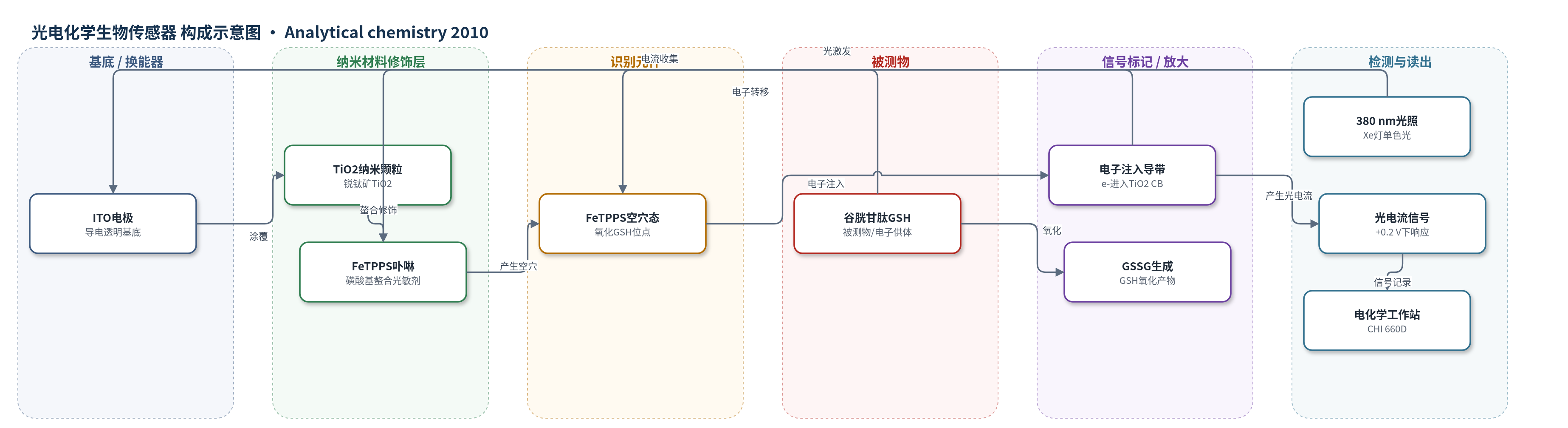
点击图片查看大图 · 依据论文自动绘制
传感器类型
光电化学生物传感器
检测对象
谷胱甘肽(glutathione, GSH,还原型谷胱甘肽);样品基质:0.1 mol/L PBS(pH 7.0)及谷胱甘肽注射液(gluthion injection)
检测原理
FeTPPS通过磺酸基与TiO2纳米颗粒齿合结合,形成FeTPPS-TiO2修饰ITO电极。380 nm光照激发FeTPPS后,其激发态电子注入TiO2导带,留下空穴;GSH作为电子供体和牺牲剂被FeTPPS空穴氧化为GSSG,同时电子快速注入TiO2导带。该过程增强电子-空穴分离、抑制载流子复合,使光电流在+0.2 V下随GSH浓度升高而增大。由于检测电位远低于GSH直接电化学氧化电位,可排除其他还原性物质干扰,实现低电位光电化学传感。
检测灵敏度
LOD: 0.03 mmol L-1(S/N = 3);线性范围: 0.05–2.4 mmol L-1
效应效果
该传感器对10倍浓度GSH的顺铂、氟尿嘧啶和阿霉素无干扰,选择性良好。五支新制电极校准曲线斜率RSD为5.6%;在400和1600 µmol/L GSH下重复测定RSD分别为5.8%和5.3%。室温避光保存10 d无明显衰减,4周后保持初始光电流的94.6%。响应15 s内稳定,快于SERS的5 min和微芯片电泳-激光诱导荧光的50 s。线性范围宽于量子点电化学发光(0.024–0.214 mmol/L)、荧光法(0.025–0.25 mmol/L)和SERS(0.1–0.8 µmol/L)。谷胱甘肽注射液测得0.018±0.002 mol/L,与标示值0.017 mol/L一致。
传感器的构成
- 基底/换能器电极:ITO(indium tin oxide)电极,导电透明基底,收集光电流
- 纳米材料修饰层:TiO2(anatase, <25 nm)纳米颗粒,光催化半导体,受光产生电子-空穴对
- 光敏修饰层:FeTPPS([meso-tetrakis(4-sulfonatophenyl)porphyrin] iron(III) monochloride),经磺酸基与TiO2齿合结合,提高光电流转换效率
- 识别/氧化元件:FeTPPS空穴态,氧化GSH为GSSG,无独立抗体/适配体/酶识别层
- 电子供体:GSH(glutathione),被测物兼牺牲电子供体,向FeTPPS空穴态转移电子
- 支持电解质:0.1 mol/L PBS(pH 7.0,去氧),提供离子导电环境
- 检测系统:三电极体系(铂丝辅助电极、饱和甘汞电极参比)、CHI 660D电化学工作站、500 W Xe灯380 nm激发
中文摘要
本文报道了一种基于卟啉功能化TiO2纳米颗粒的低电位光电化学生物传感平台,用于在相对较低外加电位下检测生物分子。作者通过水溶性[meso-四(4-磺酸苯基)卟啉]铁(III)一氯化物(FeTPPS)的磺酸基与TiO2纳米颗粒齿合结合,制备了FeTPPS-TiO2功能纳米颗粒,并经TEM、接触角、拉曼、XPS和紫外-可见吸收光谱表征。该纳米颗粒在水中及ITO表面分散良好。FeTPPS-TiO2修饰ITO电极在380 nm光激发、+0.2 V下产生光电流,并可由空穴注入FeTPPS氧化生物分子进一步敏化。以谷胱甘肽(GSH)为模型,建立了低电位光电化学检测方法。优化条件下,方法可检测0.05–2.4 mmol/L GSH,检出限为0.03 mmol/L(信噪比3)。该传感器对抗癌药物具有优异特异性,并成功用于谷胱甘肽注射液中还原型谷胱甘肽的检测,显示在光电化学生物传感中的应用前景。
英文摘要
A novel photoelectrochemical biosensing platform for the detection of biomolecules at relatively low applied potentials was constructed using porphyrin-functionalized TiO₂ nanoparticles. The functional TiO₂ nanoparticles were prepared by dentate binding of TiO₂ with sulfonic groups of water-soluble [meso-tetrakis(4-sulfonatophenyl)porphyrin] iron(III) monochloride (FeTPPS) and characterized by transmission electron microscopy; contact angle measurement; and Raman, X-ray photoelectron, and ultraviolet-visible absorption spectroscopies. The functional nanoparticles showed good dispersion in water and on indium tin oxide (ITO) surface. The resulting FeTPPS-TiO₂-modified ITO electrode showed a photocurrent response at +0.2 V to a light excitation at 380 nm, which could be further sensitized through an oxidation process of biomolecules by the hole-injected FeTPPS. Using glutathione as a model, a methodology for sensitive photoelectrochemical biosensing at low potential was thus developed. Under optimal conditions, the proposed photoelectrochemical method could detect glutathione ranging from 0.05 to 2.4 mmol L⁻¹ with a detection limit of 0.03 mmol L⁻¹ at a signal-to-noise ratio of 3. The photoelectrochemical biosensor had an excellent specificity against anticancer drugs and could be successfully applied to the detection of reduced glutathione in gluthion injection, showing a promising application in photoelectrochemical biosensing.