组成图示
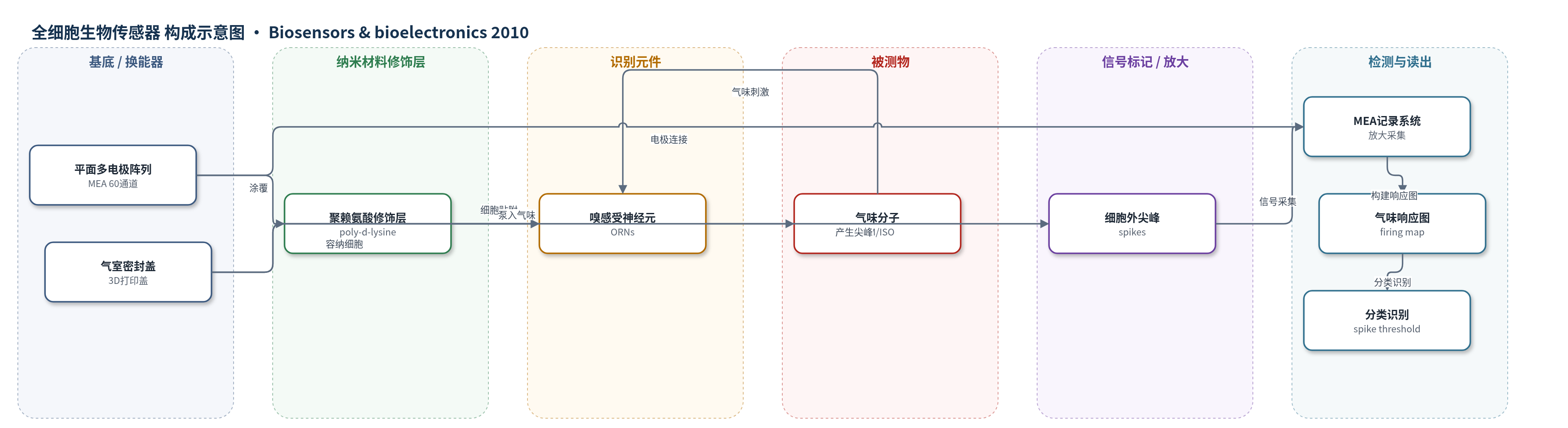
点击图片查看大图 · 依据论文自动绘制
传感器类型
全细胞生物传感器
检测对象
dl-柠檬烯(dl-limonene,LIM)、异戊乙酸酯(isoamyle acetate,ISO);样品基质:气相气味物(经 MEA 培养液/气室)
检测原理
气味分子进入 MEA 气室后,与培养在电极表面的嗅感受神经元(ORNs)上的嗅觉受体(ORs)结合,触发受体介导的信号转导和膜电位变化,使神经元产生动作电位。平面多电极阵列(MEA)同步记录多个位点的细胞外尖峰,尖峰幅度、发放阈值、平均发放速率和发放通道数随气味物种类与浓度变化。对于 LIM 和 ISO,只有达到一定浓度阈值后才出现发放,且高浓度 ISO 可抑制发放。系统通过累计发放率(CFR)和平均发放率(AFR)提取动态特征,并将 60 个通道的发放信息整合为多通道气味响应图;基于尖峰阈值的分类算法利用不同气味物激活通道的空间分布差异,实现 LIM 与 ISO 的识别。
检测灵敏度
LOD: ISO about 50 mg/m3;LIM about 2.6 g/m3;响应阈值: LIM between 1.1 × 10⁻⁵ mol/l and 1.9 × 10⁻⁵ mol/l;ISO between 1.0 × 10⁻⁷ mol/l and 4.0 × 10⁻⁷ mol/l
效应效果
两个不同批次神经芯片的主要电生理特征基本相似,说明方法具有一定重现性。对 LIM 和 ISO 的 45 s 脉冲刺激中,LIM 激活 12 个通道,ISO 激活 30 个通道,其中 4 个通道(8、11、12、55)重叠;非重叠通道对两种气味物表现出良好特异性,多通道气味响应图可在不同批次芯片中识别两种气味物。LIM 的平均发放速率约为 4.4 和 4.2 spikes/s,ISO 约为 10.1 和 14.3 spikes/s。作者认为该 ORN 芯片比化学气体传感器电子鼻更接近真实嗅觉响应,具有更敏感、可靠和快速响应的潜力;当前体外 ORN 存活约 30 min,仍需提高气味物溶解度、细胞密度和培养稳定性。
传感器的构成
- 基底/换能器电极:60通道平面多电极阵列(MEA,MCS 200/30iR-Ti-pr),Ti 电极用于细胞外电生理记录
- 生物相容修饰层:聚-L-赖氨酸(poly-d-lysine)涂覆 MEA 表面,促进 ORN 贴附
- 识别元件:大鼠嗅感受神经元(ORNs),表达嗅觉受体(ORs),识别气味分子并产生动作电位
- 样品供给系统:微流控注射泵(Fialab-3200)与气体传输管路,将 LIM/ISO 气味脉冲泵入
- 气室/样品池:3D 打印定制密封盖与 MEA 培养细胞形成气室,容纳培养液和气味气体
- 信号读出:MEA 记录系统、接口电路与 PC 控制程序,放大、采集并分析尖峰序列
中文摘要
本研究开发了一种基于嗅感受神经元(ORNs)的新型嗅觉神经芯片。ORNs 被培养在60通道平面多电极阵列(MEA)表面,利用定制气体进样系统将两种不同浓度的气味物定量泵入芯片,并在体外同步记录多个 ORNs 的细胞外电活动。研究基于 ORN 尖峰序列,对气味响应的发放幅度、发放阈值、发放速率及发放通道等特征进行了定性与定量分析。进一步引入基于尖峰阈值的分类算法后,多通道气味响应图可用于区分 dl-柠檬烯(LIM)和异戊乙酸酯(ISO)两种气味物。结果表明,体外培养的 ORNs 仍保留主要电生理响应特征,且不同气味物在 MEA 通道上形成具有特异性的空间响应模式。该 ORN 生物传感器有望作为仿生电子鼻,实现对不同气味物的识别。
英文摘要
A novel olfactory neurochip based on olfactory receptor neurons (ORNs) cultivated on the surface of the 60-channel planar multi-electrode array (MEA) devices was developed in this study. In order to investigate the odor-response characteristics of ORNs, two types of odorants at different concentrations were quantitatively pumped into the neurochip by a customized gas intake system, and the extracellular electrical activities of multiple ORNs were simultaneously recorded in vitro. Accordingly, the odor-response features of ORNs such as firing amplitude, firing threshold, firing rate as well as firing channels were analyzed qualitatively and quantitatively in terms of ORN spike trains. Especially, after introducing the classification algorithm based on the spike threshold, the odor-response maps from the multiple sites could be used to identify dl-limonene (LIM) and isoamyle acetate (ISO) odorants. These preliminary studies indicate that the ORN-based biosensor developed here has a potential capability of distinguishing different odorants as a true bionic electronic nose.