组成图示
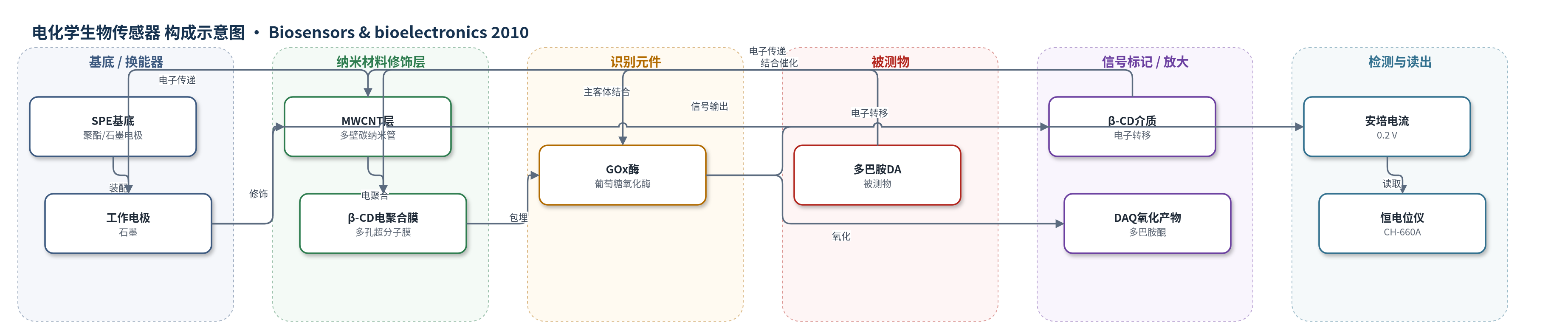
点击图片查看大图 · 依据论文自动绘制
传感器类型
电化学生物传感器
检测对象
多巴胺(Dopamine, DA);样品基质:磷酸盐缓冲液(PBS,pH 7.44)水溶液
检测原理
多巴胺(DA)扩散进入 SPE/MWCNT/β-CD/GOx 电极表面的多孔 β-CD 电聚合膜。β-CD 腔体可形成主客体相互作用,富集 DA 并稳定 GOx;GOx 作为生物催化元件将 DA 氧化为多巴胺醌(DAQ)。MWCNT 提供高比表面积和导电通道,β-CD 电聚合物作为电子转移介质,将氧化还原电子传递至石墨工作电极。在 0.2 V 恒电位下,安培电流随 DA 浓度升高而增大,线性范围 10–50 μM。MWCNT 与 β-CD/GOx 协同降低电子转移阻力,提高响应速度和灵敏度。
检测灵敏度
LOD: 0.48 ± 0.02 μM;线性范围: 10–50 μM;灵敏度: 0.0302 ± 0.0003 μA μM−1;R^2 = 0.999
效应效果
该传感器对 DA 响应快(约 5 s),重复性变异系数 1.3%,三电极间重现性变异系数 3%。4 ℃ 冷藏约 8 个月后仍保持 LOD 1.319 μM、灵敏度 0.014 μA μM−1,寿命较长。抗干扰方面,10 倍抗坏血酸(AA)存在下仍可定量 DA,校准 r2=0.987,LOD 3.14 μM、灵敏度 0.0044 μA μM−1、线性 5–35 μM;10 倍尿酸(UA)存在下峰分辨良好。与文献报道电极相比,其分析性能相当或更优,作者认为该电聚合包埋策略适用于需要高灵敏度、稳定性和快速响应的其他生物传感系统。
传感器的构成
- 基底/换能器:丝网印刷电极(SPE),含石墨工作电极、Ag/AgCl 参比电极与石墨对电极,聚酯基底,提供电化学换能
- 纳米材料修饰层:多壁碳纳米管(MWCNT),滴涂于工作电极表面,增大有效面积并促进电子传递
- 修饰层:β-环糊精(β-CD)电聚合膜,形成多孔超分子膜并包埋 GOx
- 识别元件:葡萄糖氧化酶(GOx),催化多巴胺(DA)氧化;β-CD 腔体提供主客体富集
- 信号介质:β-环糊精(β-CD),作为电子转移介质,将电子传递至 MWCNT/电极
- 电解液:磷酸盐缓冲液(PBS,pH 7.44),提供离子传导环境
中文摘要
本文报道了一种基于多壁碳纳米管(MWCNT)、β-环糊精(β-CD)和葡萄糖氧化酶(GOx)电聚合的新型酶包埋方法,用于构建丝网印刷电极(SPE/MWCNT/β-CD-GOx)多巴胺(DA)生物传感器。作者分别测试了 SPE、SPE/β-CD、SPE/GOx、SPE/β-CD/GOx、SPE/MWCNT/β-CD、SPE/MWCNT/GOx 和 SPE/MWCNT/β-CD/GOx 等电极,发现含 MWCNT 的电极分析性能更好,其中全组分电极最优。该传感器具有良好的重现性、重复性和冷藏长期稳定性,DA 检出限为 0.48 ± 0.02 μM,线性范围为 10–50 μM,灵敏度为 0.0302 ± 0.0003 μA μM−1,可与文献报道的许多电极相比甚至更优。此外,在抗坏血酸和尿酸等干扰物存在下仍可定量 DA,表明该酶包埋策略可用于其他生物传感系统。
英文摘要
A novel enzyme entrapment approach based on an electropolymerization process utilizing multi-walled carbon nanotubes (MWCNT), β-cyclodextrin (β-CD) and glucose oxidase (GOx) is shown. Dopamine (DA) quantification is presented using a screen-printed electrode modified by electropolymerization of cyclodextrin with glucose oxidase, SPE/MWCNT/β-CD-GOx. In order to show the relevance of the enzyme entrapment strategy controlled by electropolymerization to develop a specific and efficient biosensor, the various parts composing the electrode: SPE, SPE/β-CD, SPE/GOx, SPE/β-CD/GOx, SPE/MWCNT/β-CD, SPE/MWCNT/GOx and SPE/MWCNT/β-CD/GOx were tested separately. It was shown that although DA determination can be achieved with all of them, the electrodes modified with MWCNT presented better analytical features that those built without MWCNT, the best being the one including all components. This biosensor displayed good reproducibility, repeatability, and prolonged life-time under cold storage conditions. Its DA limit of detection (LOD) was 0.48±0.02 μA in a linear range of 10-50 μM with a sensitivity of 0.0302±0.0003 μA μM(-1) that makes it comparable or even better than many other electrodes reported in the literature. Moreover, it was also shown that using this electrode, DA quantification can be done in the presence of interfering agents such as ascorbic and uric acid. These findings demonstrate that the approach employed is feasible for enzyme entrapment and may find applications in other biosensing systems, where better sensitivity, stability and fast response are required.