组成图示
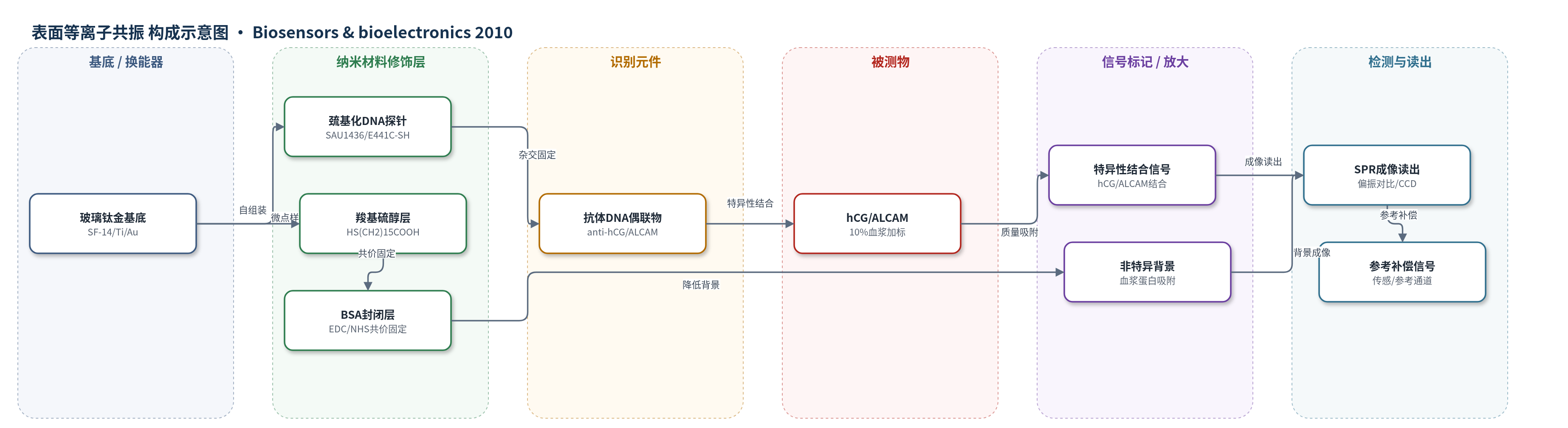
点击图片查看大图 · 依据论文自动绘制
传感器类型
表面等离子共振(SPR)生物传感器
检测对象
人绒毛膜促性腺激素(hCG)、活化白细胞细胞黏附分子(ALCAM);样品基质:TENa缓冲液和10%稀释人血浆(TE含1% BSA稀释)
检测原理
该传感器基于Kretschmann几何的SPR成像。Au膜表面微点样巯基化寡核苷酸,抗体-DNA偶联物杂交固定形成抗体阵列;羧基硫醇与BSA共价固定形成低污染背景。当hCG或ALCAM与对应抗体结合时,传感区表面质量增加,局部折射率升高,改变表面等离子体共振条件。偏振对比使反射光强度随折射率变化而改变,CCD对120个传感区成像,并与相邻参考通道相减以扣除非特异吸附和流路波动。响应以等效折射率变化(mRIU)表示,在低浓度区与蛋白浓度近似线性,从而实现平行定量检测。
检测灵敏度
LOD: 7 ng/mL(ALCAM,缓冲液);13 ng/mL(hCG,缓冲液);45 ng/mL(ALCAM,10%血浆);100 ng/mL(hCG,10%血浆);线性范围: hCG <250 ng/mL;ALCAM <500 ng/mL
效应效果
10%血浆非特异吸附平均0.052 mRIU(约5 ng/cm2),传感/参考差值标准差0.004 mRIU,可分辨<0.01 mRIU(约1 ng/cm2)。抗体固定量anti-ALCAM 44 ng/cm2、anti-hCG 46 ng/cm2,每点约13 pg,通道变异约10%。>200 ng/mL时缓冲液重现性>90%,血浆>80%;血浆与缓冲液曲线差异<30%。血浆LOD为ALCAM 45 ng/mL、hCG 100 ng/mL,与低通量SPR相当,适合复杂样品蛋白标志物高通量筛查。
传感器的构成
- 基底/换能器:SF-14玻璃基底,1 nm Ti粘附层和49 nm Au膜,用于Kretschmann几何激发SPR
- 捕获修饰层:巯基化互补寡核苷酸探针(SAU1436-SH、E441C-SH)微点样于Au表面,通过Au-S作用形成DNA导向固定位点
- 低污染修饰层:16-巯基十六烷酸(HS(CH2)15COOH)自组装于Au表面,经EDC/NHS活化后共价固定BSA,抑制非特异吸附
- 识别元件:抗体-寡核苷酸偶联物(anti-hCG或anti-ALCAM与Sau1463LC-SH偶联),与微点样探针杂交固定,特异性结合目标蛋白
- 封闭/失活处理:乙醇胺(EA)失活残余羧基,高盐PBNa洗涤去除非共价BSA,10%血浆预冲洗降低背景
中文摘要
本文报道了一种用于稀释血液血浆中蛋白生物标志物高通量筛查的表面等离子共振(SPR)生物传感器。该传感器将高分辨率SPR成像传感器与具有低污染背景的高密度蛋白阵列相结合。SPR成像传感器采用偏振对比和先进参考补偿技术,可提供120个传感区,每个传感区尺寸为200 μm×150 μm。抗体通过抗体-寡核苷酸偶联物与微点样在传感器表面的巯基化互补寡核苷酸杂交实现DNA导向固定。低污染背景通过羧基终止硫醇共价固定牛血清白蛋白(BSA)实现,填充巯基化寡核苷酸之间以及传感区外区域。该传感器用于检测与癌症诊断相关的蛋白标志物人绒毛膜促性腺激素(hCG)和活化白细胞细胞黏附分子(ALCAM),在缓冲液和10%血液血浆中均实现检测。血浆样品中检出限分别低至45 ng/mL(ALCAM)和100 ng/mL(hCG)。
英文摘要
Surface plasmon resonance (SPR) biosensor for high-throughput screening of protein biomarkers in diluted blood plasma is reported. The biosensor combines a high-resolution SPR imaging sensor and a high-density protein array with low-fouling background. The SPR imaging sensor utilizes polarization contrast and advanced referencing and provides a total of 120 sensing areas (each 200 μm×150 μm). Antibodies are immobilized on the sensing areas via hybridization of antibody-oligonucleotide conjugates to thiolated complementary oligonucleotides microspotted on the sensor surface (DNA-directed immobilization). A low-fouling background is achieved by covalent immobilization of bovine serum albumin to carboxyl-terminated thiols filling the areas among the thiolated oligonucleotides and outside the sensing areas. The biosensor was evaluated for detection of protein biomarkers relevant to cancer diagnostics--human chorionic gonadotropin (hCG) and activated leukocyte cell adhesion molecule (ALCAM) both in buffer and in 10% blood plasma. Limits of detection as low as 45 ng/mL (ALCAM) and 100 ng/mL (hCG) were achieved in blood plasma samples.