组成图示
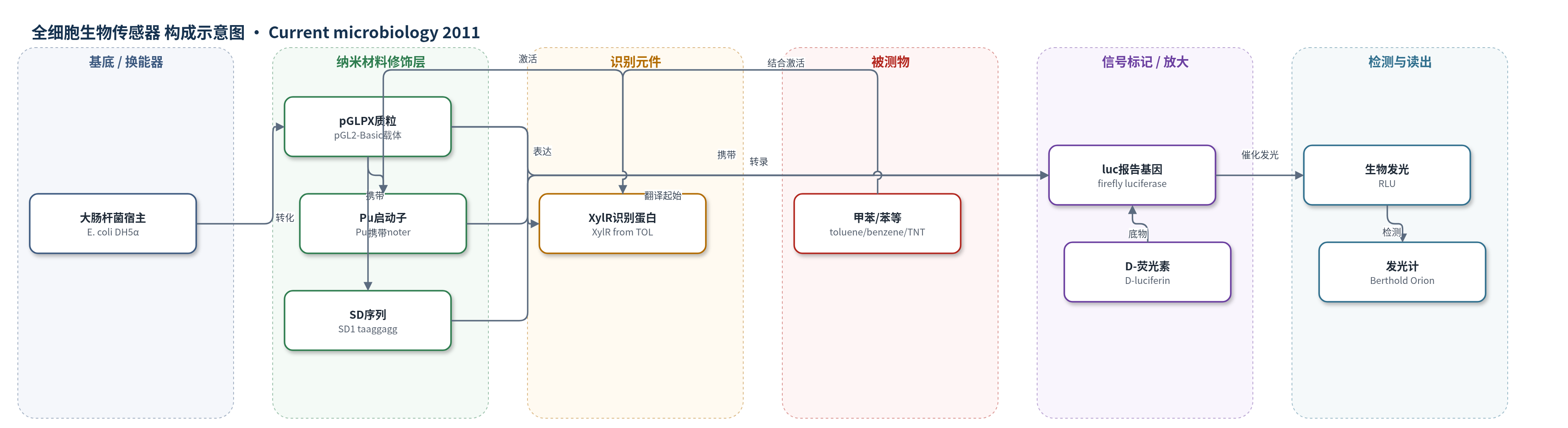
点击图片查看大图 · 依据论文自动绘制
传感器类型
全细胞生物传感器
检测对象
甲苯(toluene)、苯(benzene)、2,4,6-三硝基甲苯(TNT)、2,4-二硝基甲苯(DNT);样品基质:LB 培养液(应用背景为土壤和水环境样品)
检测原理
甲苯、苯、TNT 或 DNT 进入大肠杆菌后,与 XylR 调控蛋白结合,使其由非活性构象转变为活性转录激活因子。活性 XylR 结合 Pu 启动子,驱动下游 luc 基因转录;SD1 序列(taaggagg)与 A-rich spacer 促进核糖体结合和翻译起始,T2rrnb 终止子则降低无诱导物时的背景转录。细胞内表达的荧光素酶催化加入的 D-荧光素发生氧化反应,产生化学发光。发光强度(RLU)随诱导物诱导的 luc 表达量增加而增强,因此可反映甲苯类化合物浓度;但高浓度硝基甲苯可能因毒性使响应下降,且延长暴露时间会增加背景。该传感器依靠转录-翻译表达和酶催化底物发光实现信号放大。
检测灵敏度
LOD: 1 μmol;测试浓度范围: 1–200 μM
效应效果
pGLPX1 菌株对甲苯和苯的响应在几乎所有测试浓度下显著强于 TNT 和 DNT(P<0.05);30 min 诱导后甲苯响应较背景高约 4 倍。pGLPX1-term 菌株在 60 min 时对测试范围内所有化合物均产生显著响应(P<0.05),90 min 时仅甲苯和苯在部分浓度可接受。SD1 比 SD2 更有效,SD2 菌株多数无显著变化。T2rrnb 终止子降低基础发光,但也适度降低诱导响应。完整细胞下甲苯检出限低至 1 μmol,优于文献报道的 7.5 μmol 和 10–20 μmol;测试范围为 1–200 μM。文中未报告 RSD、实际样品回收率或与 ELISA/HPLC/qPCR 的直接对比。
传感器的构成
- 宿主细胞/换能器:大肠杆菌 DH5α(E. coli DH5α),作为全细胞传感基质,表达重组质粒并产生生物发光
- 载体/表达平台:pGLPX 质粒(pGLPX1/pGLPX2,基于 pGL2-Basic),携带 xylR、Pu、SD、spacer 和 luc 元件
- 识别元件:XylR 调控蛋白(XylR,来自 Pseudomonas putida mt-2 TOL 质粒),结合甲苯/苯等诱导物并激活 Pu 启动子
- 调控元件:Pu 启动子(Pu,TOL 质粒上游途径启动子)及可选 T2rrnb 终止子(T2rrnb),控制 luc 转录并降低背景
- 翻译起始元件:Shine-Dalgarno 序列 SD1(taaggagg)或 SD2(aggaaa)及 A-rich spacer,位于 luc 上游,促进核糖体结合
- 报告基因/信号标记物:荧光素酶基因 luc(firefly luciferase gene),在 Pu 控制下表达,催化 D-荧光素氧化发光
- 底物/电子供体:D-荧光素(D-luciferin),加入培养物后作为荧光素酶底物,产生可测化学发光
中文摘要
XylR 调控蛋白来自 Pseudomonas putida mt-2 的 TOL 质粒,参与甲苯和苯降解途径。本文描述基于 XylR 及其同源启动子 Pu 构建并实验室表征重组生物传感器(pGLPX 质粒)。在 pGLPX 质粒中,报告基因 luc 受 Pu 启动子控制。我们评估两种不同核苷酸序列作为 SD 元件改善生物报告灵敏度的能力,并评估引入 T2rrnb 终止子对构建体特异性的影响。转化 pGLPX 质粒的大肠杆菌用于感知甲苯及其衍生物。各衍生物的诱导模式不同。总体而言,在大多数测试浓度下,甲苯和苯诱导的荧光素酶活性高于 TNT 和 DNT。报告菌株对硝基甲苯的生物发光响应在较低浓度(≤50 μmol)时显著强于较高浓度。结果表明 SD 序列(taaggagg)对传感器灵敏度至关重要。生物报告质粒中 T2rrnb 终止子的存在可防止非特异性响应,并在暴露诱导物时降低传感器灵敏度。这些数据表明 pGLPX 菌株可作为全细胞生物传感器检测甲苯及相关化合物,但仍需进一步优化应用。
英文摘要
The XylR regulatory protein is a transcriptional activator from the TOL plasmid of Pseudomonas putida mt-2 that is involved in the toluene and benzene degradation pathway. Here we describe the construction and laboratory characterization of recombinant biosensors (pGLPX plasmids) based on XylR and its cognate promoter (Pu). In the pGLPX plasmid, the reporter luc gene is under the control of the Pu promoter. We evaluated the ability of two distinct nucleotide sequences to function as SD elements and improve sensitivity of bioreporting. We also evaluated the effect of introducing the T₂rrnβ terminator on the specificity of the construct. E. coli transformed with pGLPX plasmids were used to sense toluene and its derivatives. The pattern of induction was different for each derivative. In general, more luciferase activity was induced by toluene and benzene than by TNT and DNT at most tested concentrations. The bioluminescence response of the reporter strains to the nitrotoluenes was significantly stronger at lower concentrations (≥ 50 μmol) than at higher concentrations. Our results show that the SD sequence (taaggagg) is crucially important for biosensor sensitivity. The presence of the T₂rrnβ terminator in the bioreporter plasmid prevents nonspecific responses and also reduces biosensor sensitivity upon exposure to inducers. These data suggest that pGLPX strains can be used as whole-cell biosensors to detect toluene and related compounds. Further investigation will be required to optimize the application of pGLPX biosensors.