组成图示
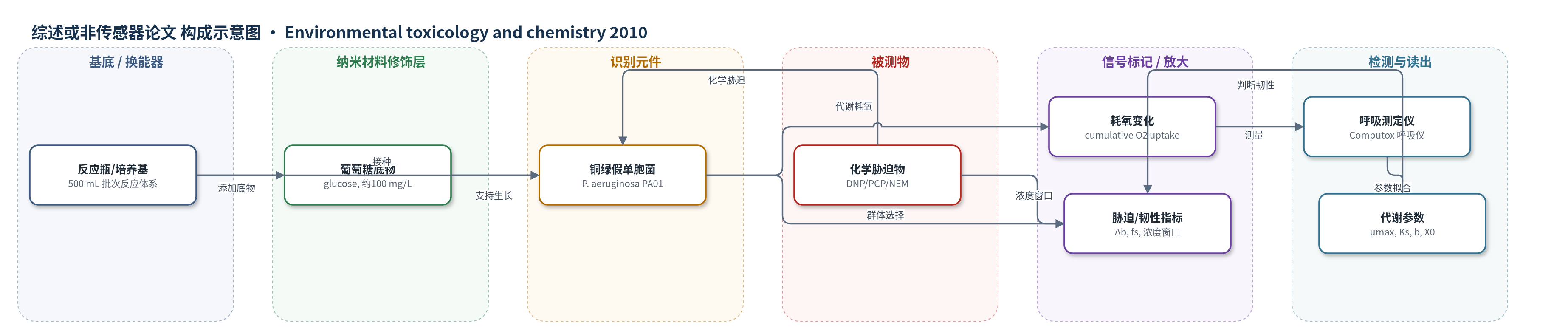
点击图片查看大图 · 依据论文自动绘制
传感器类型
综述或非传感器论文
检测对象
2,4-二硝基苯酚(DNP)、五氯苯酚(PCP)、N-乙基马来酰亚胺(NEM);样品基质:含 Pseudomonas aeruginosa 的葡萄糖营养液批次反应体系
检测原理
本文并非基于固定识别元件的传感器,而是以微生物群体代谢作为响应信号。DNP 和 PCP 可进入细胞膜并解偶联氧化磷酸化,NEM 可激活谷胱甘肽门控钾外排等应激机制,使碳和能量从生长转向维持与保护,表现为内源衰减系数 b 升高、底物利用或生物量下降。实验在含葡萄糖的培养基中接种 Pseudomonas aeruginosa,加入不同浓度胁迫物,用呼吸测定仪连续记录累计耗氧。将耗氧速率与底物消耗、生物量生长关联,拟合 Monod 模型得到 μmax、Ks、b 和初始生物量 X0。通过胁迫组与无胁迫对照比较,并扣除转移造成的 b 变化,得到化学胁迫引起的 Δb;通过生物量损失分数 fs 判断毒性淘汰。随 DNP 浓度变化,低浓度多次暴露增加胁迫,中间浓度多次暴露后 Δb 下降且生物量减少,提示群体韧性增强。
检测灵敏度
无:原文未报告 LOD、线性范围、灵敏度斜率或相关系数。
效应效果
实验采用双重复和 t 检验,在 90% 置信水平判断差异;参数方差估计为胁迫组 b 0.0021、非胁迫组 0.002,初始生物量 X0 分别为 0.24 和 0.22。两次低浓度 DNP、PCP 或 NEM 暴露未产生超出单次暴露的代谢影响;DNP 400 mg/L 多次暴露使胁迫增加但未形成韧性;800 和 900 mg/L DNP 多次暴露后胁迫下降,且初始生物量减少,提示弱个体被淘汰后群体韧性增强;1200 mg/L DNP 下无生物活性。作者认为该浓度窗口内的适应性变化有助于预测生物处理过程、生物传感器技术响应及生态毒理风险评估,但未报告实际样品回收率、RSD 或与 ELISA/HPLC/qPCR 的直接对比。
传感器的构成
- 无传感器构成:本文未报道具体生物传感器或传感检测装置
- 实验换能/读出:Computox 呼吸测定仪(N-Con Systems),通过累计耗氧量反映微生物代谢活性
- 生物响应元件:Pseudomonas aeruginosa PA01 WT 菌株,作为受 DNP、PCP、NEM 胁迫的微生物群体
- 刺激物/被测物:2,4-二硝基苯酚(DNP)、五氯苯酚(PCP)、N-乙基马来酰亚胺(NEM),用于诱导化学胁迫
- 培养基质:葡萄糖(glucose)及营养盐,作为微生物生长底物,目标初始浓度约 100 mg/L
- 对照体系:无胁迫物对照瓶,用于区分转移胁迫与化学胁迫效应
中文摘要
本研究利用呼吸测定法考察自然与工程系统中微生物群体在多种化学胁迫物反复暴露下的代谢响应,以铜绿假单胞菌(Pseudomonas aeruginosa)为模型。结果表明,对低浓度2,4-二硝基苯酚(DNP)、五氯苯酚(PCP)或N-乙基马来酰亚胺(NEM)进行两次暴露,其代谢影响未超过单次暴露预期;但在较高浓度下,三次DNP暴露使群体同时出现代谢胁迫与韧性。在400 mg/L DNP下,多次暴露增加胁迫但未形成韧性;在1200 mg/L DNP下未观察到生物活性,说明群体未能存活;在800和900 mg/L DNP下,多次暴露后胁迫下降,且群体规模减小,提示弱个体被淘汰后群体韧性增强。低浓度下缺乏韧性则归因于强弱个体均存活,降低整体韧性。该浓度窗口内的韧性发展对预测生物处理过程、生物传感器技术及生态毒理风险评估具有重要意义。
英文摘要
Microbiological populations in natural and engineered systems may experience multiple exposures to chemical stressors, which may affect system functions. The impact of such exposures on the metabolism of a population of Pseudomonas aeruginosa was studied using respirometry. Two serial exposures to low concentrations of 2,4-dinitrophenol (DNP), pentachlorophenol (PCP), or N-ethyl maleimide (NEM) did not affect metabolism beyond that expected for a single exposure. However, at higher concentrations, three exposures to DNP led to a combination of metabolic stress and resilience in the population. At a low DNP concentration of 400 mg/L, multiple exposures led to increased stress but indicated no development of resilience. At a high DNP concentration of 1,200 mg/L, no biological activity was observed, indicating that the population did not survive the exposure. At intermediate concentrations of 800 and 900 mg/L DNP, stress was observed, but it was found to decrease after multiple exposures. This, combined with the observation that the size of the population decreased, indicated that resilience in the population had developed because of elimination of the weaker organisms in the population. In contrast, the lack of resilience at the lower DNP concentration was attributed to the survival of the strong as well as weak members, lowering the resilience of the population as a whole. The development of resilience within a window of stressor concentrations is an important finding with implications for predicting the performance of biotreatment processes and biosensor technologies and for interpreting ecotoxicity risk assessments.