组成图示
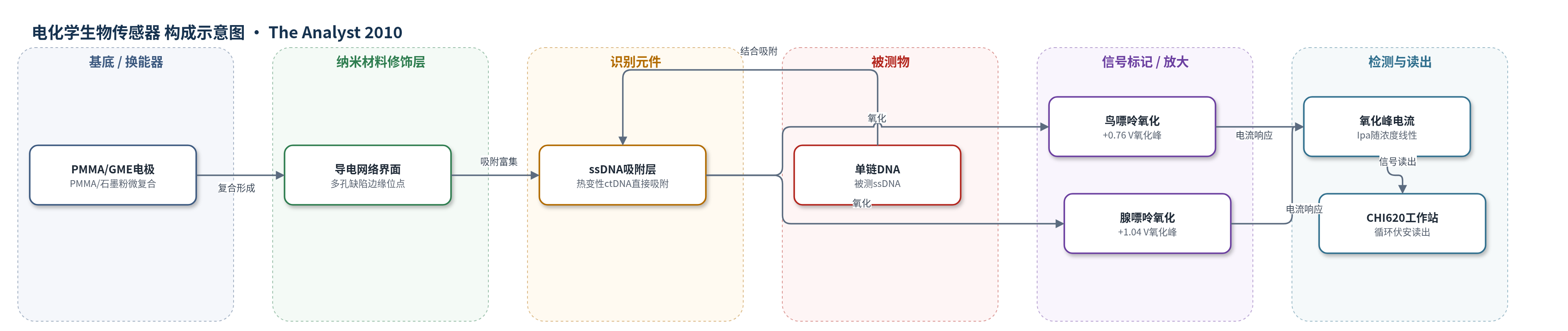
点击图片查看大图 · 依据论文自动绘制
传感器类型
电化学生物传感器
检测对象
单链 DNA(ssDNA,热变性牛胸腺 DNA,thermally denatured calf thymus DNA);样品基质:0.1 mol/L PBS 缓冲液(pH 5.5)
检测原理
检测基于 ssDNA 在 PMMA/GME 表面的直接电化学氧化。先将含 ssDNA 的 PBS 溶液在 +0.25 V 预富集 300 s,使 ssDNA 吸附于复合电极表面;PMMA/石墨粉导电网络和多孔缺陷界面降低氧化过电位并促进电子转移。随后在 pH 5.5 PBS 中以 100 mV/s 进行循环伏安扫描,ssDNA 中鸟嘌呤和腺嘌呤残基分别在约 +0.76 V 和 +1.04 V(vs. Ag/AgCl)发生不可逆氧化,产生氧化峰电流。由于过程受吸附控制,峰电流与扫描速率线性相关,并随 ssDNA 浓度增加而增大,因此通过测定 G 或 A 氧化峰电流即可定量 ssDNA。预富集步骤起到富集放大作用,氧化产物易使电极污染,但电极可水洗再生。
检测灵敏度
LOD: 1.0 mg/mL (3s);线性范围: 5.9×10^-3–约1.1 mg/mL;腺嘌呤: Ipa(mA)=3.9606C(mg/mL)+3.747,斜率 3.9606 mA/(mg/mL),r=0.9960;鸟嘌呤: Ipa(mA)=3.2156C(mg/mL)+0.5856,斜率 3.2156 mA/(mg/mL),r=0.9910。
效应效果
该 PMMA/GME 对 ssDNA 氧化具有明显增强作用,氧化电位较其他修饰电极负移,峰电流增大。在优化条件下,腺嘌呤和鸟嘌呤氧化峰电流与 ssDNA 浓度线性良好,相关系数分别为 0.9960 和 0.9910。由于 ssDNA 氧化产物易在电极表面积累,每次检测后需再生;作者发现 PMMA/GME 可用超纯水简单冲洗恢复新鲜表面。同一电极在 0.1 mg/mL ssDNA 中连续六次冲洗后,腺嘌呤峰电流标准偏差小于 5%,鸟嘌呤峰电流标准偏差小于 4%。作者认为该电极制备简便、稳定性高、表面可再生、机械刚性好、电化学活性高,可作为 DNA 杂交或损伤监测的电化学平台,并有利于器件小型化。
传感器的构成
- 工作电极/基底:聚甲基丙烯酸甲酯–石墨粉微复合电极(PMMA/GME),由 PMMA 与石墨粉构成,作为导电基底与换能界面。
- 修饰/导电层:PMMA 聚合物基质与石墨粉形成的导电网络,提供多孔缺陷界面和边缘位点,促进电子转移。
- 识别/吸附层:热变性牛胸腺 DNA(ssDNA)直接吸附于 PMMA/GME 表面,无外源特异性识别元件。
- 信号元件:ssDNA 中的鸟嘌呤(G)和腺嘌呤(A)残基,作为自身电化学活性信号源。
- 电解液介质:0.1 mol/L 磷酸盐缓冲液(PBS,pH 5.5),提供离子导电环境。
- 检测体系:三电极体系,工作电极为 PMMA/GME,参比电极为 Ag/AgCl,对电极为 Pt 丝,由 CHI620 电化学工作站读取循环伏安信号。
中文摘要
本文报道了热变性牛胸腺DNA(ssDNA)在聚甲基丙烯酸甲酯–石墨粉微复合电极(PMMA/GME)上的显著直接电化学行为。结果表明,由于复合电极纳米结构界面的特殊性质,PMMA/GME 对 ssDNA 氧化具有明显促进作用。在 PMMA/GME 上观察到两个不可逆氧化峰,分别位于 +1.04 V 和 +0.76 V(vs. Ag/AgCl),对应 ssDNA 分子中腺嘌呤和鸟嘌呤残基的氧化,且氧化电位负移、氧化电流增大。基于该行为,在 PMMA/GME 上实现了 ssDNA 的电化学检测。在优化条件下,鸟嘌呤或腺嘌呤残基的氧化峰电流与 ssDNA 浓度在 5.9×10^-3 至约 1.1 mg/mL 范围内呈良好线性关系,检出限为 1.0 mg/mL。该电极具有制备简便、稳定性高、表面可再生、机械刚性好和电化学活性高等优点,为 DNA 生物传感器设计提供了有前景的电化学平台。
英文摘要
Remarkable direct electrochemical behaviors of thermally denatured calf thymus DNA (ssDNA) on the poly(methyl methacrylate)-graphite powder microcomposite electrode (PMMA/GME) were observed and investigated. The result indicated that the PMMA/GME showed great promotion of the electrochemical response towards the ssDNA oxidation due to the specific characteristics of the nanostructured interface on the resultant composite electrode. Two irreversible oxidation peaks at +1.04 and +0.76 V with obvious negative movement of oxidation potential and increase of the oxidation current (vs. Ag/AgCl) were observed on the PMMA/GME, which corresponded to the oxidation of adenine and guanine residues in the ssDNA molecules. Therefore, detection of ssDNA was then performed at the PMMA/GME. Under the optimal conditions, a good linear relationship was obtained between the oxidation peak currents of guanine or adenine residues and the ssDNA concentration in the range of 5.9 × 10(-3) to ca. 1.1 mg mL(-1) with a detection limit of 1.0 μg mL(-1). This PMMA/GME exhibits some outstanding advantages, such as ease of fabrication, high stability, renewable surface, excellent stability, mechanical rigidity and high electrochemical reactivity, which holds huge promise for further DNA biosensor design.