组成图示
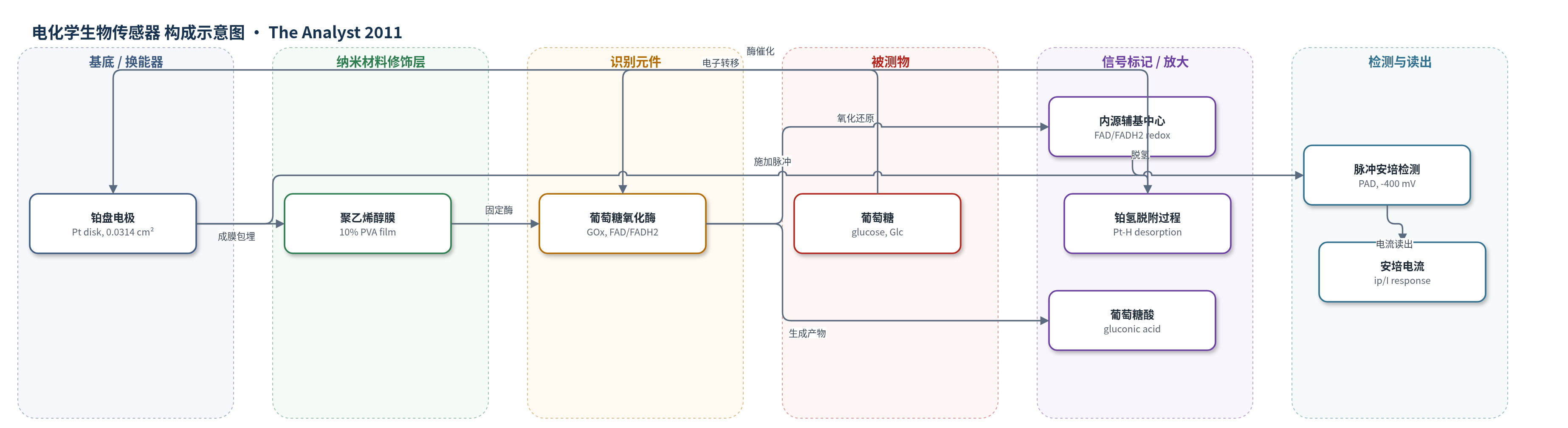
点击图片查看大图 · 依据论文自动绘制
传感器类型
电化学生物传感器
检测对象
葡萄糖(glucose,Glc);样品基质为磷酸盐缓冲液(PBS,pH 7.0,I=0.2),并评估生物流体中常见干扰物
检测原理
葡萄糖进入 Pt/GOx-PVA 界面后,被 PVA 膜中保持天然结构的 GOx 识别并催化氧化,生成葡萄糖酸,同时 GOx 的 FAD/FADH2 辅基发生氧化还原变化。该体系不使用外加电子中介体,而是依赖 GOx 内源 FAD/FADH2 与 Pt 表面之间的直接电子转移;Pt 多晶位点参与 FADH2 脱氢和氢吸附/脱附过程,促进电子从酶活性中心传至电极。在 PAD 模式下,+600 mV 步骤形成氧化物清洁表面,-630 mV 步骤还原活化,随后在 -400 mV 测量电流。葡萄糖浓度升高使催化电流增大,低浓度呈线性,高浓度因酶活性位点饱和而趋于平台,可用 Lineweaver-Burk 关系描述。
检测灵敏度
LOD: 10 mM;动态范围: 0.1–37 mM;线性范围: 0.3–2.0 mM;R^2 = 0.9913;灵敏度: 9.66 mA mM^-1;响应时间: 4 s
效应效果
传感器对葡萄糖选择性良好:果糖、山梨醇、尿酸未检出信号,抗坏血酸仅使电流下降约7%。1、5、10 mM下重复性为2.9%、10%、4%;独立电极重现性为4.6%、8.1%、4.5%。PBS 4℃保存3、5、35天响应下降20%、32%、39%;室温干燥35天仅下降13%。XPS显示薄膜均匀且工作后结构保持。作者认为其制备简单、无中介体、低电位工作,性能可与纳米材料体系媲美;K'm为12.8 mM,低于TTF-TCNQ(33 mM)、溶胶-凝胶壳聚糖(21 mM)和纳米CaCO3(21.4 mM)等体系。
传感器的构成
- 工作电极/换能器:铂盘电极(Pt disk,面积 0.0314 cm²),经抛光与 CV 预处理,提供电子转移与氢吸附/脱附位点
- 包埋/修饰膜:10% 聚乙烯醇(PVA)水溶液成膜,生物相容并稳定 GOx,维持酶结构完整性
- 识别元件:葡萄糖氧化酶(GOx,Aspergillus niger type VII,500 units/mL,约 0.60 nmol cm⁻²),催化葡萄糖氧化
- 内源氧化还原中心:GOx 的 FAD/FADH2 辅基,作为无中介体直接电子转移位点
- 电解液介质:磷酸盐缓冲液(PBS,pH 7.0,I=0.2),氮饱和,提供反应环境
- 三电极体系:饱和甘汞电极(SCE)作参比、铂丝(Pt wire)作对电极,配合 PalmSens 工作站
- 检测模式:脉冲安培检测(PAD),+600 mV/0.2 s 清洁、-630 mV/0.2 s 活化、-400 mV/0.4 s 检测
中文摘要
本文提出一种简单新颖的无中介体安培葡萄糖生物传感器。将葡萄糖氧化酶(GOx)包埋于聚乙烯醇(PVA)基质中,直接滴铸在铂电极表面,构成 Pt/GOx-PVA 电极。该传感器无需在酶与电极之间传递电子的外加中介体,通过 GOx 内源 FAD/FADH2 氧化还原中心与 Pt 表面直接电子转移实现葡萄糖检测。作者验证了峰电流与扫描速率的关系,并考察了溶液 pH 的影响。在脉冲安培检测(PAD)模式下,于 -400 mV 进行葡萄糖测定。在最优条件下,传感器具有较低检出限(10 mM)、较宽动态范围(0.1–37 mM)和较高灵敏度。其安培响应显示对葡萄糖具有特异性,生物流体中共同存在的其他糖类及电活性物质无明显干扰。稳定性方面,在适宜储存条件下响应几乎完全恢复,室温空气中放置 35 天后响应仅下降 13%。X 射线光电子能谱(XPS)表明 Pt 基底上沉积了均匀薄膜,且在工作条件下结构保持完整。
英文摘要
A simple and novel amperometric biosensor for glucose detection is proposed. It is based on the immobilization of glucose oxidase (GOx) in a poly(vinyl alcohol) (PVA) matrix directly drop casted on a platinum electrode surface (Pt/GOx-PVA). Glucose was determined in the absence of a mediator used to transfer electrons between the electrode and the enzyme. The correlation between peak current (i(p)) and scan rate has been verified and the effect of pH solution has been checked. Glucose detection has been performed amperometrically at -400 mV by using pulsed amperometric detection (PAD). Under the selected optimal conditions, the biosensor showed low detection limit (10 μM), wide dynamic range (0.1-37 mM) and high sensitivity. The biosensor amperometric response revealed it to be specific to glucose without significant interference from other sugars and electroactive species coexisting with glucose in biological fluids. Response stability was another interesting feature of the developed system as it was almost completely recovered when the biosensor was left in opportune storage conditions (i.e., a response decrease of only 13% after 35 days in air at room temperature). Finally, X-Ray Photoelectron Spectroscopy (XPS) characterization revealed a homogeneous film deposited on the Pt substrate whose structure is also preserved under operative conditions.