组成图示
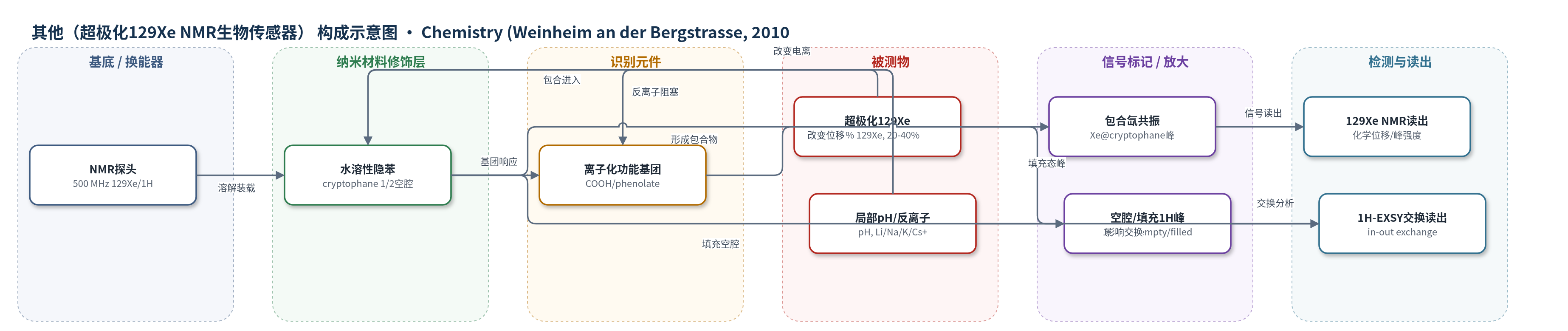
点击图片查看大图 · 依据论文自动绘制
传感器类型
其他(超极化129Xe NMR生物传感器)
检测对象
局部pH(pH)、碱金属反离子(Li+、Na+、K+、Cs+);样品基质:D2O水溶液(含超极化129Xe与约1 mM cryptophane)
检测原理
超极化129Xe在磁场中进入水溶性隐苯的疏水空腔,形成具有独特化学位移的Xe@cryptophane共振。对cryptophane 1,局部pH改变羧酸基团的电离状态,进而改变空腔周围芳香环电子密度和阳离子密度,使包合氙的129Xe化学位移发生约3 ppm/pH的变化,pKa约4.74。对cryptophane 2,酚盐基团附近的Li+、Na+、K+、Cs+与氙竞争结合或阻塞空腔入口,改变表观结合常数Kapp和进出交换速率(0.4–10 Hz)。信号通过129Xe NMR峰强度比、化学位移以及1H NMR/1H-EXSY交换峰读出;超极化提供2×10^4–4×10^4信号增强。该机制属于化学位移/交换速率型NMR传感,无需电极或光学标记。
检测灵敏度
灵敏度斜率: 约3 ppm/pH(pKa区域);Δδ = 3.55±0.17 ppm;pH拐点: 4.65±0.05(校正pH 4.74)
效应效果
cryptophane 1的包合氙化学位移不随溶质浓度变化,线宽基本不变,离子强度无相关,KOD与NaOD调节pH结果一致,表明对局部pH具有较好选择性;在pKa附近约3 ppm/pH,高于31P无机磷酸盐5个pH单位最大2.5 ppm。cryptophane 2中Cs+完全抑制氙包合,Kapp随反离子变化(K+ 327±15、Na+ 1790±90、Li+ 475±24 M-1),交换速率0.4–10 Hz,280–310 K升高约10倍;T1约8 s,慢交换有利于结合常数定量。超极化提供2×10^4–4×10^4信号增强。文中未报告RSD、加标回收率或与实际方法对比。作者认为该体系可优化交换速率、支持低pH细胞定位与多重129Xe MRI应用。
传感器的构成
- NMR换能器:Bruker Avance II 500 MHz 129Xe/1H或HTX探头,提供磁场并读取129Xe/1H NMR信号
- 氙宿主/传感层:水溶性cryptophane 1(含6个羧酸基团)或cryptophane 2(含6个酚基团),形成疏水空腔包合129Xe并响应pH/反离子
- 识别/响应基团:cryptophane 1的COOH/COO-或cryptophane 2的phenol/phenolate,感知局部pH和阳离子
- 信号客体:86%富集129Xe的超极化氙(laser-polarized/hyperpolarized 129Xe,极化20–40%),作为被包合并产生NMR信号的客体
- 样品基质:D2O水溶液,cryptophane浓度约1 mM,用强酸/碱或LiOD、NaOD、KOD、CsOD、DBU调节pH
- 反离子/调节剂:Li+、Na+、K+、Cs+(LiOD/NaOD/KOD/CsOD)或DBU,与酚盐基团竞争/阻塞空腔入口,影响结合与交换
- 读出信号:129Xe NMR化学位移与峰强度、1H NMR空腔/填充峰及1H-EXSY交换峰,用于pH、结合常数与交换速率分析
中文摘要
在基于129Xe NMR的生物传感方法中,超极化惰性气体被输送至生物受体以实现高灵敏度分子成像,隐苯(cryptophane)是优良的氙宿主体系。为避免疏水笼状分子形成自组装体系,可通过引入离子基团使其水溶化。本文表明,氙对局部环境的高度敏感性以及这些离子功能基团的存在可带来特殊性质。对第一种水溶性隐苯衍生物,作者证明可精确监测局部pH;对第二种隐苯,靠近空腔的离子基团会改变氙结合常数与进出交换速率。后者无需改变空腔尺寸即可调节氙–隐苯相互作用的物理性质。这些结果为通过化学修饰优化隐苯生物传感器性能提供了新视角。
英文摘要
In the (129)Xe NMR-based biosensing approach in which the hyperpolarized noble gas is transported to biological receptors for a sensitive molecular imaging, cryptophanes are excellent xenon host systems. However to avoid formation of self-organized systems, these hydrophobic cage molecules can be rendered water soluble by introduction of ionic groups. We show that the sensitivity of xenon to its local environment and the presence of these ionic functions can lead to interesting properties. For a first water-soluble cryptophane derivative, we show that a precise monitoring of the local pH can be performed. For a second cryptophane, the presence of ionic groups close to the cryptophane cavity modifies the xenon binding constant and in-out exchange rate. The latter allows the tuning of physical properties of xenon-cryptophane interactions without resorting to a change of the cavity size. These results open new perspectives on the influence of chemical modifications of cryptophanes for optimizing the biosensor properties.