组成图示
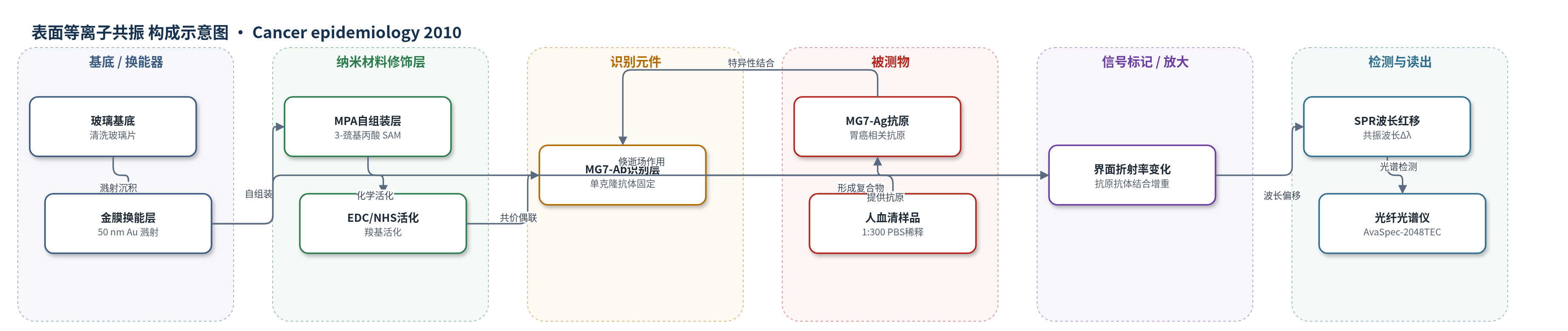
点击图片查看大图 · 依据论文自动绘制
传感器类型
表面等离子共振(SPR)生物传感器
检测对象
胃癌相关抗原 MG7-Ag(gastric carcinoma-associated antigen MG7-Ag);样品基质:人血清(胃癌患者血清、健康献血者血清)及 MKN45 胃癌细胞裂解液(阳性对照)
检测原理
该传感器采用 Kretschmann–Raether 衰减全反射构型。白光经偏振后以固定入射角照射 SF10 棱镜,激发金膜表面表面等离子体,产生共振波长。芯片表面依次形成 MPA 自组装层、EDC/NHS 活化层并共价固定 MG7-Ab。当含 MG7-Ag 的人血清流过芯片时,MG7-Ag 与 MG7-Ab 特异性结合,使金膜-液体界面附近质量与折射率增加。倏逝场对界面折射率变化敏感,导致 SPR 共振波长发生红移;被测抗原浓度越高,结合量越大,波长偏移 Δλ 越大。通过光纤光谱仪实时监测 Δλ,即可无标记、实时定量或半定量判断 MG7-Ag 表达水平。
检测灵敏度
—
效应效果
该方法无需标记和复杂前处理,仅需100 μL 1:300稀释血清,约40 min完成结合监测。11份样品中,MKN45裂解液平均Δλ为11.9 nm,某胃癌患者血清10.9 nm,健康血清5.4 nm;多数患者明显高于健康者,仅1份偏低。每份样品用3枚芯片重复取平均,具一定重现性。0.2 M甘氨酸/HCl(pH 2.5)再生9 h仅部分解离,提示亲和力高但复用有限。相比ELISA等标记法,SPR无标记、实时、前处理简单,作者认为可用于胃癌早诊,但需扩大样本并确定阈值。
传感器的构成
- 基底/换能器:玻璃片(glass slide)上直流溅射 50 nm 金膜(Au film),作为 SPR 换能基底
- 自组装修饰层:3-巯基丙酸(MPA)在乙醇中自组装形成单分子层,提供朝外羧基
- 化学活化层:EDC·HCl 与 NHS 活化 MPA 羧基,用于共价偶联抗体
- 识别元件:小鼠单克隆抗体 MG7-Ab(MG7)固定于芯片表面,特异性捕获 MG7-Ag
- 封闭层:1 M 乙醇胺(ethanolamine, pH 8.6)封闭残余羧基,降低非特异吸附
- 样品层:人血清(1:300 PBS 稀释)或 MKN45 胃癌细胞裂解液,提供 MG7-Ag
- 光学读出系统:SF10 棱镜、偏振器、光纤光谱仪(AvaSpec-2048TEC)监测共振波长变化
中文摘要
MG7-Ag 是胃癌特异性肿瘤相关抗原,可作为胃癌早期诊断标志物。本研究建立基于表面等离子共振(SPR)的无标记免疫传感方法,用于检测胃癌患者血清中的 MG7-Ag。将特异性单克隆抗体 MG7-Ab 固定于 SPR 传感芯片表面,作为捕获和识别受体;当含 MG7-Ag 的人血清流过芯片时,抗原与抗体特异性结合,引起金膜界面折射率变化,导致 SPR 共振波长发生偏移。实验检测了 9 例胃癌患者血清、2 例健康献血者血清以及 MKN45 胃癌细胞裂解液阳性对照。结果显示,多数胃癌患者血清中 MG7-Ag 表达水平显著高于健康血清,MKN45 裂解液产生明显波长偏移。初步结果表明,该 SPR 生物传感器具有用于胃癌早期诊断的潜力,但仍需进一步确定检测限和癌症风险评估标准。
英文摘要
BACKGROUND: MG7-Ag is a kind of gastric cancer-specific tumor-associated antigen and has been investigated to serve as a marker of gastric cancer for early diagnosis.
METHODS: Surface plasmon resonance (SPR) sensor was used for the detection of MG7-Ag in the sera of gastric cancer patients to develop an innovative, simple and rapid assay method for early diagnosis. The specific monoclonal MG7 antibodies were used as capture and detection receptors which were immobilized on the surface of SPR sensor chips for MG7-Ag identification in the human sera. The measurements include 9 cases of gastric cancer patients and 2 cases of healthy blood donors and a MKN45 cancer cell lysate solution sample for positive control.
RESULTS: The binding of MG7-Ag onto the sensor surface was observed from SPR spectra. The sera of most gastric cancer patients revealed much higher expression level of MG7-Ag than healthy human sera did in SPR measurement.
CONCLUSION: The initial results demonstrate that the SPR biosensor has the potential for its application in the early diagnosis of gastric cancer. However, more tests need to be done to confirm the detection limitation and the criterion for cancer risk evaluation in early diagnosis.