组成图示
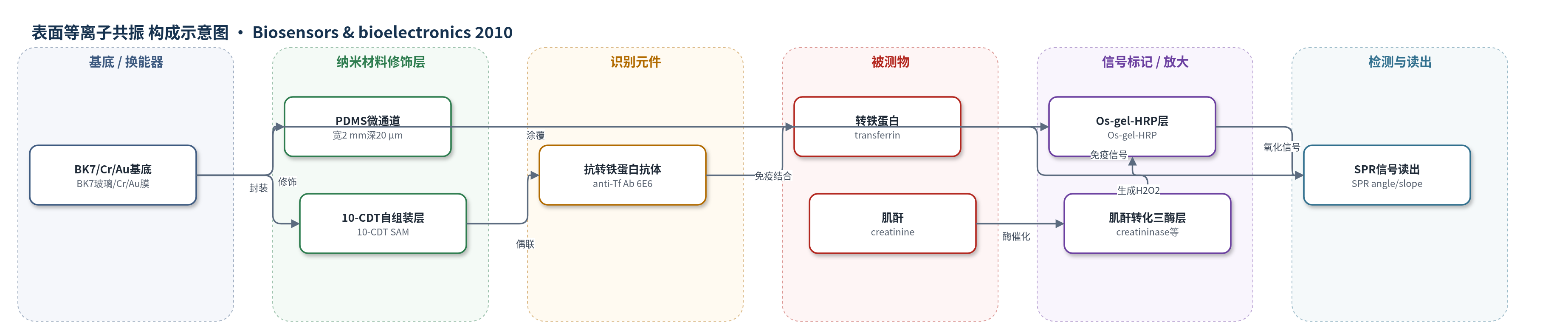
点击图片查看大图 · 依据论文自动绘制
传感器类型
表面等离子共振(SPR)生物传感器
检测对象
转铁蛋白(transferrin, Tf)、肌酐(creatinine, CRE);样品基质:人尿(稀释尿样)
检测原理
芯片包含两个SPR金膜传感区。转铁蛋白区中,金膜B经10-CDT和EDC/NHS固定抗转铁蛋白抗体,尿中Tf与抗体结合形成免疫复合物,使界面质量增加、局部折射率升高,SPR角随之增大,角度变化与Tf浓度相关。肌酐区中,上游固定肌酐酶、肌酸酶和肌氨酸氧化酶,将肌酐经肌酸和肌氨酸级联氧化为H2O2;H2O2使金膜A上的Os-gel-HRP氧化还原聚合物发生Os2+/Os3+氧化态变化,引起折射率变化,SPR角变化速率与肌酐浓度相关。样品中加入抗坏血酸氧化酶、尿酸酶和过氧化氢酶消除抗坏血酸/尿酸干扰,肌酸磷酸激酶与ATP消除肌酸干扰。酶级联将小分子肌酐转化为H2O2,实现小分子SPR检测的信号放大。
检测灵敏度
LOD: 20 ng/mL(transferrin);线性范围: 100–10,000 ng/mL(transferrin, R^2 = 0.93);线性范围: 10 μM–10 mM(creatinine, R^2 = 0.92)
效应效果
该芯片一次进样50 μL稀释人尿,15 min内同时测转铁蛋白和肌酐。尿样稀释5倍以上时非特异吸附可忽略,未稀释尿样约产生50 mdeg非特异SPR角移。加入抗坏血酸氧化酶、尿酸酶和过氧化氢酶可消除100 μM抗坏血酸/尿酸干扰;肌酸磷酸激酶与ATP将肌酸转化为磷酸肌酸,残余肌酸<0.01 mM。三个真实尿样经肌酐校准后,SPR法转铁蛋白CV由78.9%降至14.2%,ELISA/Jaffe法由64.1%降至21.2%,波动小于传统方法。传感器可用甘氨酸-HCl和抗坏血酸再生,作者认为其适合POCT及更换抗体检测其他尿标志物。
传感器的构成
- 基底/换能器:BK7玻璃片(n=1.525±0.0015)上沉积2 nm Cr粘附层和约45±2 nm Au膜,形成两个圆形SPR金膜传感区。
- 微流控通道:PDMS覆盖玻璃片,形成宽2 mm、深20 μm的直微通道,用于样品流动和酶层固定。
- 转铁蛋白识别层:金膜B自组装10-CDT(10-羧基癸硫醇)单分子层,经EDC/NHS偶联固定抗转铁蛋白抗体(6E6),用于捕获转铁蛋白。
- 肌酐信号层:金膜A涂覆Os-gel-HRP(锇-聚(4-乙烯基吡啶)线连辣根过氧化物酶)氧化还原聚合物,被H2O2氧化后改变折射率。
- 肌酐转化酶层:微通道上游固定肌酐酶(creatininase)、肌酸酶(creatinase)和肌氨酸氧化酶(sarcosine oxidase),将肌酐转化为H2O2。
- 干扰消除酶层:微通道上游上层固定肌酸磷酸激酶(creatine phosphokinase),配合样品中ATP将肌酸转化为磷酸肌酸,消除肌酸干扰。
- 封闭与样品预处理:0.1% Block Ace封闭两个传感表面抑制非特异吸附;尿样中加入抗坏血酸氧化酶(ascorbate oxidase)、尿酸酶(uricase)和过氧化氢酶(catalase)消除抗坏血酸和尿酸干扰。
中文摘要
本文报道了一种用于人尿中疾病标志物与校准物质同步检测的单芯片生物传感器。该传感器基于电化学表面等离子共振(electrochemical SPR)方法,采用宽2 mm、深20 μm的PDMS微通道,并集成两个金膜传感区:一个金膜经10-CDT(10-羧基癸硫醇)和EDC/NHS固定抗转铁蛋白抗体,用于捕获转铁蛋白;另一个金膜涂覆Os-gel-HRP(锇-聚(4-乙烯基吡啶)线连辣根过氧化物酶)氧化还原聚合物。微通道上游固定肌酐酶、肌酸酶和肌氨酸氧化酶,将肌酐转化为过氧化氢,使Os-gel-HRP发生氧化态变化。转铁蛋白由免疫复合物引起的SPR折射率变化测定,肌酐由Os-gel-HRP氧化引起的SPR角变化速率测定。采样时加入抗坏血酸氧化酶、尿酸酶和过氧化氢酶消除干扰。一次注入50 μL稀释人尿,15 min内同时测定转铁蛋白和肌酐,范围分别为20 ng/mL–10 μg/mL和10 μM–10 mM。与传统免疫分析和Jaffe法比较,肌酐校准可显著降低尿样中转铁蛋白浓度波动。
英文摘要
We have developed a miniaturized electrochemical surface plasmon resonance biosensor for measuring two biomolecules that have very different molecular sizes, one is transferrin (MW=75 kDa) as a disease marker protein, the other is creatinine (MW=113) as a calibration marker for the accurate measurement of human urinary samples. The sensor has a PDMS based microchannel that is 2 mm wide and 20 μm deep. Two gold films were integrated in the microchannel; one was modified with anti-transferrin antibody for immuno-reaction, and the other was modified with osmium-poly-vinylpyridine wired horseradish peroxidase (Os-gel-HRP). We further immobilized a tri-enzyme layer of creatininase, creatinase and sarcosine oxidase in order to measure creatinine by converting it to hydrogen peroxide in the upstream channel. We measured the transferrin concentration from the refractive index change involved in an immuno-complex formation, and we were simultaneously able to measure creatinine by employing the refractive index change in the Os-gel-HRP caused by oxidation with the hydrogen peroxide produced from creatinine by the tri-enzyme. The effects of ascorbic acid and uric acid in urine samples were sufficiently eliminated by adding ascorbate oxidase and uricase to the urine samples during sampling. We were able to measure two analyte concentrations within 15 min by one simple injection of 50 μL of diluted human urine into our sensor. The detectable transferrin and creatinine ranges were 20 ng/mL to 10 μg/mL, and 10 μM to 10 mM, respectively, which are sufficient levels for clinical tests. Finally, we compared the results obtained using our sensor with those obtained with a conventional immunoassay and the Jaffe method. We obtained a similar trend that can reduce the fluctuation in the urinary transferrin concentration from three different samples by calibrating the creatinine concentration.