组成图示
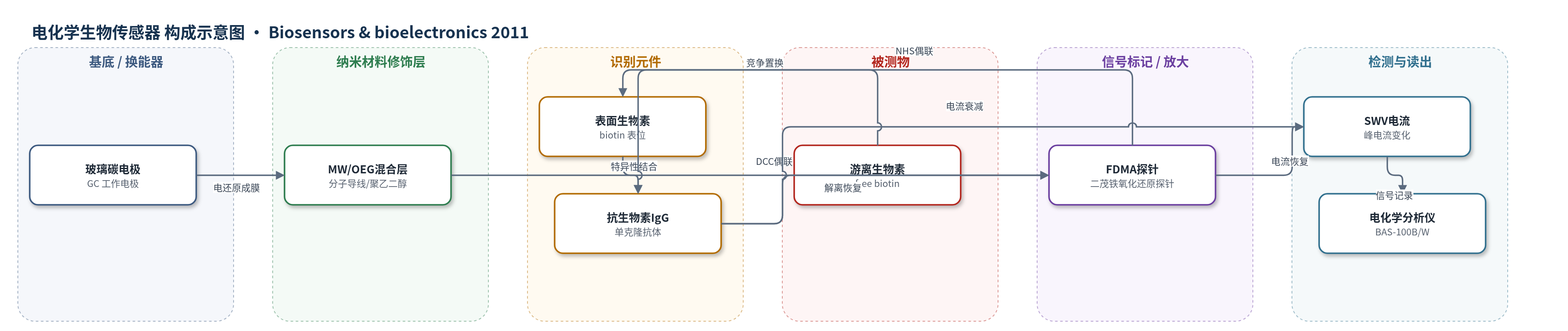
点击图片查看大图 · 依据论文自动绘制
传感器类型
电化学生物传感器
检测对象
游离生物素(free biotin, biotin),样品基质为 PBS 缓冲液;文中亦提出可用于农业、生物医学复杂基质及药物检测
检测原理
该传感器在玻璃碳电极上构建 MW/OEG 混合层,MW 提供电子传导通道,OEG 抑制非特异吸附。MW 末端共价连接 FDMA 二茂铁氧化还原探针,FDMA 末端再连接生物素表位。抗生物素 IgG 结合表面生物素后,抗体蛋白环境限制反离子接近 FDMA,阻碍电子转移,使 SWV 峰电流衰减。加入游离生物素后,其与表面抗体竞争结合,使部分抗体解离,FDMA 重新暴露,电流恢复。游离生物素浓度越高,置换越多,电流增幅越大。该体系无需标记,灵敏度受 MW/OEG 比例优化控制,1:50 时特异结合与可置换性平衡最佳。
检测灵敏度
原文未报告本传感器的 LOD、线性范围、灵敏度斜率或相关系数;文中引自先前体系的动态范围为 30 ng mL−1–0.3 mg mL−1,最低检测浓度为 30 ng mL−1。
效应效果
MW/OEG 1:50 界面灵敏度最高。抗体结合后 FDMA 电流衰减,游离生物素置换 20 min 使峰电流增加 115 nA,但仅恢复至抗体结合前 71%。1:0 电流衰减 −0.80 μA(s=0.21 μA,n=5),1:50 为 −0.31 μA(s=0.04 μA,n=5),1:50 置换增幅最大。0.3 mg mL−1 游离生物素检测重现性 RSD 6.8%(均值 0.1108 μA,s=0.0075 μA,n=5);−800 mV 10 min 再生后 10 次重复 RSD 9.6%(均值 0.1498 μA,s=0.0143 μA,n=10)。OEG 抑制非特异吸附,界面兼顾特异结合与可置换性。未报告实际样品回收率或 ELISA 对比,作者认为可用于农业、生物医学样品及复杂基质药物检测。
传感器的构成
- 基底/换能器电极:玻璃碳电极(GC),3 mm 直径,经氧化铝抛光,作为工作电极与电子传导基底
- 混合修饰层:聚苯乙炔分子导线(MW)与聚乙二醇(OEG)混合层,由原位芳基重氮阳离子电还原形成;MW 提供电子传导通道,OEG 抑制蛋白和电化学干扰物非特异吸附
- 氧化还原探针层:1,1′-双(氨基甲基)二茂铁(FDMA),经 DCC 偶联至 MW 末端羧基,提供可电化学检测的二茂铁信号
- 表面表位层:生物素(biotin,sulfo-NHS-biotin 偶联至 FDMA 末端氨基),作为抗体选择性识别的表位
- 抗体识别层:抗生物素单克隆 IgG 抗体(monoclonal anti-biotin IgG),结合表面生物素,其结合/解离调制 FDMA 电流
- 信号读出:方波伏安(SWV)/循环伏安(CV)电化学分析仪(BAS-100B/W),测量 FDMA 峰电流变化
中文摘要
描述了一种由聚乙二醇(OEG)组分与聚苯乙炔分子导线(MW)混合层构成的免疫生物传感界面。OEG 调控蛋白质和电化学干扰物与表面的相互作用,MW 实现与底层玻璃碳电极的电化学通信。各层由原位生成的芳基重氮阳离子形成。在 MW 远端连接氧化还原探针 1,1′-双(氨基甲基)二茂铁(FDMA),随后连接表面固定表位(抗体选择性识别的结构特征),抗体可与之结合。抗体与传感界面结合或解离会调制二茂铁电化学信号。采用 X 射线光电子能谱、循环伏安法和方波伏安法表征界面逐步构建过程。研究了沉积在传感界面上的 MW 与 OEG 摩尔比对最终传感器灵敏度的影响。测试了 MW/OEG 为 1:0、1:20、1:50、1:75 和 1:100 五种组合,通过置换法检测溶液中的模型分析物(游离生物素)。1:50 比例给出最高灵敏度,重现性 RSD 6.8%,重复性 RSD 9.6%。该免疫生物传感器为农业和生物医学样品提供无干预免疫生物传感平台。
英文摘要
An immuno-biosensing interface comprising a mixed layer of an oligo(ethylene glycol) (OEG) component, and an oligo(phenylethynylene) molecular wire (MW) is described. The OEG controls the interaction of proteins and electroactive interferences with the surface and the MW allows electrochemical communication to the underlying glassy carbon electrode. The layers are formed from in situ generated-aryl diazonium cations. To the distal end of the MW, a redox probe 1,1'-di(aminomethyl)ferrocene is attached followed by the surface bound epitope (the structural feature the antibody selectively recognizes) to which an antibody would bind. Association or disassociation of the antibody with the sensing interface causes a modulation of the ferrocene electrochemistry. X-ray photoelectron spectroscopy, cyclic voltammetry, and square wave voltammetry have been used to characterize the step-wise fabrication of the sensing interface. The influence of the molar ratio of the MW and OEG deposited onto the sensor interface was explored relative to the final sensor sensitivity. Five combinations of MW/OEG 1:0, 1:20, 1:50, 1:75 and 1:100 were tested on sensor sensitivity detection for a model analyte (biotin) free in solution, via a displacement assay. The ratio of 1:50 was found to give the highest sensitivity. At this ratio, good reproducibility (RSD 6.8%) and repeatability (RSD 9.6%) was achieved. This immuno-biosensor provides an intervention free immuno-biosensing platform for agriculture and biomedical samples.