组成图示
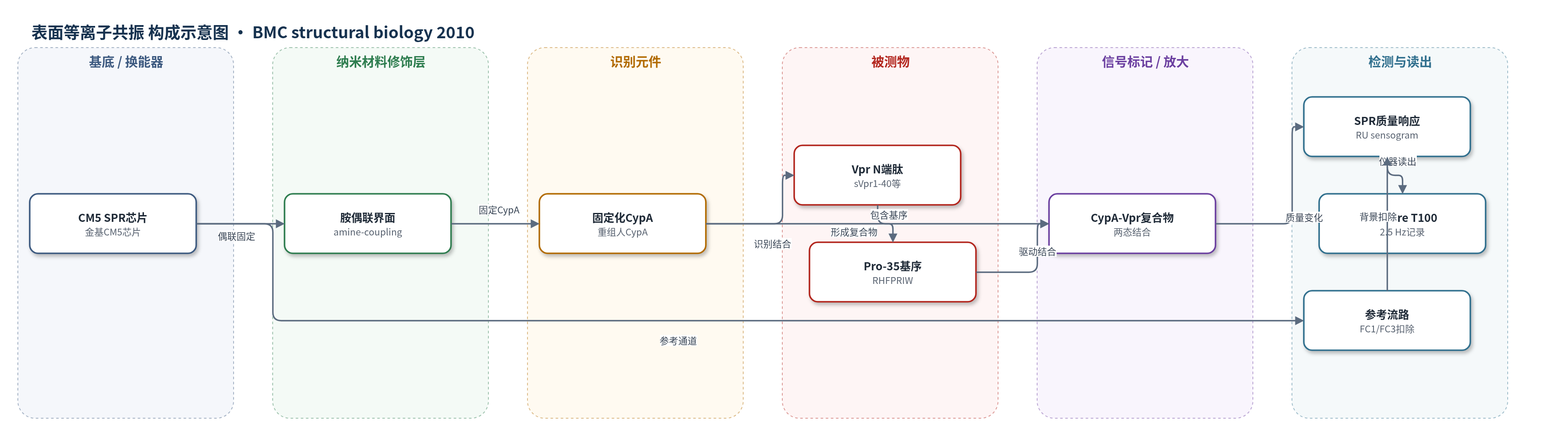
点击图片查看大图 · 依据论文自动绘制
传感器类型
表面等离子共振(SPR)生物传感器
检测对象
HIV-1 Vpr N端肽(HIV-1 Vpr N-terminal peptides, sVpr);样品基质:HBS-P buffer pH 7.4中的合成肽溶液。
检测原理
重组人CypA通过胺偶联固定于CM5 SPR芯片表面,作为识别配体。将不同序列的合成HIV-1 Vpr N端肽溶于HBS-P缓冲液并注入流动相。当肽含有以Pro-35为中心的RHFPRIW基序时,与CypA发生特异性结合,形成CypA-Vpr复合物;结合过程可能伴随构象变化,并与CypA催化Pro-35顺反异构相关。表面结合质量增加导致SPR共振条件改变,Biacore T100记录响应单位(RU)随时间变化:结合相上升、解离相下降。分析物浓度越高,结合量越大,响应信号越强。不含Pro-35的sVpr1-20或P35N突变体不产生稳定结合信号,因为瞬时酶-底物异构化复合物寿命太短,SPR无法检测。
检测灵敏度
未报告LOD、线性范围、灵敏度斜率、相关系数。
效应效果
SPR显示选择性依赖Pro-35:sVpr1-20和P35N突变体不结合CypA;含Pro-35的sVpr21-40、sVpr25-40、sVpr1-40、sVpr30-40、sVpr32-38结合,KD为1.67×10^-4–4.87×10^-4 M。七肽sVpr32-38(RHFPRIW)仍维持强结合,sVpr33-37明显减弱(KD 0.00357 M)。P5,10,14N可结合但KD 0.00615 M,ka1超出仪器范围,可能受溶解度影响。NMR在酶/底物比最高672:1下检测到CypA催化Pro-5、-10、-14、-35顺反异构,环孢素A消除交换峰;Pro-35互变速率0.19±0.01 s^-1。未报告RSD、回收率或方法对比。作者认为结果支持CypA作为分子伴侣参与HIV-1复制,为抗逆转录病毒药物设计提供依据。
传感器的构成
- 基底/换能器:CM5 research-grade sensor chip(金基SPR芯片)与Biacore T100光学系统,提供表面等离子共振换能。
- 修饰/固定层:standard amine-coupling chemistry形成的胺偶联界面,用于固定CypA。
- 识别元件:重组人Cyclophilin A(CypA),固定于CM5芯片,捕获含Pro-35的Vpr N端肽。
- 分析物:合成HIV-1 Vpr N端肽(sVpr1-20、sVpr21-40、sVpr25-40、sVpr1-40、sVpr30-40、sVpr32-38、sVpr33-37及突变体),溶于HBS-P buffer pH 7.4。
- 参考/扣除通道:FC1/FC3未固定CypA的参考流路,扣除bulk buffer effects与unspecific binding。
- 信号读出:Biacore T100记录sensogram(RU),2.5 Hz,60 s association、120 s dissociation。
中文摘要
环孢素A(CypA)是抗逆转录病毒治疗的潜在靶点,抑制CypA可抑制HIV-1复制,但其调控HIV-1感染性的机制仍不清楚。HIV-1病毒蛋白R(Vpr)与CypA在体外和体内均可相互作用,但CypA与Vpr N端Pro-35相互作用的性质尚未明确。本研究结合核磁共振(NMR)交换光谱和表面等离子共振(SPR)光谱,表征人CypA与HIV-1 Vpr N端肽的相互作用。原子分辨率NMR表明,CypA可催化Vpr高度保守的Pro-5、-10、-14和-35发生脯氨酸顺反异构,且所需异构酶浓度远低于肽底物。在Vpr N端肽中,只有含Pro-35的肽在生物传感器实验中结合CypA。SPR研究显示,以Pro-35为中心、由RHFPRIW组成的七残基基序足以维持强特异性结合。结果表明,Pro-35对CypA-Vpr特异性结合至关重要,而所有脯氨酸残基的顺反异构仅涉及瞬时酶-底物相互作用;SPR数据符合结合过程中伴随构象变化的两态结合模型,支持CypA作为分子伴侣参与HIV-1毒力的模型。
英文摘要
BACKGROUND: Cyclophilin A (CypA) represents a potential target for antiretroviral therapy since inhibition of CypA suppresses human immunodeficiency virus type 1 (HIV-1) replication, although the mechanism through which CypA modulates HIV-1 infectivity still remains unclear. The interaction of HIV-1 viral protein R (Vpr) with the human peptidyl prolyl isomerase CypA is known to occur in vitro and in vivo. However, the nature of the interaction of CypA with Pro-35 of N-terminal Vpr has remained undefined.
RESULTS: Characterization of the interactions of human CypA with N-terminal peptides of HIV-1 Vpr has been achieved using a combination of nuclear magnetic resonace (NMR) exchange spectroscopy and surface plasmon resonance spectroscopy (SPR). NMR data at atomic resolution indicate prolyl cis/trans isomerisation of the highly conserved proline residues Pro-5, -10, -14 and -35 of Vpr are catalyzed by human CypA and require only very low concentrations of the isomerase relative to that of the peptide substrates. Of the N-terminal peptides of Vpr only those containing Pro-35 bind to CypA in a biosensor assay. SPR studies of specific N-terminal peptides with decreasing numbers of residues revealed that a seven-residue motif centred at Pro-35 consisting of RHFPRIW, which under membrane-like solution conditions comprises the loop region connecting helix 1 and 2 of Vpr and the two terminal residues of helix 1, is sufficient to maintain strong specific binding.
CONCLUSIONS: Only N-terminal peptides of Vpr containing Pro-35, which appears to be vital for manifold functions of Vpr, bind to CypA in a biosensor assay. This indicates that Pro-35 is essential for a specific CypA-Vpr binding interaction, in contrast to the general prolyl cis/trans isomerisation observed for all proline residues of Vpr, which only involve transient enzyme-substrate interactions. Previously suggested models depicting CypA as a chaperone that plays a role in HIV-1 virulence are now supported by our data. In detail the SPR data of this interaction were compatible with a two-state binding interaction model that involves a conformational change during binding. This is in accord with the structural changes observed by NMR suggesting CypA catalyzes the prolyl cis/trans interconversion during binding to the RHFP35RIW motif of N-terminal Vpr.