组成图示
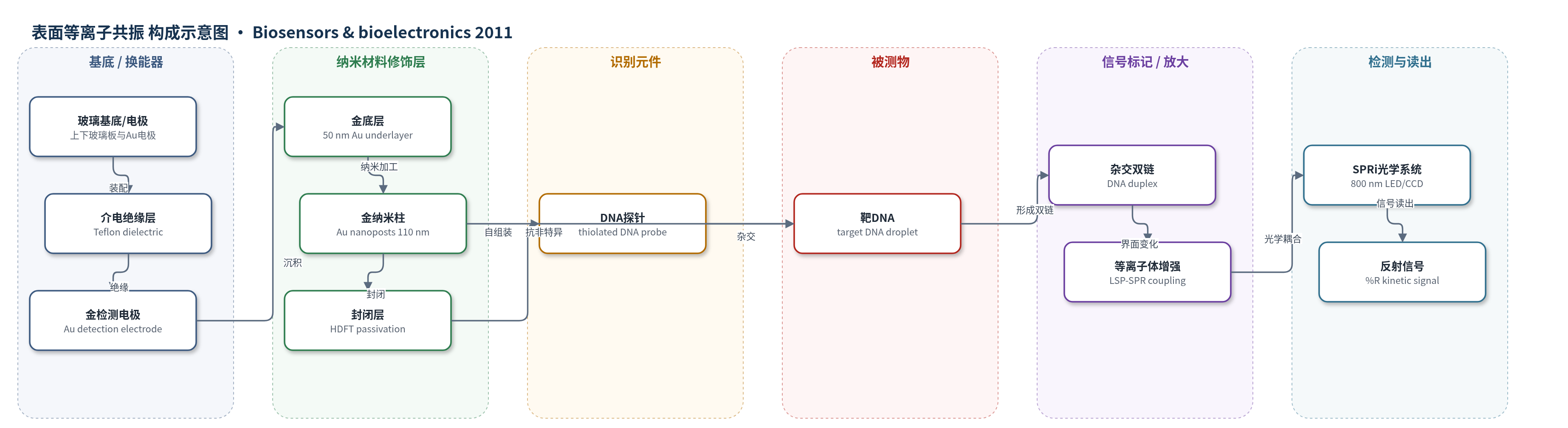
点击图片查看大图 · 依据论文自动绘制
传感器类型
表面等离子共振(SPR)生物传感器
检测对象
靶DNA(target DNA),样品基质:杂交缓冲液液滴(1 M NaCl in TE buffer)
检测原理
巯基修饰 DNA 探针通过 Au-S 自组装固定于金表面,HDFT 封闭减少非特异吸附。当 EWOD 液滴将互补靶 DNA 输送至检测点并与探针杂交形成双链时,界面介电常数/折射率增加,改变传播表面等离子体(SPR)共振条件。周期性金纳米柱激发局域表面等离子体(LSP),并与传播 SPR 及结合 DNA 强耦合,产生电磁场增强,使共振角和反射率变化放大。SPRi 在固定工作角下监测反射强度随时间变化,靶 DNA 浓度越高,表面双链密度越高,反射强度上升越大;低浓度下信号受扩散和吸附动力学限制。纳米结构使信号增强约 200%,提高低浓度 DNA 识别能力。
检测灵敏度
LOD: 500 pM (90 attomoles)
效应效果
系统以错配 DNA 为对照验证特异性,错配序列无明显结合。250 nM 靶 DNA 下,纳米结构点较均匀金对照在 16 min 内实现约两倍信号放大,SPRi 信号增强超过 200%,靶标识别时间缩短至 60 s;500 pM 仍可识别,检出限较对照提高约一个数量级。检测在 180 nL 液滴中完成,样品消耗较传统流路池 700 µL–1 mL 降低超过 3 个数量级。反应饱和约 14–16 min,ka=4.4×10^3 M^-1 s^-1,前 2 min SNR>3。表面可用 50 mM NaOH 再生且无明显信号损失,实验重复三次确认重现性,适合低体积、快速、平行、无标记诊断检测。
传感器的构成
- 基底/换能器电极:上玻璃板金接地电极(Au ground electrode)与 Teflon 介电膜,图案化形成检测点;下玻璃板含储液、传输、检测与混合电极,Teflon 绝缘,用于 EWOD 液滴操控
- 纳米材料修饰层:周期性金纳米柱(Au nanoposts,w=50 nm,period=110 nm,h=30 nm)位于 50 nm Au 底层上,增强局域/传播表面等离子体耦合,提高 SPRi 灵敏度
- 识别元件:5'端巯基修饰、C6 连接臂的 DNA 探针(thiolated DNA probe),自组装固定于 Au 表面,特异性捕获互补靶 DNA
- 封闭剂:20 mM HDFT(heptadecafluoro-1-decanethiol)乙醇溶液,封闭未修饰 Au 表面,减少非特异吸附
- 信号标记物:无标记(label-free)检测,不引入外源标记物
- 读出界面:SPRi 棱镜耦合与 800 nm LED/CCD 相机,监测反射强度随角度和时间变化
中文摘要
基因组学和蛋白质组学揭示了大量可用于遗传与感染性疾病诊断和预后的潜在生物标志物。当前生物传感器开发重点为快速、实时、无标记且高灵敏检测。表面等离子共振成像(SPRi)有望用于生物标志物诊断,但商用 SPRi 受流路池限制,只能串行处理样品,且低浓度检测灵敏度有限。本文提出增强样品处理与提高 SPRi 灵敏度的方法,开发了集成纳米结构生物传感器界面的数字微流控平台,实现 DNA 杂交反应的快速、超低体积、高灵敏、自动化片上 SPRi 检测。利用周期性金纳米柱的电磁特性,SPRi 信号提高 200%,估计检出限为 500 pM(90 阿摩尔)。借助数字微流控,180 nL 样品体积下 1 min 内即可在多个阵列元件上完成平行靶标识别。通过可独立寻址低体积液滴输送多种靶标,无需外部泵和流体互连,降低检测时间、成本与复杂度,适合诊断应用。
英文摘要
The advances in genomics and proteomics have unveiled an exhaustive catalogue of biomarkers that can potentially be used as diagnostic and prognostic indicators of genetic and infectious diseases. Current thrust in biosensor development is towards rapid, real-time, label-free and highly sensitive detection of the indicative biomarkers. While surface plasmon resonance imaging (SPRi) biosensors could potentially be the best suited candidate for biomarker-based diagnosis, important milestones need to be reached. Commercially available SPRi instrumentation is currently limited by the flow-cell technology to serial-sample processing and has limited sensitivity for the detection of markers present at low concentration. In this paper, we have implemented an approach to enhance sample handling and increase the sensitivity of the SPRi detection technique. We have developed a digital microfluidic platform with an integrated nanostructured biosensor interface that allows for rapid, ultra-low volume, sensitive, and automated on-chip SPRi detection of DNA hybridization reactions. Through the exploitation of electromagnetic properties of nanofabricated periodic gold nanoposts, SPRi signal was increased by 200% with the estimated limit of detection of 500 pM (90 attomoles). Using the versatile fluidic manipulation provided by the digital microfluidics, rapid and parallel target identification was achieved on multiple array elements within 1 min using 180 nL sample volume. By delivering multiple target analytes in individually addressable low volume droplets, without external pumps and fluidic interconnects, the overall assay time, cost and complexity was reduced. The proposed platform allows extreme versatility in the manipulation of precious low volume samples which makes this technology very suitable for diagnostic applications.