组成图示
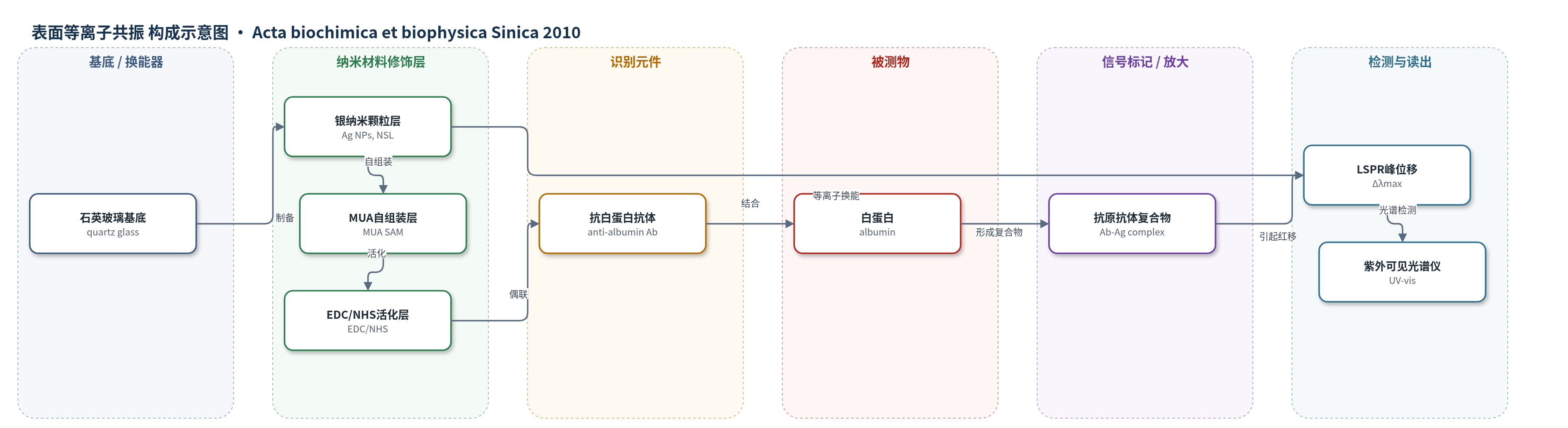
点击图片查看大图 · 依据论文自动绘制
传感器类型
表面等离子共振(SPR)生物传感器
检测对象
人白蛋白(human albumin, Alb);样品基质:尿液(尿样,PBS稀释1:1000)及商业白蛋白标准品
检测原理
该传感器采用无标记LSPR免疫检测。石英玻璃基底上通过纳米球光刻制备银纳米颗粒阵列,其LSPR消光峰波长对周围介电环境变化敏感。MUA在银表面形成自组装单分子层,经EDC/NHS活化后与抗人白蛋白抗体氨基偶联固定。当尿样或标准品中的白蛋白与固定抗体特异性结合时,传感器表面局部质量与折射率增加,改变银纳米颗粒周围介电环境,使LSPR消光峰发生红移。白蛋白浓度越高,结合量越大,Δλmax越大。紫外-可见光谱仪记录峰位变化,从而实现白蛋白浓度的定量检测。该体系未使用额外信号放大策略,依赖LSPR对界面质量变化的直接响应。
检测灵敏度
LOD: 1 ng/ml;动态范围: 1 ng/ml–1 mg/ml
效应效果
该传感器对非特异蛋白IL-17(100 ng/ml)仅产生+0.73 nm红移,误差Δλmax=0.61±0.21 nm(三次重复),非特异结合低。3例轻度子痫前期患者尿样经PBS稀释1:1000后直接检测,1例LSPR峰由715.96 nm红移至723.45 nm(+7.49 nm),另2例明显红移;未稀释尿样临床化学法测得白蛋白为8、9.8、9.2 mg/ml,结果一致。检测约40 min,无需纯化。其较RIA、ELISA更简便、无标记,设备成本低于传统SPR,适合低成本、快速床旁筛查。
传感器的构成
- 基底:石英玻璃基底(quartz glass),承载银纳米颗粒并提供光学透过性
- 银纳米颗粒层:银纳米颗粒(Ag nanoparticles),由纳米球光刻(NSL)制备,提供LSPR换能
- 自组装单分子层:11-巯基十二烷酸(MUA)在Ag表面形成SAM,稳定纳米颗粒并提供羧基
- 活化层:EDC/NHS活化MUA羧基,用于与抗体氨基偶联
- 识别元件:抗人白蛋白单克隆抗体(anti-human albumin monoclonal antibody),特异性结合白蛋白
- 读出层:紫外-可见分光光度计(UV-visible spectrometer),记录LSPR消光峰波长位移
中文摘要
为探索基于局部表面等离子共振(LSPR)纳米生物传感器的临床应用,本研究利用自研LSPR生物传感器检测尿微量白蛋白。银纳米颗粒通过纳米球光刻法制备,抗人白蛋白抗体经氨基偶联法固定于传感器表面。依据LSPR消光光谱峰位变化,测定不同浓度商品白蛋白及3例轻度子痫前期患者尿样中的白蛋白。在优化条件下,该传感器检出限为1 ng/ml,动态范围为1 ng/ml至1 mg/ml。此外,3例患者的微量白蛋白尿可在短时间内完成检测,且无需样品纯化。该传感器制备简便,可用于低成本、快速、无标记、高灵敏的微量白蛋白尿筛查,为临床诊断应用提供了有前景的平台。
英文摘要
In order to explore the clinical application of the nanobiosensor based on localized surface plasmon resonance (LSPR), we used our LSPR biosensor to detect the microalbuminuria in this work. The sliver nanoparticles were fabricated by using nanosphere lithography. The anti-human albumin antibody was immobilized on the sensor surface by amine coupling method. The different concentrations of commercial albumin and albumin in urine samples from three mild preeclampsia patients were determined according to the peak of LSPR extinction spectra. Under optimum conditions, our results showed that the biosensor displayed a detection limit of 1 ng/ml and wide dynamic range of 1 ng/ml to 1 μg/ml. Furthermore, the microalbuminuria of three patients was determined by our biosensor within a short assay time, without sample purification. This biosensor proposed herein is easy to prepare and could be used for low-cost, rapid, label-free, and sensitive screening of the microalbuminuria. This approach provides a promising platform for developing clinical diagnostic applications.