组成图示
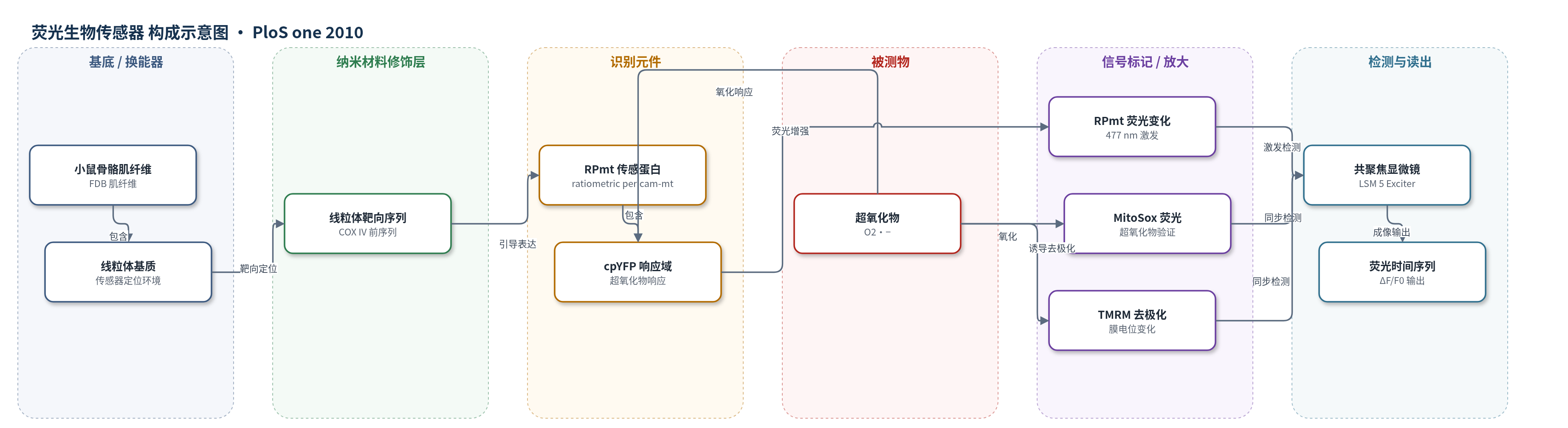
点击图片查看大图 · 依据论文自动绘制
传感器类型
荧光生物传感器
检测对象
超氧化物阴离子(superoxide anion, O2•−);样品基质:小鼠 FDB 骨骼肌纤维(线粒体基质,Tyrode 溶液)
检测原理
RPmt 经线粒体靶向序列进入骨骼肌线粒体基质,其 cpYFP 部分可被超氧化物阴离子(O2•−)氧化/还原,导致荧光光谱改变。实验选择 477 nm 激发、505–545 nm 发射,以避开钙依赖的比率型荧光变化,使荧光增强主要反映超氧化物升高。线粒体电子传递链产生超氧化物时,局部 O2•− 浓度上升,RPmt 荧光出现约 20 s 的 ΔF/F0 升高;共聚焦显微镜逐帧采集并计算闪烁面积、频率和幅度。MitoSox 同步荧光增强可验证超氧化物来源。该法无酶促放大,信号直接来自荧光蛋白氧化还原状态变化。
检测灵敏度
—
效应效果
RPmt 与 TMRM 共定位,细胞质污染少。增加激光强度不改变闪烁频率和性质,两次 3 min 记录一致,提示非光损伤伪影。MitoSox 同步增强支持超氧化物来源。15 mM tiron 使闪烁频率由 12±4.2 降至 2.4±1.1;2.5 mM antimycin A 使频率由 26.7±4.1 降至 9.9±3.2。86% 闪烁伴随 TMRM 去极化,cyclosporin A 和 atractyloside 不影响,提示非经典 PtP 机制。该法可揭示骨骼肌线粒体超氧化物生理信号。
传感器的构成
- 表达基底:小鼠 FDB 骨骼肌纤维,经 pcDNA3/RPmt 电穿孔表达传感器,提供线粒体检测环境
- 线粒体靶向层:细胞色素 c 氧化酶亚基 IV N 端 12 氨基酸前序列,将 RPmt 导向线粒体基质
- 识别/传感元件:RPmt 中的 cpYFP(循环置换黄色荧光蛋白)部分,响应线粒体基质超氧化物
- 荧光报告蛋白:RPmt(ratiometric pericam-mt),在 477 nm 激发下以荧光变化报告超氧化物
- 验证信号标记:MitoSox,线粒体超氧化物荧光探针,用于同步确认超氧化物升高
- 辅助读出探针:TMRM 与 Rhod-2/AM,分别监测线粒体膜电位与基质钙,用于机制验证
中文摘要
活性氧(ROS)是重要的细胞内信号分子,线粒体电子传递链是超氧化物阴离子的主要来源。本研究将线粒体靶向比率型 pericam(RPmt)作为超氧化物生物传感器,通过选择合适激发波长,在活体小鼠骨骼肌中表达并用于成像。对分离肌纤维的共聚焦观察显示,RPmt 自发出现约 20 s 的荧光闪烁;同步记录线粒体超氧化物探针 MitoSox 证实这些闪烁对应超氧化物生成增加。闪烁可发生于肌膜下和肌原纤维间线粒体等所有亚细胞群体。空间分析表明,线粒体以界限明确的“超氧化物产生单元”协同工作;肌纤维水平超氧化物生成增加主要通过招募额外单元实现,而非单个单元产量增加。结果说明骨骼肌中的超氧化物闪烁是与线粒体代谢相关的生理信号,并提示超氧化物或其衍生物可在线粒体水平调节自身生成。
英文摘要
Reactive Oxygen Species (ROS) constitute important intracellular signaling molecules. Mitochondria are admitted sources of ROS, especially of superoxide anions through the electron transport chain. Here the mitochondria-targeted ratiometric pericam (RPmt) was used as a superoxide biosensor, by appropriate choice of the excitation wavelength. RPmt was transfected in vivo into mouse muscles. Confocal imaging of isolated muscle fibers reveals spontaneous flashes of RPmt fluorescence. Flashes correspond to increases in superoxide production, as shown by simultaneous recordings of the fluorescence from MitoSox, a mitochondrial superoxide probe. Flashes occur in all subcellular populations of mitochondria. Spatial analysis of the flashes pattern over time revealed that arrays of mitochondria work as well-defined superoxide-production-units. Increase of superoxide production at the muscle fiber level involves recruitment of supplemental units with no increase in per-unit production. Altogether, these results demonstrate that superoxide flashes in muscle fibers correspond to physiological signals linked to mitochondrial metabolism. They also suggest that superoxide, or one of its derivatives, modulates its own production at the mitochondrial level.