组成图示
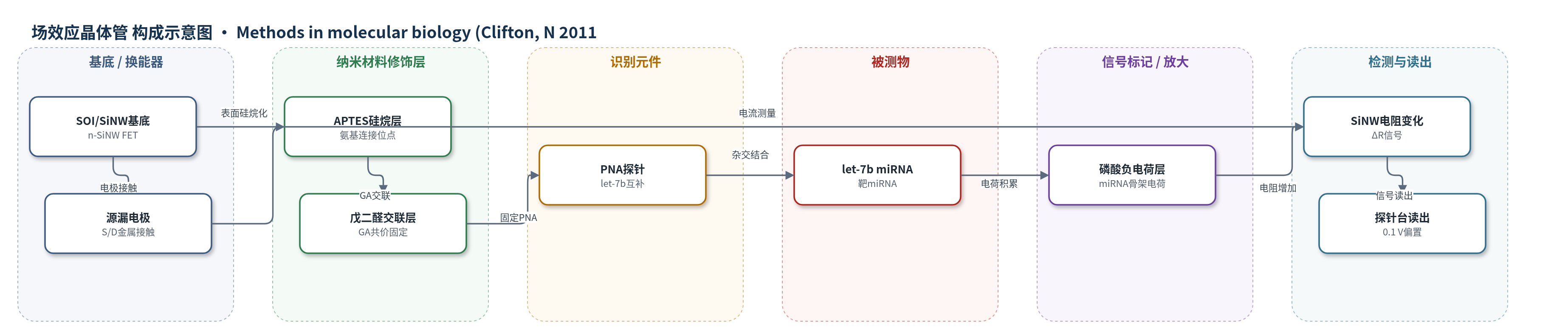
点击图片查看大图 · 依据论文自动绘制
传感器类型
场效应晶体管(FET)生物传感器
检测对象
miRNA(microRNA,let-7b/let-7c/非互补对照);样品基质:0.01×SSC缓冲液及HeLa细胞总RNA
检测原理
该传感器以n型SiNW FET为换能器,PNA探针经APTES和GA共价固定于SiNW表面。当互补miRNA存在时,PNA与miRNA发生杂交,miRNA磷酸骨架携带的负电荷在SiNW表面形成电荷层,改变表面电荷密度并耗尽SiNW体内载流子,使源漏电阻增大。杂交的miRNA越多,表面负电荷积累越多,电阻变化越大;错配或非互补序列杂交弱,电阻变化小。由于SiNW具有高比表面积,少量结合事件即可引起明显电学响应,因此无需荧光、酶或纳米颗粒标记,直接通过0.1 V偏置下的电阻变化实现无标记检测。
检测灵敏度
LOD: 1 fM (10^-15 M)
效应效果
该传感器表现出良好的序列特异性:1 nM完全互补let-7b使SiNW电阻变化约47.2%,单碱基错配let-7c约7.9%,非互补序列响应可忽略;1 fM let-7b仍产生7.3%响应,可区别于对照信号,说明其具备单碱基分辨能力。作者还证明该传感器能检测HeLa细胞总RNA中的let-7b,表明其适用于复杂细胞样品。与Northern blot、微阵列、PCR及纳米颗粒/酶标记方法相比,该方法无需标记、偶联或信号放大步骤,直接电学读出,流程更简单。原文未报告长期稳定性、RSD、加标回收率或与ELISA/HPLC/qPCR的定量对比,但作者认为其可用于癌症诊断中miRNA生物标志物的高灵敏、无标记早期检测。
传感器的构成
- 换能器基底:SOI晶圆(145 nm埋氧层)上磷掺杂n型SiNW鳍(直径约50 nm),两端n+源漏接触与金属欧姆接触,作为FET换能器
- 表面硅烷化层:3-aminopropyltriethoxysilane(APTES)在SiNW/SiO2表面形成氨基,提供共价连接位点
- 交联固定层:2.5% glutaraldehyde(GA)水溶液与APTES氨基反应,共价固定PNA探针
- 识别元件:PNA探针(序列N-AACCACACAACCTACTACCTCA-C),与let-7b互补,无磷酸骨架以降低静电排斥并提高杂交效率
- 信号标记物:无(label-free),miRNA磷酸骨架负电荷直接作为电学信号源
- 反应介质:0.01×SSC缓冲液,用于杂交与电阻测量;RNaseZap用于去除RNase污染
- 读出层:探针台在0.1 V源漏偏置下测量SiNW电阻变化
中文摘要
microRNA(miRNA)是一类广泛存在于动植物基因组中的18–24 nt非编码RNA,参与基因表达调控,其表达谱可作为疾病分子诊断和药物发现的重要依据。因此,高灵敏、高选择性地检测miRNA对于理解其功能具有重要意义。现有miRNA检测方法大多依赖靶miRNA与互补探针的杂交,并常通过引入纳米材料、酶或荧光标记来增强信号,但这些方法通常属于间接检测,需要标记或偶联步骤,流程较复杂。为克服上述限制,作者报道了一种基于肽核酸(PNA)功能化硅纳米线(SiNW)生物传感器的miRNA无标记直接检测方法。该传感器利用PNA与miRNA杂交后磷酸骨架负电荷改变SiNW表面电荷密度,引起器件电阻变化,从而实现直接电学读出。该方法可检测低至1 fM的靶miRNA,并能区分完全匹配与单碱基错配序列,还可在HeLa细胞总RNA中检测miRNA,显示其在癌症诊断中作为miRNA生物标志物无标记早期检测的应用潜力。
英文摘要
MicroRNA (miRNA), a large and growing class of 18-24-nucleotide long, noncoding RNA molecules in all known animal and plant genomes, is a key player in gene regulation. The functions of miRNA are yet to be understood with respect to how and where it is produced and the changes within an organism associated with variations in miRNA expression level. The expression profiles serve as molecular diagnostics for diseases and new targets in drug discovery. Consequently, highly sensitive and selective detection of miRNA is playing a significant role in understanding miRNA functions. Existing major methods of detecting miRNA are dependent on hybridization, in which a target miRNA molecule is hybridized to a complementary probe molecule. Recently developed detection methods introduce nanomaterials to the hybridized duplex to enhance the sensitivity. However, all of them are indirect, involving labeling or conjugating process. To overcome the above-mentioned issues, we have demonstrated a highly sensitive and label-free direct detection method for miRNA by using peptide nucleic acids (PNAs)-functionalized silicon nanowires (SiNWs) biosensor. The sensor is capable of detecting target miRNA as low as 1 fM (10(-15) M), as well as identifying fully matched versus mismatched miRNA sequences. More importantly, the SiNW biosensor enables miRNA detection in total RNA extracted from HeLa cells. The developed detection method shows potential applications in label-free, early detection of miRNA as a biomarker in cancer diagnostics with very high sensitivity and good specificity.