组成图示
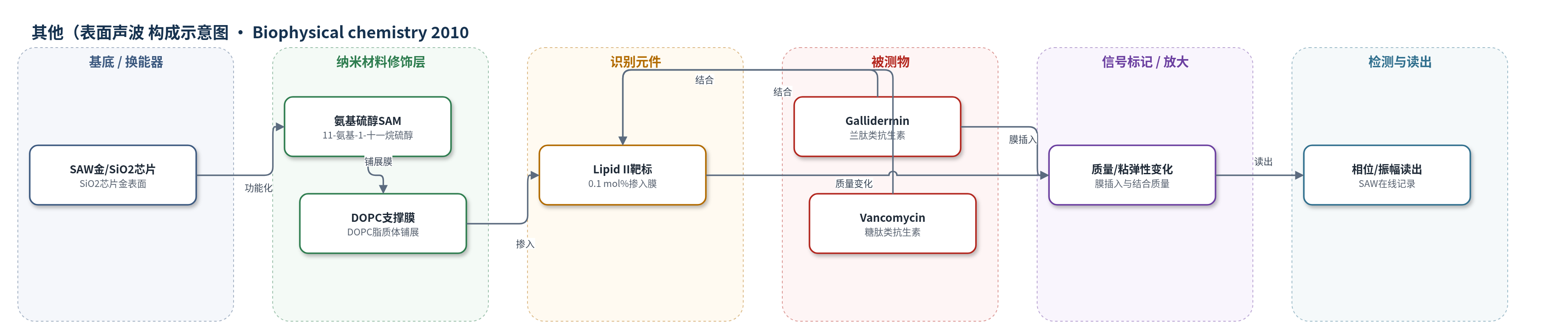
点击图片查看大图 · 依据论文自动绘制
传感器类型
其他(表面声波(SAW)生物传感器)
检测对象
gallidermin(加利德明)、vancomycin(万古霉素);样品基质为DOPC或DOPC/DOPG模型膜/脂质体(含0.1 mol% lipid II)
检测原理
SAW传感器以金/SiO2芯片为基底,经11-氨基-1-十一烷硫醇自组装单分子层功能化后,铺展DOPC或DOPC/DOPG脂质体形成支撑膜,并将0.1 mol% lipid II掺入膜中作为识别位点。注入gallidermin或vancomycin后,肽与lipid II发生特异性结合;gallidermin还因疏水结构插入双分子层。结合质量增加以及膜粘弹性/刚性改变会调制表面声波的相位和振幅,浓度越高,结合量与膜扰动越大,信号变化越强。SAW在100 pM gallidermin处出现显著可逆相位峰,对应约1:1肽/lipid II结合。QCM则通过肽结合导致的质量增加引起频率下降,用于计算结合动力学常数;ITC提供热力学参数作为辅助验证。
检测灵敏度
SAW 测量浓度范围: 10−13 M–10−6 M;可在皮摩尔浓度范围测量
效应效果
QCM、SAW和ITC分别重复至少4、7和7次,未报告RSD。选择性上,vancomycin对含lipid II的DOPC膜亲和力显著增强(KD 0.30 μM vs 纯DOPC 2.42 μM),gallidermin对纯DOPC膜已有较高亲和力(0.53 μM),对DOPC/lipid II为0.27 μM;膜电荷影响较小(约0.22 μM vs 0.11 μM)。SAW显示gallidermin在100 pM处与lipid II约1:1结合并伴随膜插入,vancomycin相同条件下无明显相互作用。ITC中gallidermin与DOPC相互作用焓为−5455±391 cal/mol,vancomycin仅−508±165 cal/mol;MC540荧光显示gallidermin使膜刚性增加,荧光下降43%–55%,vancomycin基本无影响。作者认为SAW是研究抗菌肽–靶标相互作用的高灵敏模型膜工具。
传感器的构成
- 换能器基底(SAW):SiO2芯片金表面,承载表面声波并响应质量/粘弹性变化
- 自组装单分子层:11-氨基-1-十一烷硫醇盐酸盐(2 mM)在金表面形成SAM,提供膜铺展界面
- 模型膜层:DOPC或DOPC/DOPG(9:1)脂质体铺展形成支撑膜,模拟细菌膜
- 靶标识别层:0.1 mol% lipid II掺入DOPC膜,作为抗生素肽识别位点
- 被测物:gallidermin或vancomycin溶液注入,与lipid II结合
- 信号变化:无外源标记,肽结合质量及膜插入引起的粘弹性/刚性变化
- 换能器基底(QCM):石英晶体经1-十六烷硫醇修饰,LB法承载DOPC/DOPG±lipid II膜
- 读出:SAW相位/振幅或QCM频率变化在线记录
中文摘要
本研究利用质量敏感生物传感器和等温滴定量热(ITC)模拟并比较兰肽类抗生素加利德明(gallidermin)与糖肽类抗生素万古霉素(vancomycin)同细菌模型膜的相互作用。两者均通过靶向细胞壁前体脂质II(lipid II)干扰肽聚糖合成,但对不同菌株的抗菌活性差异明显。作者详细测定了两种肽与DOPC/lipid II模型膜的结合亲和力,分别为KD 0.30 μM和0.27 μM。加利德明对纯DOPC膜也表现出较强亲和力(KD 0.53 μM),该结果得到ITC支持。表面声波(SAW)传感器可在皮摩尔浓度范围进行测量,并揭示加利德明以接近等摩尔比靶向lipid II,同时插入脂质双分子层。结果表明,与万古霉素不同,加利德明兼具细胞壁合成抑制和破坏细菌膜完整性的双重作用,从而产生强效抗菌活性。
英文摘要
The interaction of the lantibiotic gallidermin and the glycopeptide antibiotic vancomycin with bacterial membranes was simulated using mass sensitive biosensors and isothermal titration calorimetry (ITC). Both peptides interfere with cell wall biosynthesis by targeting the cell wall precursor lipid II, but differ clearly in their antibiotic activity against individual bacterial strains. We determined the binding affinities of vancomycin and gallidermin to model membranes±lipid II in detail. Both peptides bind to DOPC/lipid II membranes with high affinity (K(D) 0.30 μM and 0.27 μM). Gallidermin displayed also strong affinity to pure DOPC membranes (0.53 μM) an effect that was supported by ITC measurements. A surface acoustic wave (SAW) sensor allowed measurements in the picomolar concentration range and revealed that gallidermin targets lipid II at an equimolar ratio and simultaneously inserts into the bilayer. These results indicate that gallidermin, in contrast to vancomycin, combines cell wall inhibition and interference with the bacterial membrane integrity for potent antimicrobial activity.