组成图示
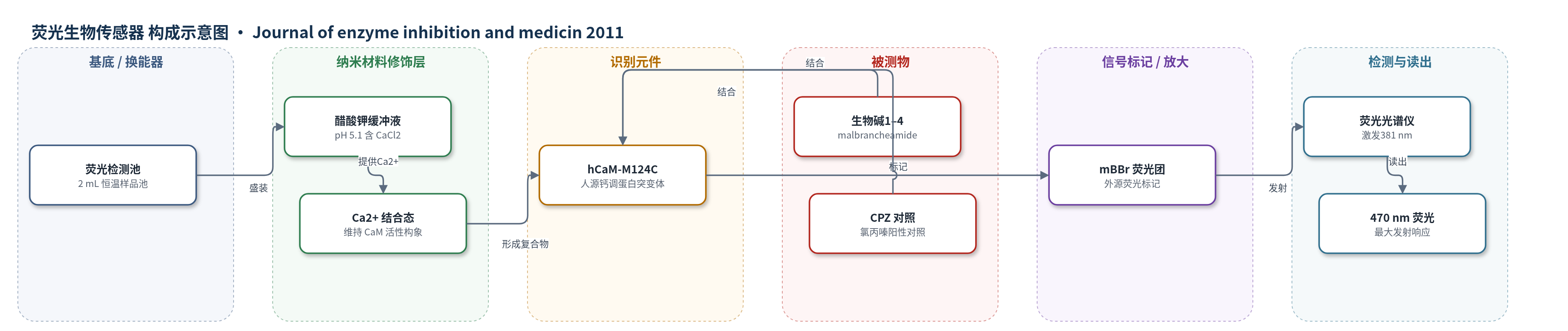
点击图片查看大图 · 依据论文自动绘制
传感器类型
荧光生物传感器
检测对象
malbrancheamide(1)、isomalbrancheamide(2)、isomalbrancheamide B(3)、premalbrancheamide(4)及对照氯丙嗪 CPZ;样品基质为 100 mM 醋酸钾缓冲液(pH 5.1,含 CaCl2)/PDE1 酶反应液
检测原理
该检测基于荧光工程化人源钙调蛋白 hCaM-M124C-mBBr 生物传感器。Ca2+ 先与 hCaM 结合形成活性构象,mBBr 荧光团标记在 M124C 位点,提供外源荧光。当 malbrancheamide 类配体进入 CaM 的疏水结合口袋时,M124 附近微环境改变,导致 mBBr 荧光强度发生淬灭或变化。稳态荧光以 381 nm 激发,在 400–550 nm 记录发射,最大响应约 470 nm;荧光变化随配体浓度增加而增大,可拟合表观解离常数 Kd 和化学计量比。圆二色监测二级结构变化,NMR 化学位移和分子对接进一步定位结合位点。该体系无化学放大,信号直接来自蛋白-配体结合引起的荧光报告。
检测灵敏度
原文未报告 LOD、线性范围、灵敏度斜率或 R^2;报告结合常数 Kd: 1.11±0.08 μM(1)、4.82±0.30 μM(2)、4.82±0.09 μM(3)、CPZ 1.43±0.09 μM;酶学 IC50: 19.33±1.40 μM(1)、183.28±37.58 μM(2)、41.56±4.64 μM(3)、35.73±3.01 μM(4);对接 Ki: 0.23 μM(1)。
效应效果
该荧光 CaM 生物传感器可区分经典与功能性抑制剂:1–3 引起外源荧光淬灭,4 无明显变化。CD 显示 Ca2+-CaM α-螺旋由 84.2% 降至 68.1%(1),CPZ 为 61.3%,2、3 为 75.45%、78.33%,4 不变。PDE1 抑制 IC50:1 为 19.33±1.40 μM,接近 CPZ 16.78±3.99 μM,效力 1.1;2–4 为 183.28±37.58、41.56±4.64、35.73±3.01 μM。NMR 显示 Met 残基位移,对接 EFEB −9.04 kcal/mol、Ki 0.23 μM。未报告 RSD、稳定性或回收率。作者认为 1 是 CaM 抑制剂先导化合物。
传感器的构成
- 基底/检测池:2 mL 恒温样品池,承载溶液相荧光检测,原文未给出固定电极材料
- 缓冲/离子环境:100 mM 醋酸钾缓冲液(pH 5.1)和 1 mM CaCl2,维持 Ca2+-CaM 活性构象
- 识别元件:人源钙调蛋白 hCaM(M124C 突变体),作为 Ca2+ 依赖的配体结合识别元件
- 信号标记物:mBBr 荧光探针标记于 M124C 位点,形成 hCaM-M124C-mBBr,提供外源荧光信号
- 对照/校准配体:氯丙嗪 CPZ,作为经典 CaM 抑制剂阳性对照,用于比较荧光响应与结合参数
中文摘要
从真菌 Malbranchea aurantiaca 的生物碱部分,作者以较高收率分离得到新类似物 isomalbrancheamide B(3)及已知化合物 malbrancheamide(1)、isomalbrancheamide(2)和 premalbrancheamide(4)。采用酶学、荧光、圆二色、核磁共振和分子模拟方法研究 1–4 与钙调蛋白(CaM)的相互作用,旨在确定其抑制 CaM 的性质。酶学与荧光实验表明,1–3 为经典 CaM 抑制剂,而 4 不能淬灭 CaM 荧光生物传感器的外源荧光,可能为功能性抑制剂。圆二色、NMR 和分子对接结果显示,1 与经典抑制剂氯丙嗪(CPZ)和三氟拉嗪(TFP)结合于同一疏水口袋。因此,malbrancheamide 及其单氯类似物具有作为 CaM 靶向治疗先导化合物的潜力。
英文摘要
A new malbrancheamide analogue, isomalbrancheamide B (3), along with three known compounds, malbrancheamide (1), isomalbrancheamide (2), and premalbrancheamide (4), were isolated in higher yields from the alkaloid fraction of the fungus Malbranchea aurantiaca. The interaction of the alkaloids 1-4 with calmodulin (CaM) was analyzed using different enzymatic, fluorescence, spectroscopic, nuclear magnetic resonance (NMR), and molecular modelling techniques. On the basis of the enzymatic and fluorescence experiments, malbrancheamides 1-3 are classical CaM inhibitors. Compound 4, however, did not quench the extrinsic fluorescence of the CaM biosensor indicating that it could be a functional inhibitor. Circular dichroism, NMR, and molecular modelling studies revealed that 1 binds to CaM in the same hydrophobic pocket than the chlorpromazine and trifluoperazine, two classical CaM inhibitors. Thus, malbrancheamide and related monochlorinated analogues are compounds with a high potential for the development of new therapeutic agents, involving CaM as their molecular target.