组成图示
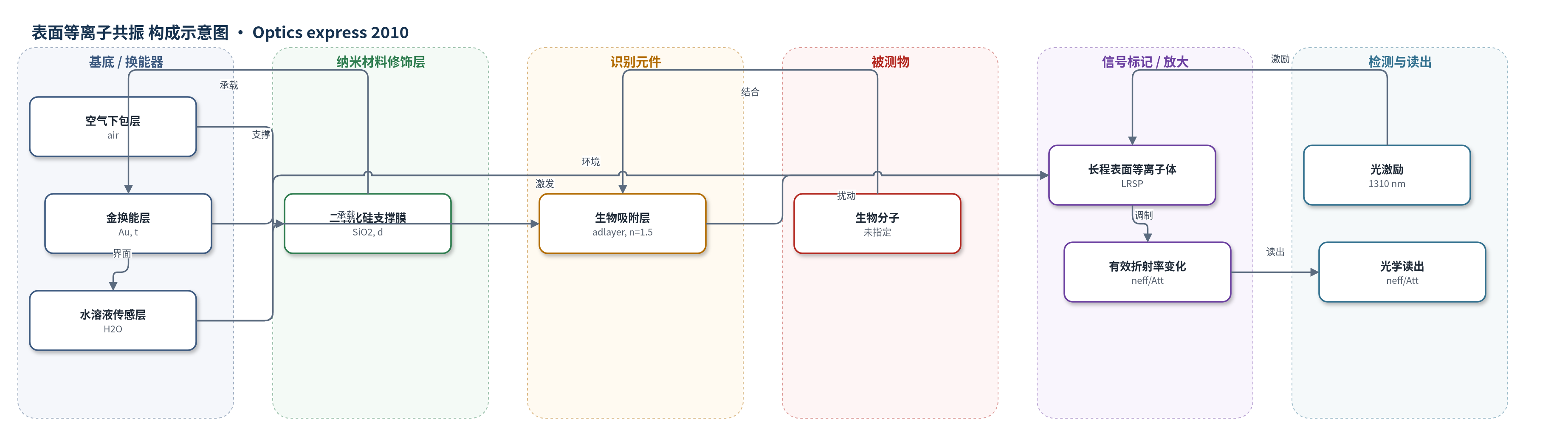
点击图片查看大图 · 依据论文自动绘制
传感器类型
表面等离子共振(SPR)生物传感器
检测对象
未指定具体生物分子(生物吸附层/生物分子),样品基质:水溶液(H2O)
检测原理
该结构利用长程表面等离子体(LRSP)作为换能机制。生物分子在 Au/H2O 界面形成折射率约 1.5 的吸附层,使界面折射率和厚度发生变化,从而扰动 LRSP 模式的横向场分布、有效折射率 neff 和衰减系数。物理不对称的 H2O-Au-SiO2-air 结构通过选择 SiO2 膜厚度 d 与 Au 厚度 t,使金属内横向场近似对称,恢复低损耗 LRSP 导波;相比对称 IMI 结构,模式与界面吸附层重叠增强,表面敏感度提高。信号读出为 neff 或衰减随吸附层厚度的变化,文中以表面敏感度 ∂neff/∂a 和品质因数 G、M2 评价。未涉及酶催化、HCR、RCA 等化学放大。
检测灵敏度
表面敏感度 ∂neff/∂a: 0.00018 nm^-1(IMII, t=50 nm, d=341.7 nm);0.00011 nm^-1(IMII, t=20 nm, d=381.5 nm);对应 IMI 为 0.00011 nm^-1(t=50 nm)和 0.00006 nm^-1(t=20 nm)。
效应效果
该文为理论/模拟研究,未报告实际样品检测、选择性、抗干扰、稳定性、重现性或加标回收率。模拟显示,不对称 IMII 结构虽损耗高于对称 IMI,但表面敏感度和品质因数更高:t=50 nm 时,∂neff/∂a 由 0.00011 提高到 0.00018 nm^-1,G 由 0.22 提高到 0.23,衰减由 20.07 增至 31.39 dB/mm;t=20 nm 时,∂neff/∂a 由 0.00006 提高到 0.00011 nm^-1,G 由 1.07 提高到 1.29,衰减由 2.23 增至 3.26 dB/mm。条纹结构 w=5 μm、t=20 nm、d=380 nm 时,1310 nm 下衰减约 3.27 dB/mm。作者认为其适合水溶液传感并利于微流控集成。
传感器的构成
- 空气下包层:air,低折射率下包层,与 SiO2 膜共同构成悬空结构
- 支撑膜层:SiO2,高折射率介质膜,厚度 d,机械支撑 Au 层并约束 LRSP 对称
- 金属换能层:Au,厚度 t,支持长程表面等离子体(LRSP)并作为传感界面
- 传感介质层:H2O,低折射率水溶液环境,承载生物吸附层并决定表面敏感度
- 生物吸附层:未指定生物分子形成的薄层,折射率 1.5,位于 Au/H2O 界面,用于模拟生物结合
- 释放衬底:Si,未参与传感,用于刻蚀释放 SiO2 膜
中文摘要
本文表明,长程表面等离子体(LRSP)可在一种物理不对称薄膜结构中支持:低折射率介质位于金属薄板上方,金属薄板由高折射率介质膜支撑并悬置于空气之上,构成悬空波导。为便于设计,作者在一维模型中推导解析公式,得到超越方程,通过约束金属薄板与介质膜厚度,使 LRSP 在金属薄板内的横向场保持对称。该公式结果与由水-金-二氧化硅-空气构成的候选平板波导的传输矩阵计算定量一致。对不对称与对称结构比较生物传感器相关品质因数后发现,尽管损耗更高,不对称结构反而改善性能。有限差分法还用于分析提供二维约束的金属条纹结构,并讨论其上实现无辐射 LRSP 导波所需附加约束。这些结果对需要在水溶液中工作、否则需低折射率匹配衬底才能实现 LRSP 的传感器具有前景。
英文摘要
We show that long-range surface plasmons (LRSPs) are supported in a physically asymmetric thin film structure, consisting of a low refractive index medium on a metal slab, supported by a high refractive index dielectric layer (membrane) over air, as a suspended waveguide. For design purposes, an analytic formulation is derived in 1D yielding a transcendental equation that ensures symmetry of the transverse fields of the LRSP within the metal slab by constraining its thicknesses and that of the membrane. Results from the formulation are in quantitative agreement with transfer matrix calculations for a candidate slab waveguide consisting of an H(2)O-Au-SiO(2)-air structure. Biosensor-relevant figures of merit are compared for the asymmetric and symmetric structures, and it is found that the asymmetric structure actually improves performance, despite higher losses. The finite difference method is also used to analyse metal stripes providing 2D confinement on the structure, and additional constraints for non-radiative LRSP guiding thereon are discussed. These results are promising for sensors that operate with an aqueous solution that would otherwise require a low refractive index-matched substrate for the LRSP.